AI tools are at the fingertips of students and teachers, and no one has all the answers about how either group should use them. It’s a curious and complicated time, and educators at Stanford are meeting the moment through considered experimentation and open discussion.
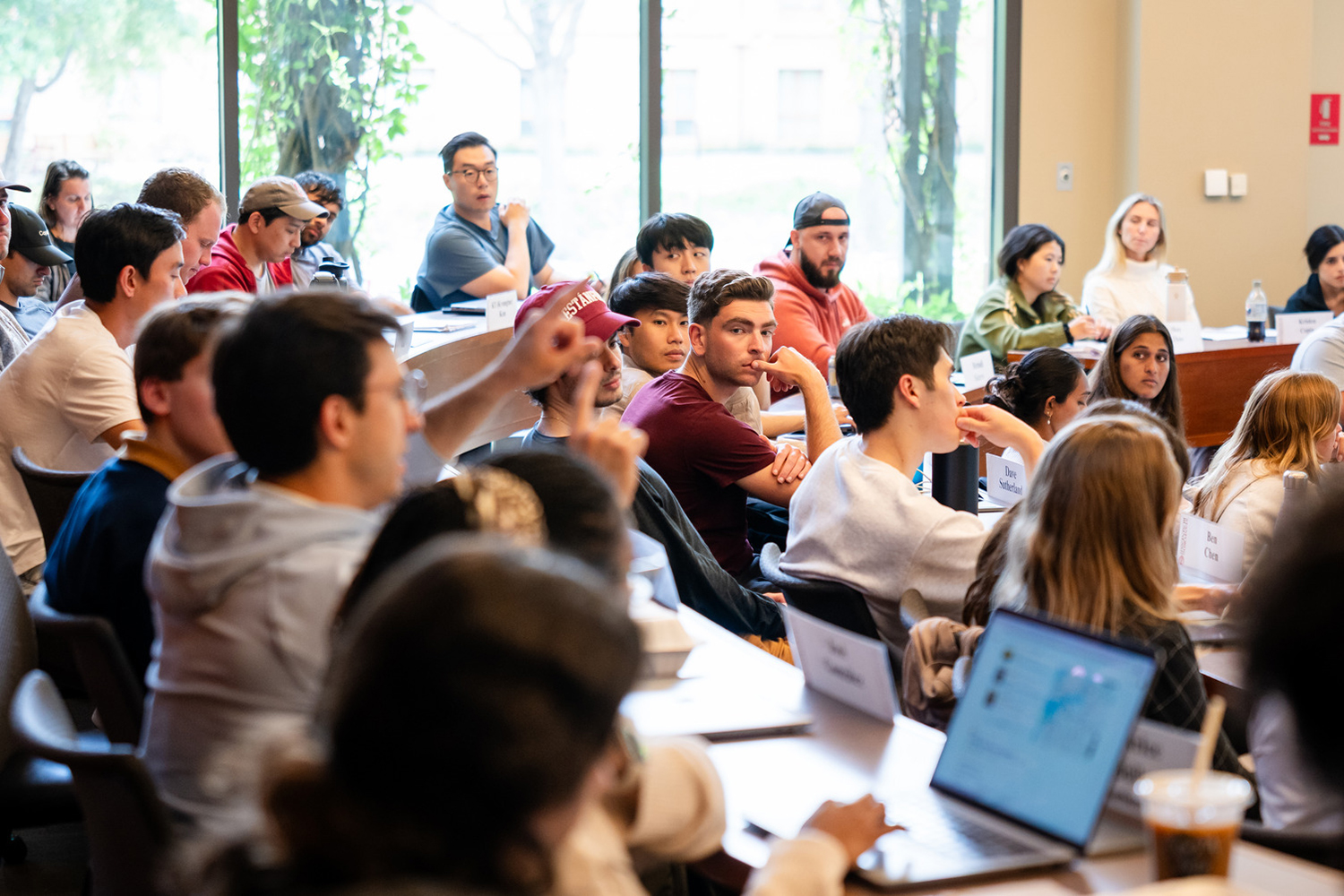
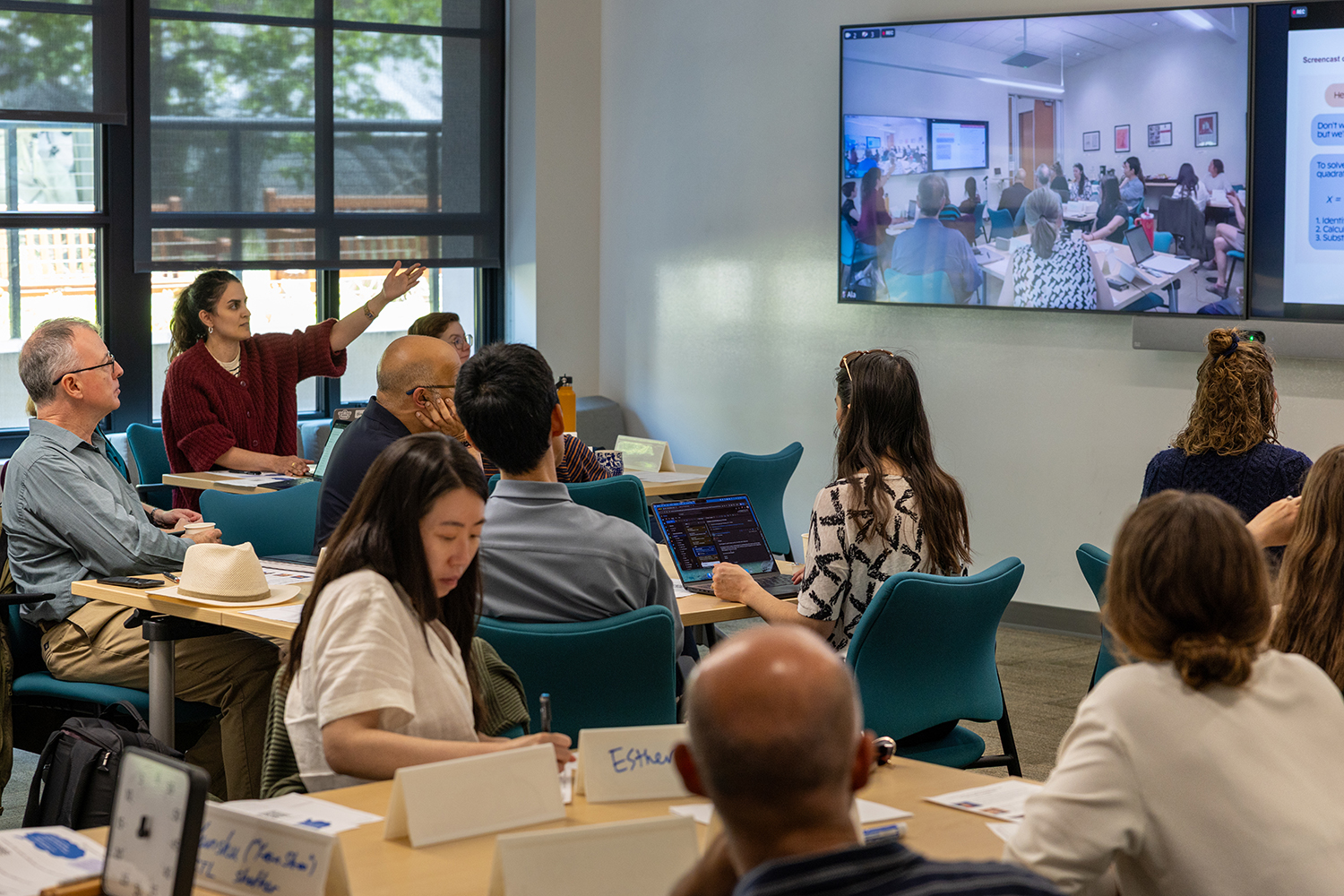
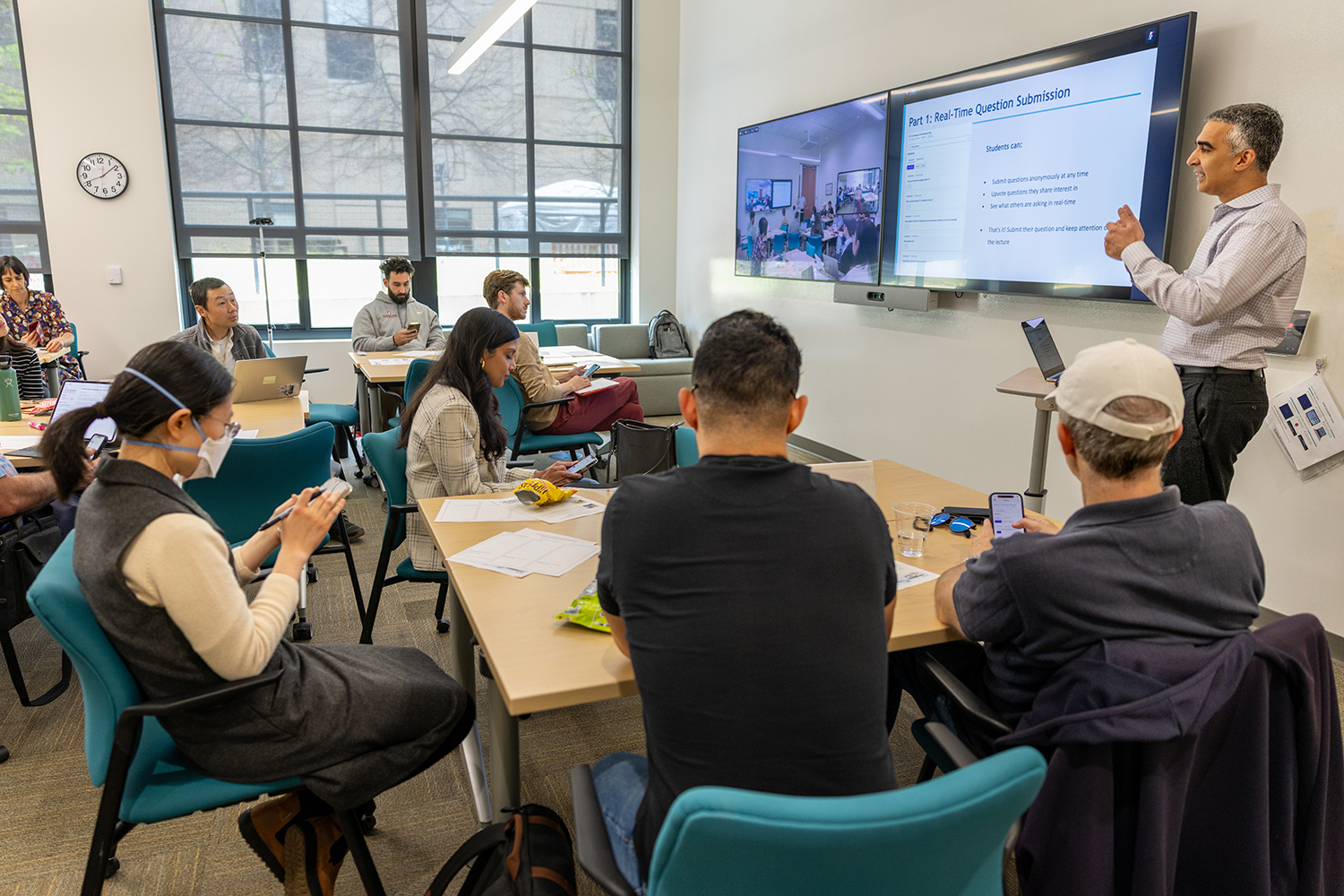
In the interest of encouraging better understanding of the intersection of AI and education at Stanford, the Center for Teaching and Learning (CTL) has been hosting a “Teaching with AI Community Share-out” series, in which instructors present and discuss specific ways they have applied AI in their courses. Presenters included lecturers, graduate student instructors, and staff, as well as faculty members.
This series is part of AI Meets Education at Stanford (AIMES), an effort by the Office of the Vice Provost for Undergraduate Education (VPUE) to catalyze and support critical engagement with generative AI in Stanford teaching and learning contexts.
“The intent of this event series is not to judge the projects or spotlight the speakers. It is designed to foster a community where people can come together to talk about AI in teaching and learning,” said Kenji Ikemoto, associate director for academic technology at CTL, who developed and facilitated the share-out series with Yunshu Fan, associate director for academic teaching programs at CTL.
Over the past two academic years, 23 instructors have presented at the share-out events, from VPUE, the School of Humanities and Sciences, the School of Engineering, the School of Medicine, the Graduate School of Education, and Stanford Online High School. CTL plans to continue creating opportunities to share ideas, lessons, and feedback, and to evolve this community of shared practice and learning.
More AI in education resources at Stanford
- To invite speakers (yourself or your colleagues) for future share-outs, please nominate them through this form.
- Looking for thought partners to think through how you can effectively engage with generative AI in your course? Submit a CTL consultation request.
- For UIT support for developing a custom AI tool, contact the AI Catalyst team early on, to ensure the tool you develop is secure, safe, compliant, and effective.
To give insight into the types of projects that have been shared, here are four examples, from a tool to help instructors handle in-class questions to a bot that can help students learn classical Japanese.
Opening the floor to questions during talks and lectures
Amit Kaushal, a clinical associate professor in the School of Medicine and adjunct professor of bioengineering in the schools of Engineering and Medicine, turned to AI tools to build his own real-time question-submission system for lectures. Kaushal wanted his students to have an easy way to submit a question whenever something was confusing or they wanted to know more, but he knew it would not be possible to sift through a flood of questions mid-presentation. The tool uses AI to group, rank, and summarize student input as a moderator would.
There are other in-course chat tools available, but Kaushal has found that they shifted the focus from the student-teacher interaction to the technology, to the extent that they sometimes became a distraction. He wanted something that recognized the importance of student input while still allowing for a cohesive class experience. “I want that relationship between lecturer and learner to remain intact,” he said. “So, I’m always trying to balance spending time understanding what the audience is thinking or confused about with delivering the material they came to learn."
His tool identifies themes and synthesizes umbrella questions from groups of related questions, giving a sense of what common questions students have and what information needs further reinforcement. “It gives me a way to look and say, ‘Hey, it seems like two or three students are confused about this one thing, or there are a lot of upvotes on this topic, we should tackle that first,’” he said.
Kaushal also noted that it provides a way for students to participate anonymously and without the pressure of public speaking. Of course, he still encourages his students to raise their hands and speak, if that’s their preference. “Different approaches work better for different students,” he said.
Since Kaushal made the tool available online, people have used it across different settings – from town halls to educational forums to multiday conferences – around the world. He sees it as an example of how AI can empower instructors to consider new ways of working. “As teachers, we all have ideas for ways to approach what we’re trying to teach, and now we have the ability to freely build tools that address our own classroom challenges,” he said.
Meeting incoming students where they are
At the share-outs, Waheeda Khalfan, a senior lecturer in the Department of Biology in the School of Humanities and Sciences (H&S), presented an AI tool to help students better navigate the foundational biology course series.
The challenge this tool addresses is that undergrads often arrive at Stanford with different levels of preparedness for coursework. In addition, the foundational biology series allows students to take introductory biology courses in any order with no formal prerequisites.
With support from Stanford’s Curriculum Transformation Project, Khalfan and her colleagues, including H&S biology professor Jessica Feldman, collaborated with data scientist and former graduate student Mayank Sharma to build an AI pipeline that analyzes years of course content and relationships between courses. This analysis identifies what is taught in a course and what students should know beforehand, providing a structured path to success.
“There’s a lot of flexibility with these courses, but at the same time, students were sometimes struggling with the material because we were making assumptions about their knowledge,” said Khalfan. “We’ve been dealing with this challenge for a number of years and advising students on a one-on-one basis about what they need to succeed in these courses. With AI tools becoming ever more capable, we saw an opportunity.”
After personally reviewing and refining the output, the team used the identified prerequisite knowledge to build self-diagnostic assessments for students to take during the first week of each course. The diagnostic tests are paired with curated preparation guides aimed at closing knowledge gaps in specific concepts.
The team also developed the Foundations Navigator, a web-based tool that lays out the background knowledge each course assumes and shows which other courses cover those concepts. This helps students identify an optimal sequence through the Foundations series.
For Khalfan, this application of AI offers an incredible opportunity to support student success. “Something that would have taken months, we’ve now reduced to weeks, and so it’s making things possible that otherwise we would just never do,” she said. Still, human subject expertise is essential in ensuring the materials remain accurate. “There’s very close human curation involved,” said Khalfan. “We will never automate the process entirely.”
The team is now developing companion courses, known as the X series, to help students apply concepts from the Foundations courses and develop effective study habits.
Slowing students down to learn problem-solving
Shima Salehi, an assistant professor of education in the Graduate School of Education (GSE), partnered with senior chemistry lecturer Jennifer Schwartz Poehlmann in H&S to design an AI tutor called STEPS (Science Tutor for Effective Problem-Solving). The tutor is modeled closely on Schwartz’s teachings and geared toward walking students through the steps of solving complex STEM problems. Importantly, STEPS helps protect students’ productive struggle during the problem-solving process. It was also supported by a Curriculum Transformation Seed Grant.
This work was built on a collaboration between Salehi and her former PhD advisor, Carl Wieman, to find more successful methods for teaching STEM problem-solving skills. An early product of this work was pen-and-paper problem-solving guides. Some students struggled to complete the guides on their own, and providing feedback to each student was unsustainable for the teaching team. By developing STEPS, the researchers are now examining whether AI can address these challenges in a more sustainable and individualized way.
STEPS doesn’t give students the answer; instead, it asks questions aimed at getting them closer to solving the problem themselves. The students’ opinions of STEPS shifted over time. “At first, the students were frustrated and annoyed by it, and the feedback was ‘Why doesn't it give me the answer?’” Salehi said. “The eventual take was that they could appreciate that it teaches them the problem-solving process, rather than solving the problem for them.”
By helping students form a habit of asking targeted questions to understand the problem and develop a plan to solve it, this tool is intended to help them gain more confidence in tackling new problems on their own.
In the end, students have responded favorably to STEPS, seeing it as a useful resource for approaching problems across STEM courses – with some noting the AI tutor “sounds like Dr. Schwartz coaching us.” As one student said: “There’s nothing else like STEPS right now that makes you slow down and really try to understand what you’re learning.”
Reading classical Japanese
In his winter graduate seminar, Ariel Stilerman, assistant professor of East Asian languages and cultures in H&S, introduced BungoBot. This AI tool, developed by Stilerman and his students, functions as a Socratic tutor for classical Japanese, known as bungo. Students can input a sentence in classical Japanese, and rather than readily delivering translations, the bot responds with targeted questions that gently push them toward a deeper understanding of the text and finding answers themselves.
There are no native speakers of classical Japanese today, and the writing system is so complex that students typically need years of academic training before they can work directly with historical manuscripts. Stilerman didn’t want this complexity to narrow down who could enroll in his graduate seminar in classical Japanese. “I want my seminar to be as open as possible, and that involves opening it to people in other majors or other concentrations,” he said.
The students quickly began using BungoBot extensively and coming up with ways to improve it. “By week five, students were thriving in the classroom. They enjoyed using the tool, and they had all this feedback that I could use week to week to tweak it. By week seven or eight, it was their tool as much as it was mine,” said Stilerman.
To motivate the students and test their learning, Stilerman organized a rare-materials workshop in which they deciphered calligraphic scrolls containing poems by the female tea master Ōtagaki Rengetsu (1791-1875), recently acquired by Stanford. Working with Joshua Capitanio, a curator at the East Asia Library, he assigned two poems to each student to prepare.
Stilerman found that the tool allowed the students to dive into classical Japanese at an accelerated rate. “To be able to spend time on the manuscripts, you need to accelerate how you process grammar. Otherwise, you’re taking the whole quarter just to understand grammar,” he said.
Following BungoBot, Stilerman recruited Alan Y. Cheng, a PhD student in computer science, and Andrew Nelson, a PhD student in Japanese linguistics, to further delve into the possibilities for AI-assisted course tools.
In the spring quarter, they introduced Hiki, a reverse lookup dictionary. Rather than being designed to decipher texts, this new tool allowed students to search, in English, for terms in order to write classical prose and poems to share in class. Their third tool was Sata, a conversational partner that simulates a chat with an 11th-century court lady. When students make mistakes, she doesn’t stop the conversation or correct them. Instead, she can naturally model the correct language in her response.
Together, the tools enabled students to work through classical Japanese at an accelerated rate, even to the point of using freed-up class time to transcribe undeciphered manuscripts for the Stanford library.
For Stilerman, these tools do more than improve how students learn. “You can see these tools as just deepening the learning process, but they also aim to make it fun, which is equally important,” he said.
Watch select share-outs
The Center for Teaching and Learning has published short videos of selected “Teaching with AI” share-out presentations.
For more information
Wieman is a professor emeritus of physics and of education, in H&S and the Graduate School of Education.
The Curriculum Transformation Seed Grant is part of the Leveling the Learning Landscape (L3) initiative supported by VPUE.
Writer
Alonso Daboub