


Following an extensive process of community engagement, Stanford University has released StanfordNext, its long-term plan for addressing academic, housing, transportation, sustainability, and infrastructure needs on existing campus lands.
The university submitted the plan today as an application to Santa Clara County for an updated General Use Permit, the county authorization that guides Stanford’s academic campus development. The application seeks to do two things together: support Stanford’s mission of education and research, and help the region and the university succeed together by addressing shared local needs and concerns.
“Stanford’s future and our region’s success are inseparable, and both have been in the forefront as we have developed this plan,” said Stanford President Jonathan Levin. “StanfordNext seeks to create shared progress by advancing emerging research and transformative education over the coming decades while also helping address housing, transportation, sustainability, and other critical needs in our region.”
Public webinar
Learn more about the StanfordNext application on Sept. 10 at 5:30 p.m. PT.
Submission of the application kicks off a comprehensive regulatory and environmental review process led by Santa Clara County. Throughout that public process, the county will provide opportunities for community members to share input, and Stanford will continue to host its own events to encourage dialogue and engagement.
Full details of the application are available on the StanfordNext website. They include:
- Academic space: Authorizing Stanford to gradually add academic and support space, corresponding to roughly 1% annual growth over approximately the next two decades, to support state-of-the-art research and modern learning environments.
- Student housing: Building new student beds to continue addressing the housing needs of Stanford’s student community and enable a gradual increase in undergraduate access to Stanford in the coming years.
- Workforce housing: Constructing up to 500 units of affordable, transit-oriented housing for the university’s workforce, located on campus to support sustainable commuting and reduce housing pressure on neighboring communities.
- Transportation: StanfordNext would invest in pedestrian, bicycle, and transit infrastructure to make it simpler, safer, and more efficient to get to, around, and from the university while continuing the university’s 25-year commitment to ensuring that peak-hour commute trips do not exceed the baseline established by Santa Clara County.
- Community investment: Shape a Development Agreement that addresses community priorities and enables the Stanford Community Fund, a $100 million contribution predominantly focused on supporting affordable housing, along with transportation, education, and other community benefits and partnerships across the region.
Stanford’s current General Use Permit was approved in 2000. The application for an updated permit does not include specific plans for individual facilities, but rather guides long-term space planning for the core Stanford campus in unincorporated Santa Clara County. As a result, it does not include university-owned land in Palo Alto and other surrounding cities, such as the Stanford Research Park, Stanford’s hospitals, and the Stanford Shopping Center.
Leading with listening
Over more than 18 months, the StanfordNext team engaged with university stakeholders to understand the physical spaces needed to empower the next generation of teaching and research. At the same time, the university conducted an extensive local engagement and outreach effort to hear the priorities and concerns of residents in Stanford’s neighboring communities.
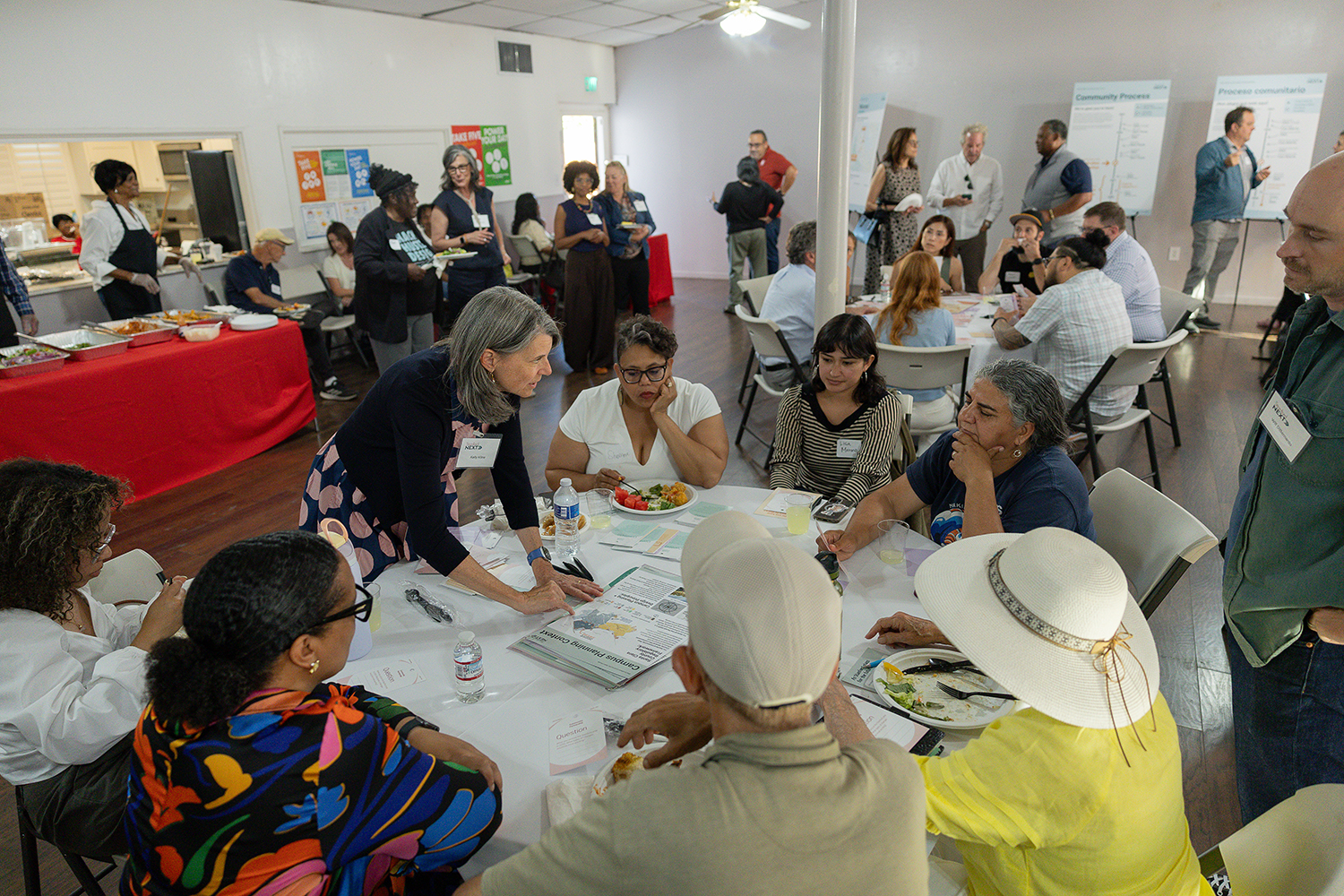
Community members discuss StanfordNext at an open house in East Palo Alto. | Iliana Garcia-Ruiz
The local engagement effort included:
- seven open houses on the campus and in neighboring communities;
- regular convening of the StanfordNext Advisory Council, a group of 22 local leaders appointed by Santa Clara and San Mateo County supervisors and the university;
- more than 2,100 individual pieces of feedback, from comment cards to one-on-one conversations; and
- dozens of meetings with local residents, Stanford community members, local elected officials and staff, and community organizations.
“We undertook a dedicated effort to listen closely to the ideas and concerns of residents in our neighboring communities,” said Whitney McNair, Stanford senior associate vice president and StanfordNext project executive. “From the beginning, a key goal of this planning effort has been to ensure the plan reflects the university’s academic needs and simultaneously responds to the shared needs and priorities of our region as a whole.”
A number of priorities emerged consistently across the hundreds of interactions:
- Affordable housing is the defining regional challenge and the central opportunity.
- Growth within the campus is supported when its benefits and tradeoffs are clear.
- Traffic congestion and transportation are major concerns.
- Engagement with the community is valued and expectations for follow-through are high.
- Sustainability, infrastructure, outdoor amenities, and campus character must be considered.
Building a future of discovery and connection
One significant component of StanfordNext is planning for modern spaces for learning and discovery that will be needed in the coming years to advance Stanford’s mission of teaching and research.
Stanford researchers are engaged in addressing many of the world’s most critical challenges, pursuing discoveries in fields with the potential for benefits both locally and globally – including data science, medicine, environmental science, cosmology, genomics, nanoscience, chemical biology, and many others. As these fields continue to evolve, many require new modes of collaboration and highly specialized spaces. While Stanford renovates existing facilities when feasible, some areas of frontier science and innovation require the creation of new spaces.
“Both today and in the future, students and researchers need spaces that are flexible, that bring people together, that enable them to use new technologies, and that in many cases include specialized infrastructure and equipment. StanfordNext plans for these needs,” said Stanford Provost Jenny Martinez, the university’s chief academic officer.
“Stanford is fundamentally about discovery and education. Our faculty and students are pushing forward the frontiers of knowledge, and at the same time, we’re sharing that knowledge through our education programs and with the world. That has a huge payoff for the real world, and so many of these issues are of vital importance right here in the Bay Area,” Martinez said.
What happens next
Santa Clara County’s process for reviewing the General Use Permit application is expected to continue over the next couple of years, with an anticipated Board of Supervisors vote in 2028.
As the application moves through public review, Stanford plans to continue engaging the community through events, newsletters, website updates, and more. Individuals interested in staying informed about StanfordNext can sign up on the website to receive updates.
StanfordNext at a glance
- What It Is: StanfordNext is the university’s long-term plan to meet future academic, housing, transportation, sustainability, and infrastructure needs on existing campus lands. It is reflected in Stanford’s application for an updated General Use Permit.
- Why It’s Needed: Stanford’s people need modern spaces to learn, teach, live, work, collaborate, and discover in a rapidly changing world. Our local and regional communities need continued collaboration to address shared priorities.
- How It Was Shaped: The plan reflects the university’s long-term needs and extensive feedback from neighboring communities, local governments, civic and nonprofit leaders, and the Stanford community.
- What It Will Do: It will create new academic space, student and workforce housing, transportation improvements, and other community-focused investments.
- How It Will Matter: StanfordNext will help the university and the region succeed together while supporting the people, discoveries, and innovations that improve lives locally and globally.