In brief
- A SLAC-Stanford team developed a new way to precisely measure just how much energy has dissipated into heat in a liquid crystal device.
- By controlling how they applied energy to a system, the researchers reduced waste heat by more than 60 percent.
- The method could inform design of future computers and other electrical devices to make them more energy efficient.
Almost all of the energy that flows into computing devices will be eventually squandered as waste heat.
As data centers proliferate, researchers are racing to find ways to make computing more energy efficient. One way to do that is to increase the percentage of energy that does useful work.
But first, researchers must find a way to measure heat dissipation at the smallest levels. That’s no small feat, considering that even personal computers contain billions of transistors – where much of the energy leaks away into heat via mechanisms that are difficult to track.
Researchers at the Department of Energy’s SLAC National Accelerator Laboratory and Stanford University developed a new way to measure just how much energy has dissipated into heat in an electrical system.
The team, led by Stanford professor Aaron Lindenberg, also optimized the shape of the voltage pattern used to control the device, which reduced the waste heat by more than 60 percent.
Their results, published in Physical Review Letters, could be used to design future computational devices to make them more energy efficient.
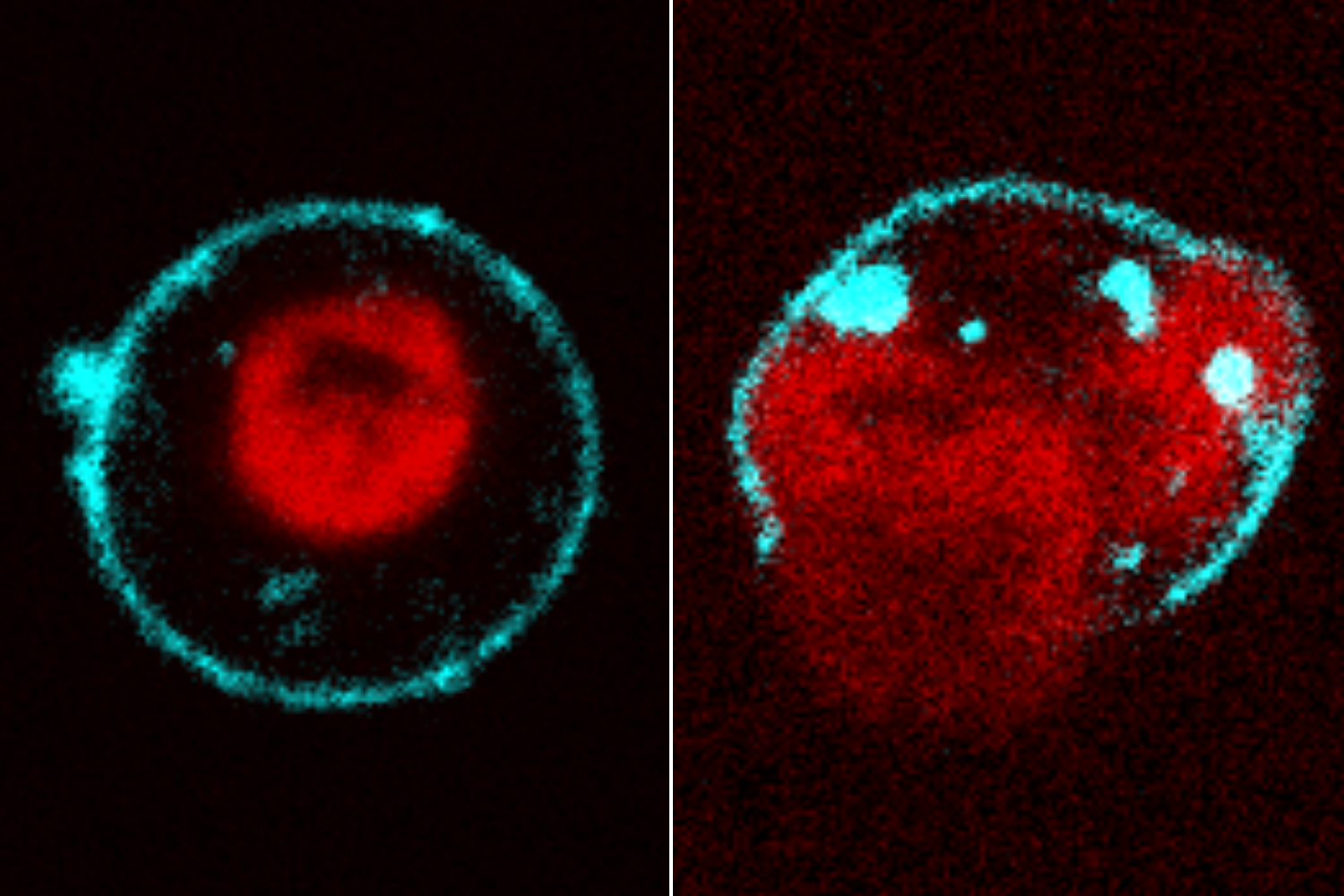
To study how electrical devices lose energy as heat, researchers created a model system based on liquid crystals that change shape in response to a voltage. Using a polarized optical microscope, the team watched the liquid crystal molecules rotate as the researchers ramped up and down the voltage. From these studies they derived a highly precise measurement of energy dissipation. | Shen, Y. et al. / SLAC National Accelerator Laboratory
Tracking energy loss in liquid crystals
The most common way to measure energy dissipation in an electrical device is to probe the local temperature change – when devices shed heat, the temperature goes up. But that measurement isn’t exact and requires additional modeling of the heat flux from the system to the surroundings. Often, the temperature change can be very small and hard to probe directly.
Because computers have so many different parts involved in the transfer of energy, they are inherently difficult to measure when it comes to how they expend heat.
“When you think about a computer or any device that stores information, there are dynamics within that system that are difficult to track,” said Lindenberg, professor of materials science and engineering at Stanford and photon science at SLAC. “But to really understand what’s happening, you can’t take an average of measurements. You have to track the flow of energy. That’s part of why this problem is challenging and hasn’t been approached before.”
Lindenberg’s team used a liquid crystal device as a model system and took a new approach: They injected clean electrical signals into the device and calculated the dissipation from electrical measurements alone, correlated with optical measurements of the dynamical switching processes occurring within the liquid crystals.
Though liquid crystals aren’t computational devices themselves, they are a collection of components that interact much like those of a computer. These crystals consist of bar-like molecules that rotate when a voltage is applied. But their rotation isn’t uniform: Molecules in different areas of the crystal might rotate one way, while others rotate another way, creating a system that is made up of local domains.
To measure how much energy was wasted into heat, the team applied varying amounts of voltage over time and measured the current as the molecules in the liquid crystal rotated. They then very slowly ramped down the voltage, so the liquid crystal returned to its original state. Using a polarized optical microscope, the team watched the molecules of the liquid crystal rotate.
By combining their high-precision electrical measurements with these images, the team derived the real-time capacitance – the ability of the system to store electrical charge.
To really understand what’s happening, you can’t take an average of measurements. You have to track the flow of energy.Aaron LindenbergProfessor of Materials Science and Engineering and of Photon Science
That gave them a highly precise measurement of dissipation. Though the team’s approach did not measure temperature, if it did, and the system was thermally isolated, the accuracy of their measurement would have a sensitivity equal to sensing a 10-nanokelvin-degree temperature rise – an extremely small change.
Optimizing voltage to reduce energy turning into waste heat
The team then took their experiment a step further and used machine learning, a form of artificial intelligence, to optimize their process to create the least amount of wasted energy. They found that if they ramped up the voltage quickly, then slowed the increase for a fraction of a second, then sped it up again, more than 60 percent less energy was wasted.
Next, the team plans to use the same approach to measure and optimize dissipation in ferroelectric devices commonly found in computer memory, as well as other devices that store data and make computations. These sorts of devices are fast and use minimal power, making them a key contender for future computing systems.
“Compared to liquid crystals, these are much closer to actual computing devices, so it will give us more measurements that could potentially apply to future computers,” said Yuejun Shen, a Stanford graduate student and first author of the paper. “The ultimate goal is to develop universal methods that can be used to extract dissipation and optimize it for all different kinds of electrical devices.”
For more information
Portions of this research were conducted at the SLAC-affiliated Stanford Institute for Materials and Energy Sciences and Stanford PULSE Institute. This work was supported by the Department of Energy Office of Science. In addition to SLAC and Stanford, the team also included researchers from the University of Malaya, Malaysia.
Citation: Shen, Y. et al., Physical Review Letters, 12 August 2026 (10.1103/z9nd-rprp)
This story was originally published by SLAC National Accelerator Laboratory.
Media contacts
Media inquiries: media@slac.stanford.edu
Other questions or comments: SLAC Strategic Communications & External Affairs, communications@slac.stanford.edu
Writer
Emily Ayshford