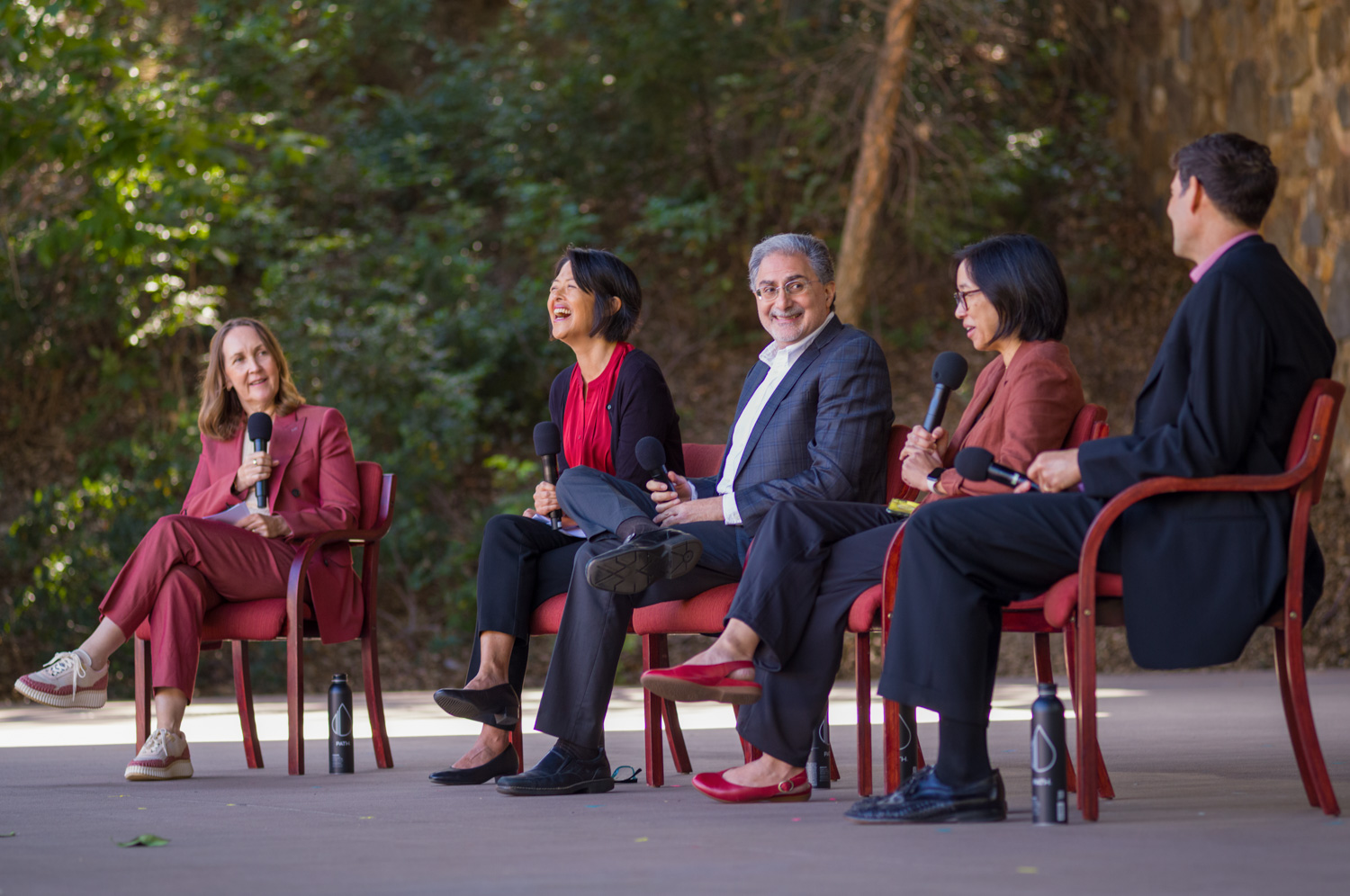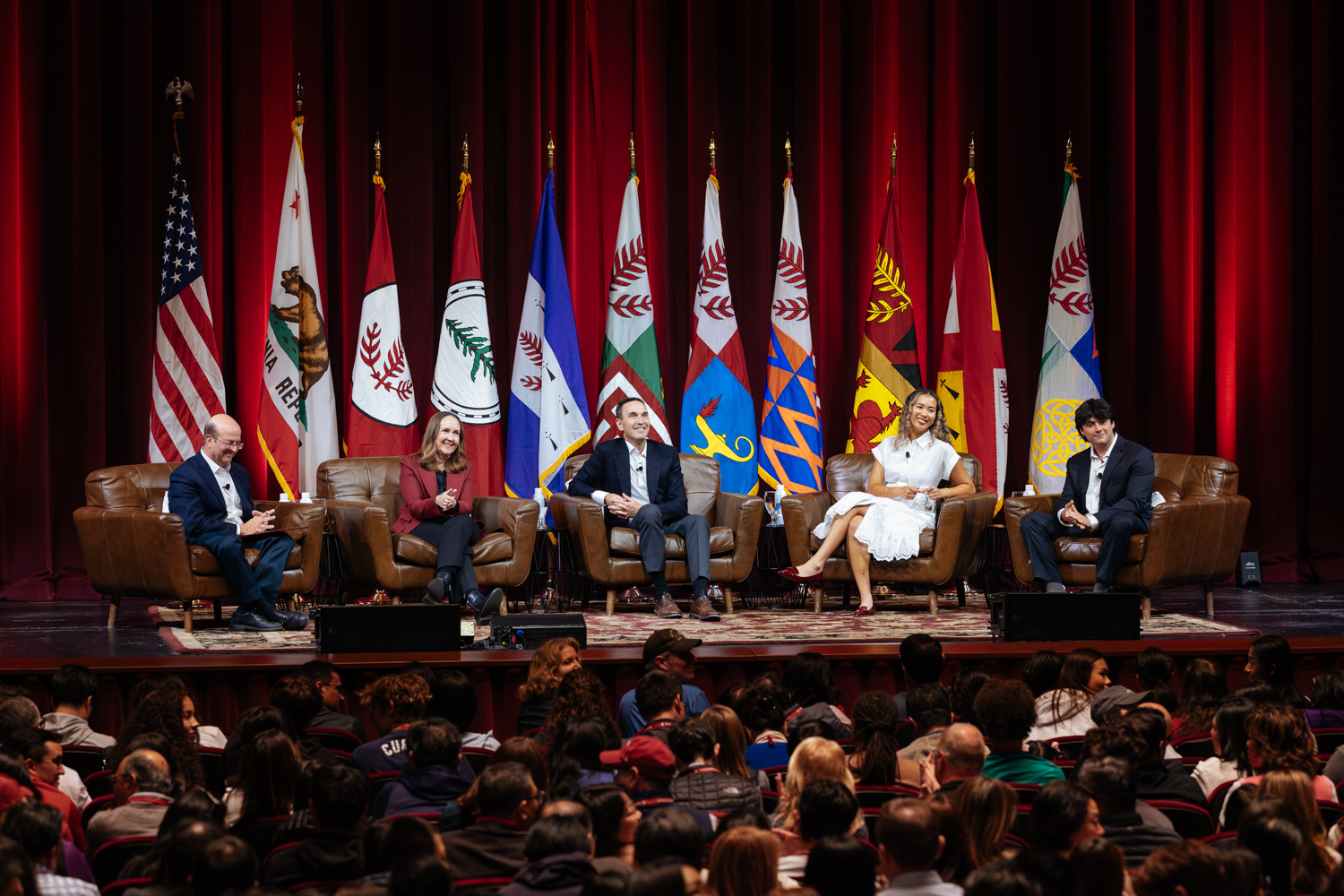
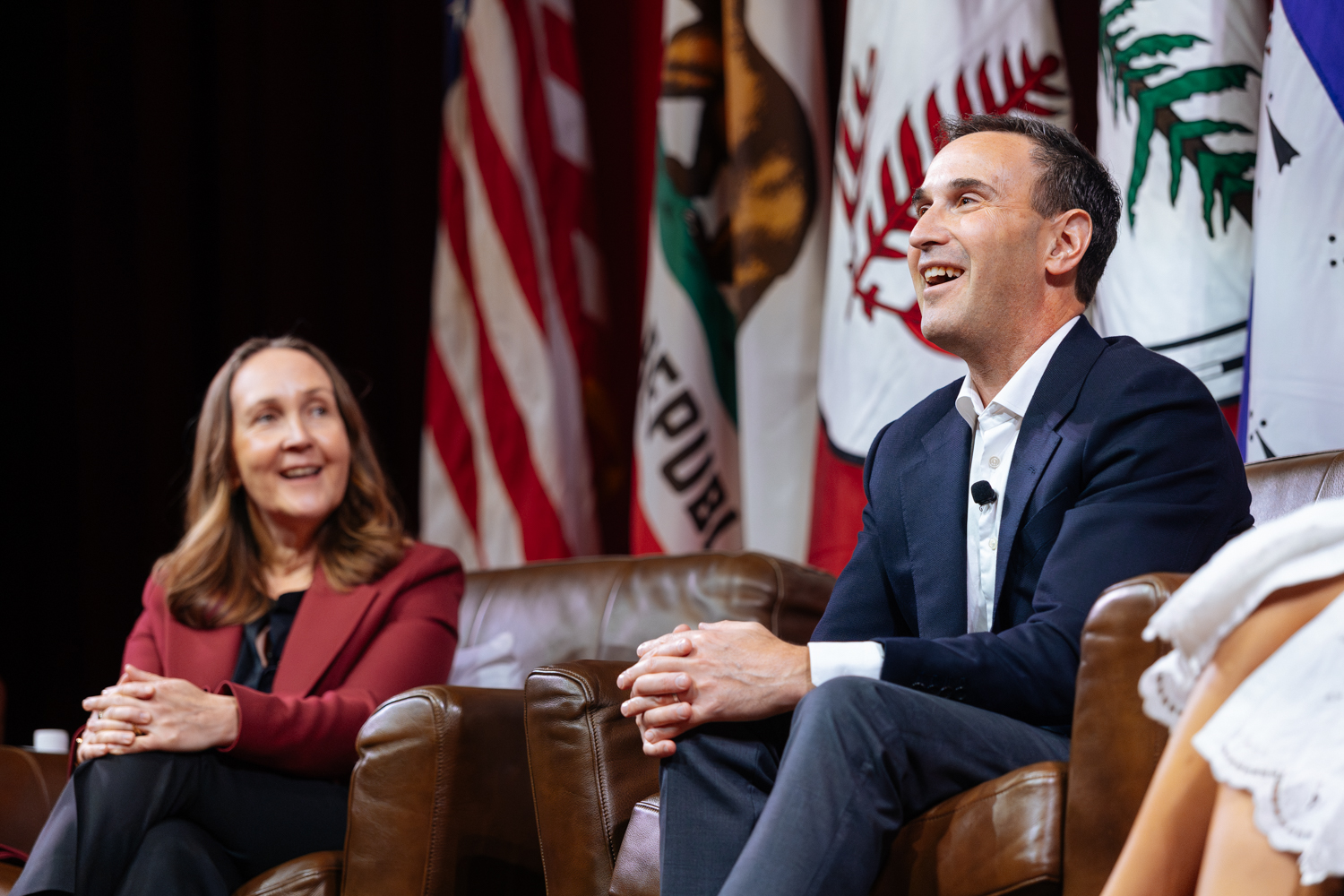
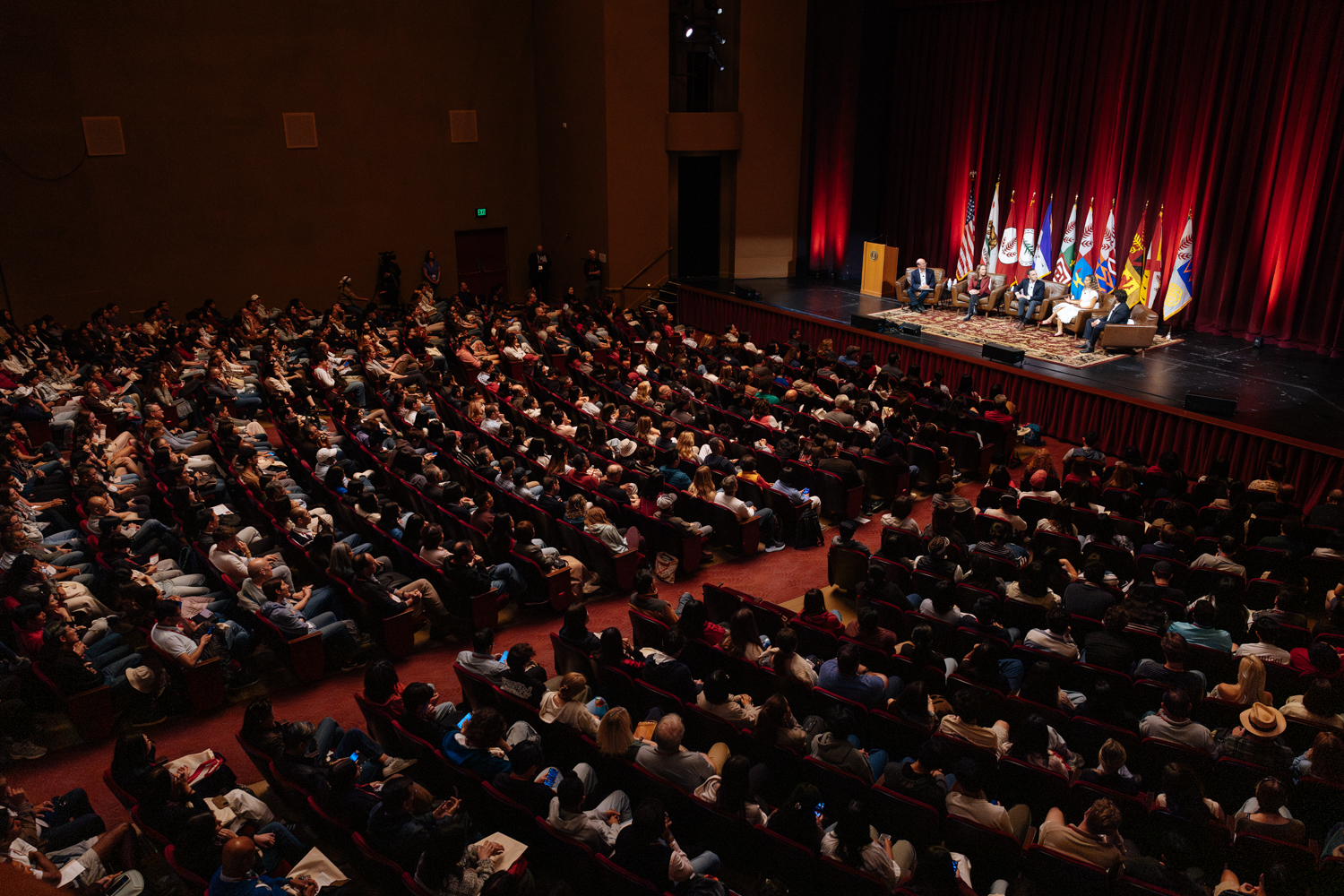
Students from across the country and around the world arrived on campus Thursday for Admit Weekend, a three-day event designed to showcase what makes Stanford special to prospective members of the Class of 2030.
“There are aspects of being a student at Stanford that are just different than being a student anywhere else in the world,” said President Jonathan Levin during a conversation with university leaders Friday morning at Memorial Auditorium.
He noted Stanford’s “extraordinary breadth of excellence” across campus, from the humanities to medicine to engineering. Students, he said, have unparalleled freedom to explore. He also noted that Stanford is an entrepreneurial problem-solving place.
“When there’s a lot of change in the world, as there is today … people at Stanford view that as an opportunity, as a way to roll up your sleeves and problem solve, to figure out what the future could look like,” Levin said. “That makes Stanford a really exciting place to be a student.”
Stanford is also an optimistic place, Levin said – “not naive optimism of just sort of hoping for the best, but optimism in the sense of believing the best is possible and working hard to get there.” That spirit, he said, is what brought him back to teach after graduating and what has kept him on the faculty for so many years. It’s what admits will feel when they walk onto campus in September.
Levin moderated a discussion that included Provost Jenny Martinez, Vice Provost for Undergraduate Education Jay Hamilton, ASSU President Ava Brown, and ASSU Vice President Will Berriman that touched on campus culture, constructive dialogue, AI, research opportunities, and more.
A culture of openness
The panelists conveyed how Stanford’s mission of discovery and learning relies heavily on a culture of open-mindedness and curiosity, including for those with unorthodox ideas or opinions. “It’s really essential to have an environment where people feel free to share those ideas and to challenge each other in a way that’s constructive,” said Martinez.
Numerous initiatives on campus are designed to support that culture, such as ePluribus, which promotes open and constructive dialogue across difference, and the COLLEGE curriculum, in which students explore the purpose of education, citizenship and democracy, and learn how to discuss controversial issues.
“Coming out of the program, three-quarters of the students feel really comfortable sharing their ideas, even when they think that their classmates might find them controversial, which is much higher than what you see across the country in how people describe their college experience,” she said.
Martinez added that student-led programming, such as Democracy Day and the Stanford Political Union, is an essential part of Stanford’s culture of openness.
The epicenter of the AI revolution
Artificial intelligence is transforming teaching and learning at universities everywhere. According to Hamilton, Stanford students have a unique opportunity to seize the moment.
“Stanford is definitely the epicenter of the AI revolution, and if you come here, you’re going to be here at a remarkable time,” he said. “You’re going to take classes that help sharpen your critical thinking skills, that help you appreciate the benefits and the limitations of AI, and will help you learn to use generative AI in a way that will help you flourish in your career.”
Hamilton is leading AI Meets Education at Stanford (AIMES), an initiative that supports faculty, instructors, and students as they engage and teach with generative AI.
“The evolution of AI is uncertain, but what is not uncertain is our commitment to offer classes that are going to help you stretch and grow, that will help prepare you to both earn a living and have a life that is well lived,” he said.
Hands-on experiences
When asked which experiences have been most impactful during their time at Stanford, students Brown and Berriman both pointed to the opportunities for hands-on learning.
When there’s a lot of change in the world, as there is today … people at Stanford view that as an opportunity.President Jonathan Levin
Berriman said serving as an undergraduate researcher at Stanford’s Institute for Economic Policy Research (SIEPR) and Stanford’s Institute for Human-Centered AI allowed him to “learn by doing,” and “deepened my technical tool bag and made me more ready for what comes after Stanford.”
Brown said that serving as director of speaker curation and mentorship for TEDx Stanford exposed her to the people, ideas, and projects shaping the world. “It’s been really inspiring for me as I figure out how I want to spend my life and what I want to study,” she said.
Audience Q&A
During the question-and-answer portion of the event, an audience member from Michigan asked Brown and Berriman about their experience with floating duck syndrome, a term for high achievers who appear calm while experiencing pressure and stress beneath the surface.
Brown said that while the syndrome is a natural part of being a student and of coming of age, “What I’ve found is that we really emphasize collaboration over competition here.”
“The best way people can overcome that here, and they do, is relying on their peers, working together, seeing that everyone has the same struggles … understanding your fellow student more and how they’re just like yourself in a lot of ways,” said Berriman.
When asked about research opportunities for undergraduates, Hamilton said that next year his office will provide $7.5 million to support more than 1,000 undergraduates pursuing research. Berriman noted that, in his experience, faculty are receptive when undergrads reach out seeking research opportunities, and that labs and institutes often publicize such positions on their websites.
At Stanford, Levin noted, students can work with and take courses taught by faculty who are leaders in their fields, including Nobel laureates. “As an undergraduate, you have an unusual amount of access to top scholars in all of the different disciplines,” he said.
An attendee from Paris asked Levin about his vision for Stanford “in an era where we’re converging towards an attention economy” and how the university could promote what he called a “noninstitutional path to success.”
“The parts of life and work that will take on more value are the parts that are maybe less technological – they can’t be substituted by technology,” Levin said. “They’re the relational parts of people’s lives.”
Advice for students
The panelists’ closing advice to potential students converged on a single theme: stay open. Martinez advised students to try new things, Brown encouraged them to take risks, and Berriman urged them not to limit themselves to a single path or plan but rather be open to opportunities. And Hamilton called on students to ask themselves, What would you do if you could not fail?
“That’s the question Cory Booker’s mother asked him when he was in law school. It put him on a pathway to politics,” Hamilton said. “I think it’s a really helpful thought experiment. What she said is, ‘Even if you don’t succeed, you’ll be stronger and wiser because you tried.’”
Writer
Alex Kekauoha