


As smoke curled toward a blue sky, Charlene Nijmeh pulled dry branches from a nearby grove and placed them atop a crackling fire before pausing to gaze at the burning pile.
“We want to listen to what the land needs and have the land hear what we want. It is a reciprocity, and it comes with respect,” said Nijmeh, chairwoman of the Muwekma Ohlone Tribe of the San Francisco Bay Area. “Fire gives life to the land, and everyone benefits from this living spirit, just as we benefit from all elements around us.”
In late January, 13 small piles of brush were set aflame as part of a cultural burn training with the Muwekma Ohlone Tribe at the Jasper Ridge Biological Preserve ('Ootchamin 'Ooyakma).
Members of the North Fork Mono Tribe guided the Muwekma Ohlone in the cultural burn. It was the first of its kind for the Muwekma Ohlone in nearly a century and a half since the practice was disrupted throughout their ancestral homeland, and an opportunity for the two tribes to come together to preserve the tradition.
“A lot of tribes are working on bringing back cultural burns and learning our ways that were taken,” Nijmeh said. “It’s very useful in helping us understand and respect the fire. Hopefully, we teach our children to continue these methods and continue that respect to the land.”
In 2024, the preserve sought guidance from the Muwekma Ohlone on prescribed burns conducted as part of the university’s land management and wildfire risk mitigation.
“The prescribed burn is about land management, but a cultural burn has part of our essence in the land,” Nijmeh explained. “It’s about prayer and giving thanks when we are on this land.”
A learning experience
The cultural burn training, a collaborative effort between the two tribes and Stanford, provided a unique opportunity for a new introductory seminar class, Traditional Ecological Knowledge for Land Stewardship. Offered jointly by the Biology Department and the Native American Studies program in the School of Humanities and Sciences, the class explores how Traditional Ecological Knowledge (TEK) developed by Indigenous communities is increasingly recognized by scholars as fundamental to addressing sustainability and environmental issues.
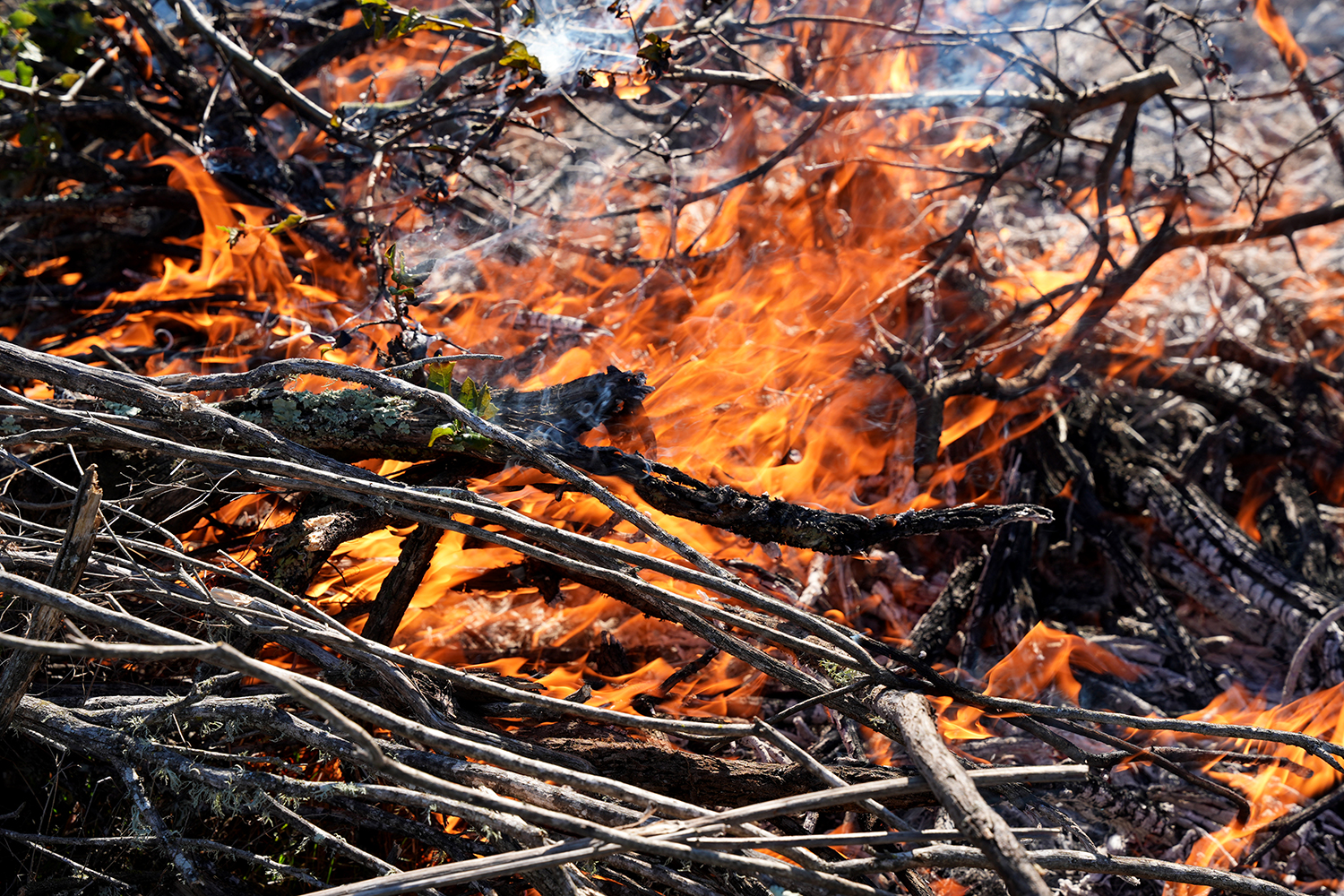
The cultural burn training gave a hands-on learning opportunity for a new class, “Traditional Ecological Knowledge for Land Stewardship,” which is cross-listed as Biology and Native American Studies.
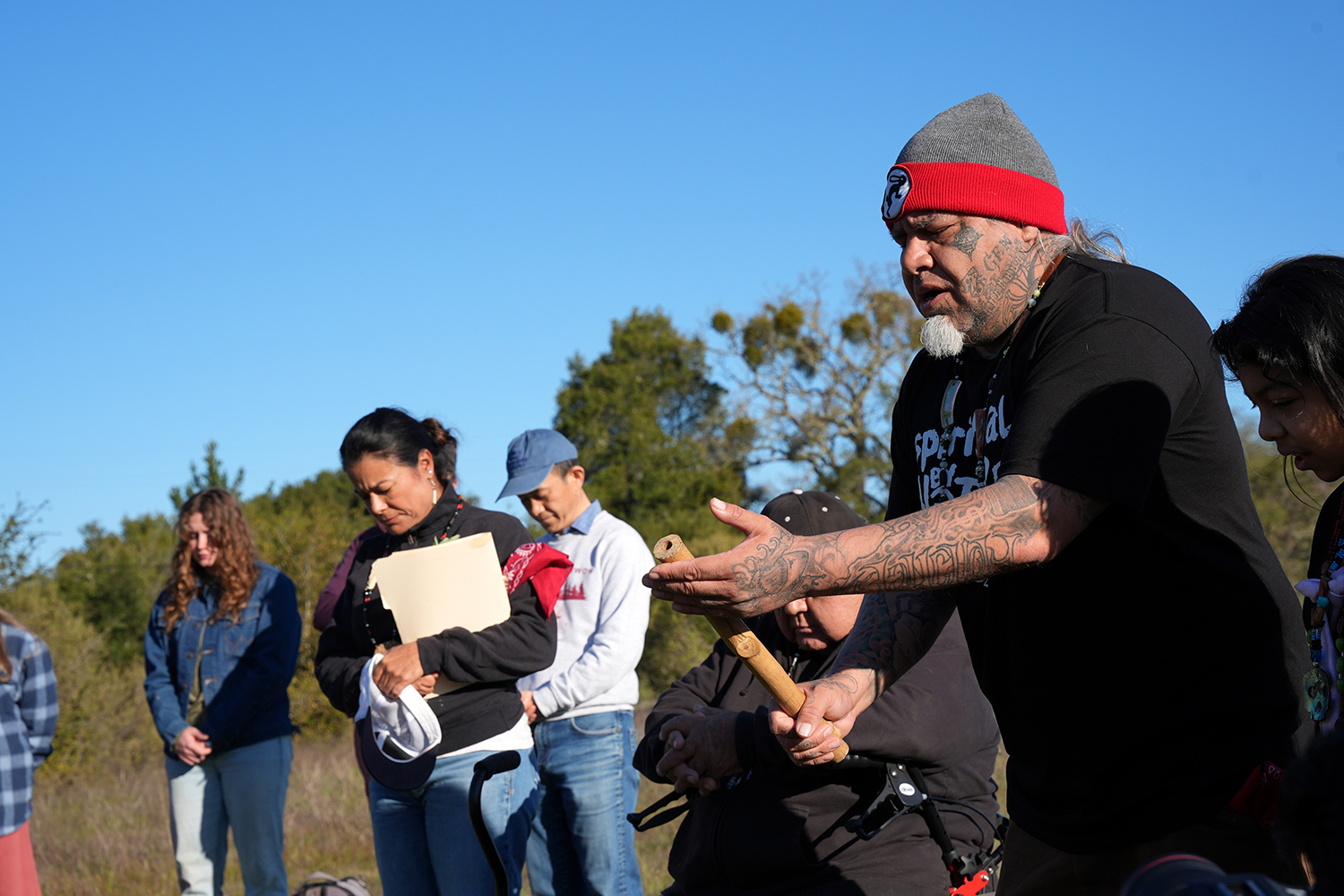
Charlene Nijmeh, chairwoman of the Muwekma Ohlone Tribe (third from right), Ron Goode, chair of the North Fork Mono Tribe (second from right), and Joey Iyolopixtli Torres, culture bearer of the Muwekma Ohlone Tribe, pray during a pre-burn ceremony.
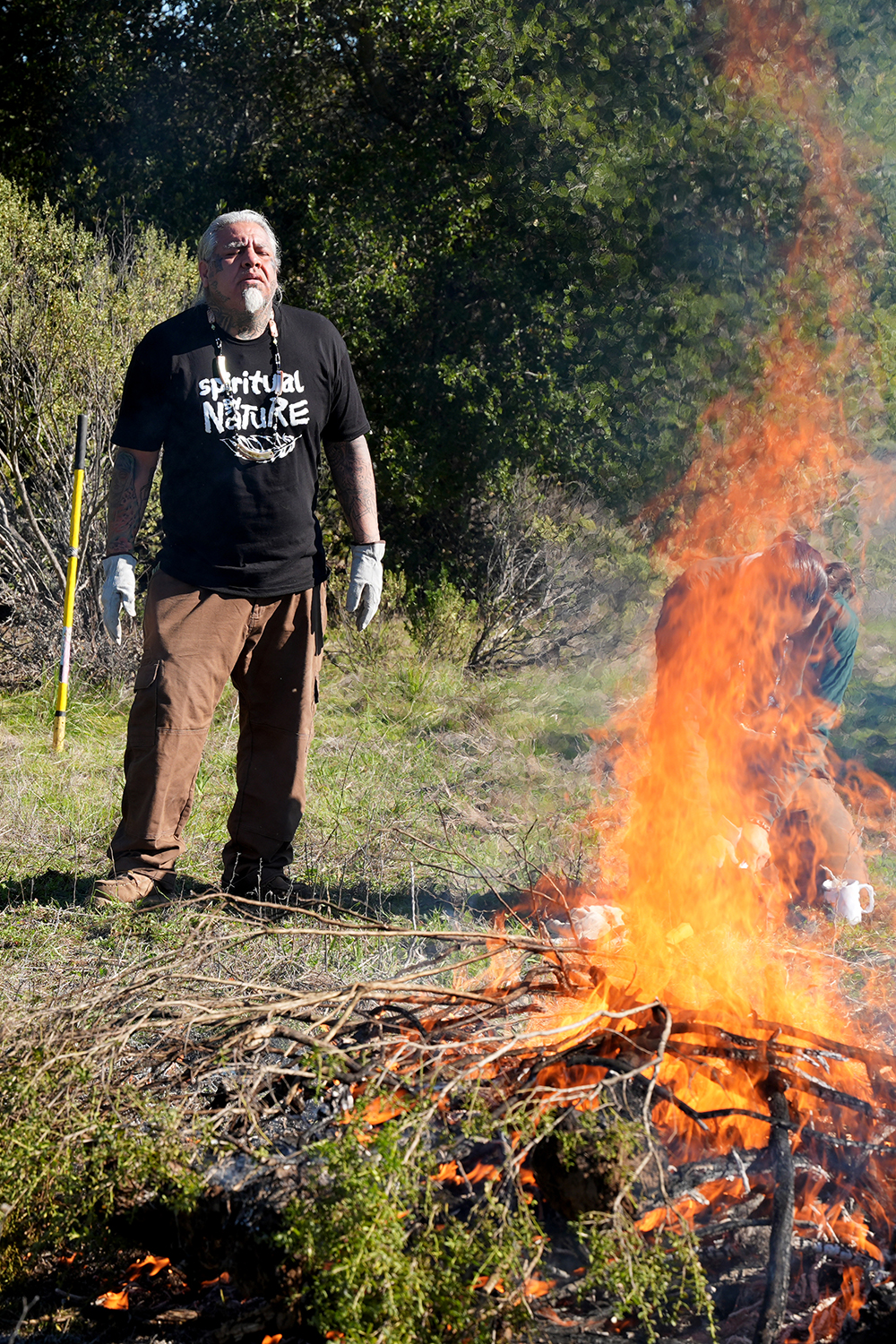
Iyolopixtli Torres prays during the ceremony.
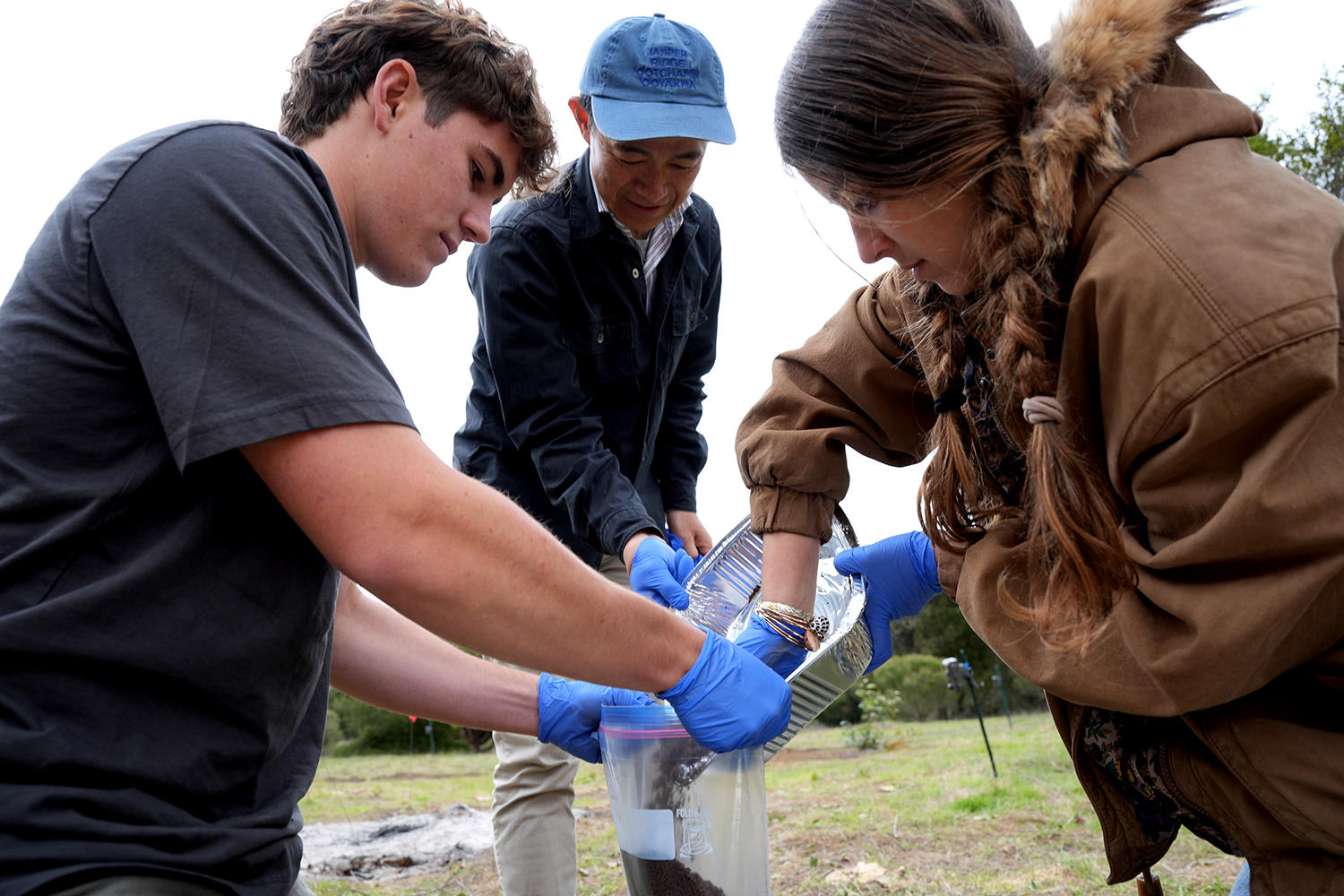
Tadashi Fukami, professor of biology and of Earth system science, helps students Kalaʻi Romanchak and Yeva Allyn collect soil samples.
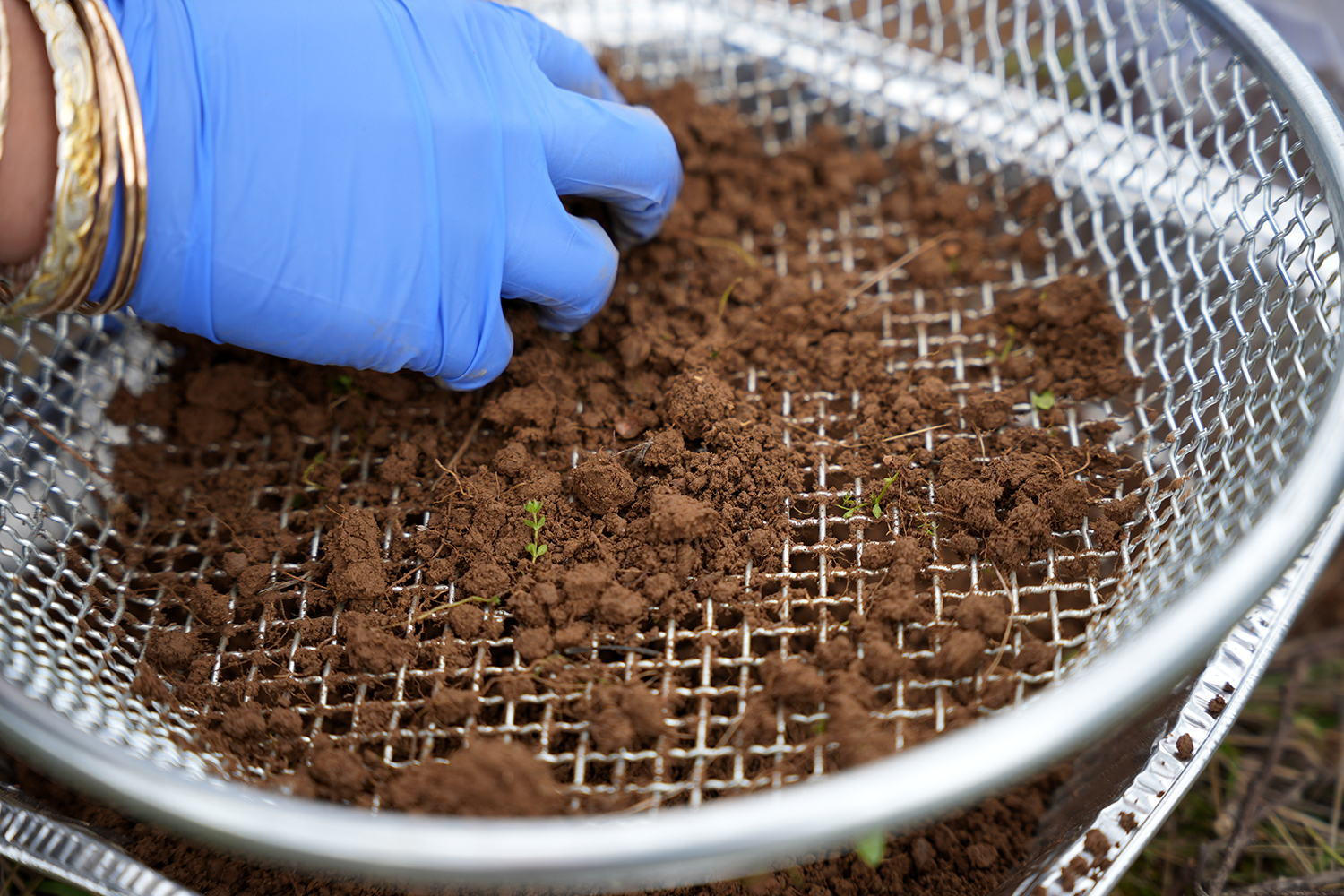
The students collected soil samples from the burn sites to see how the fire impacted the soil’s ecology.
“Western science is a powerful tool to understand nature, but Indigenous science has been developed for generations and shows how to be part of the landscape without being too destructive,” said Tadashi Fukami, professor of biology and of Earth system science. “Having both approaches and seeing how they can be synergistic is what we need.”
Fukami, who was appointed faculty director of Jasper Ridge in 2023, propelled the shift in the preserve’s long-term management to “two-eyed seeing,” an approach that looks to Indigenous and Western sciences as independent but complementary ways of acquiring knowledge.
With the help of the preserve staff, he designed the class, which combines field-based learning at the preserve with lecture, discussion, and guest speakers such as tribal elders.
Frosh Alyxx Ford, ’29, is interested in pursuing a degree in the environmental sciences and attended the burn. “I enjoy that the class is discussion-based, and Tad is very good about listening to everyone’s opinions and a broad range of perspectives,” Ford said. “Being able to physically engage with what you’re learning is also very important.”
A few days after the burn, Fukami and graduate students Chloe Golde, Yuerong Xiao, and Katie Huy led the class through the site to collect soil from burn areas marked with small flags. The students brought the samples to the preserve’s field station, where they added larvae to see how the burn impacts insect parasites in the soil, including bacteria, fungi, and nematodes. Researchers also placed motion-sensing cameras in the area to monitor animal movement and activity in response to the burn.
Frosh Yeva Allyn, ’29, said she first learned about Traditional Ecological Knowledge while growing up in Kauai and was excited by the opportunity that the course presented to learn more about its use. “It’s special to take a class like this, and I feel like it’s important,” she said. “I feel lucky to have been part of the burn.”
Revitalizing land and culture
Before the flames were lit, a group of about 60 people gathered in a circle to participate in a pre-burn ceremony led by members of the Muwekma Ohlone Tribe and the North Fork Mono Tribe. The crowd included Stanford students, researchers, staff, and faculty, as well as firefighters.
Western science is a powerful tool to understand nature, but Indigenous science has been developed for generations and shows how to be part of the landscape without being too destructive.Tadashi FukamiProfessor of Biology and of Earth System Science
“It’s not about the fire, not about the flame. It’s about revitalizing our culture – either culture we have lost or culture we were unable to maintain,” said Ron Goode, chairman of the North Fork Mono Tribe and the Muwekma Ohlone’s cultural burn advisor. “This is to refresh, renew, revitalize, but not destroy.”
Tribes who practice cultural burns may hold them two or three times a year, depending on the needs of the land, Goode explained. Fire can support the health of vegetation and animals; for example, smoke kills mistletoe, a parasite for oak trees. It also helps reduce vegetation density and increase visibility – referred to as the “see through” concept – which historically helped tribes manage the land.
“Cultural burning is a ceremonial practice, and what makes it ceremonial is when we connect with the spirituality of the land, our culture, and our heritage,” Goode said.
Tribal members lit sage to cleanse each person before the ceremony, and Joey Iyolopixtli Torres, Culture Bearer of the Muwekma Ohlone Tribe, led the group in a prayer.
Other tribal members with experience in cultural burns attended to help guide the Jasper Ridge burn and ensure its safety, including Dirk Charley, a member of the Dunlap Band of Mono Indians and a Tribal liaison working with the North Fork Mono Natural Resources Team, and Jesse Valdez, a tribal councilmember of the North Fork Mono Tribe.
“Tribes know what to do through family and experience,” Charley said. “You can talk about it, read, share, but when they come to do it, they get that smell, they can hear, and they can feel it. That’s how you learn.”
For more information
The Jasper Ridge Biological Preserve ('Ootchamin 'Ooyakma) is a unit of the School of Humanities and Sciences (H&S).
Writer
Chelcey Adami