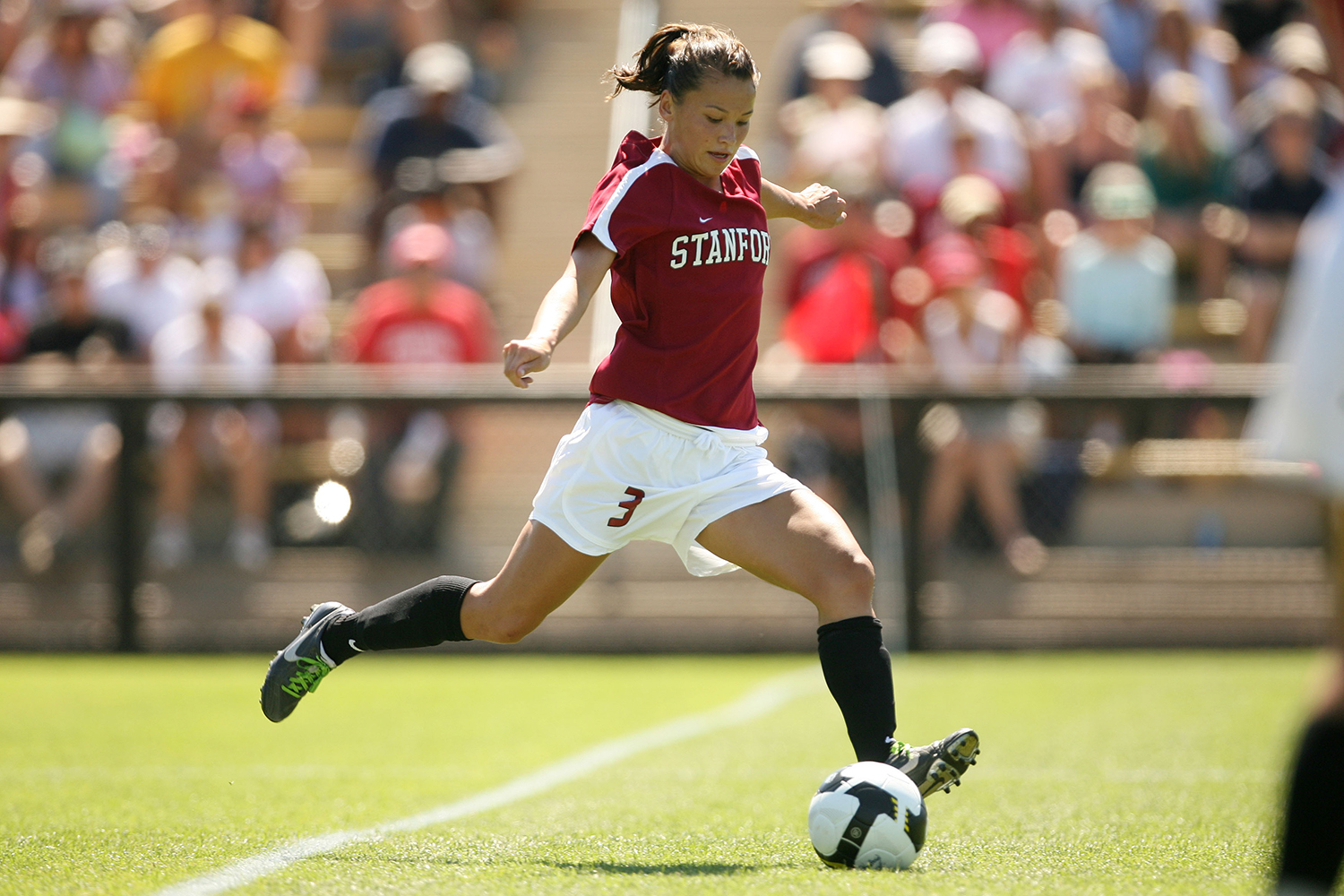
The day Sydney Barta, ’26, received her prosthetic running blade changed her life.
“It was an incredible experience,” said Barta, a senior majoring in bioengineering. “I didn’t even know it could be this good because it’s so responsive and springy. I remember feeling so happy. It was one of the reasons I wanted to run.”
Stanford track and field
Stanford track and field competes from winter through late spring and includes more than 70 athletes competing in seven events, including distance, hurdles, jumps, middle distance, multis, sprints, and throws. Sign up for email updates on home track and field meets.
Barta’s career as a professional runner took off during her teenage years. She is a five-time U.S. Paralympic Track and Field national champion, a two-time Parapan American champion and record holder, a two-time World Para Athletics medalist, and the first Paralympic athlete to compete for Stanford track and field.
Her experiences as a runner laid the foundation for her academic path at Stanford. To fit her blade, Barta’s prosthetist filmed her running. Together, they watched the videos to see what her pelvic tilt, joint angles, ankle flexion, and foot strike looked like in different phases of motion.
“I had to learn biomechanics without knowing it and then getting to learn that fundamentally at Stanford was really special and impactful,” Barta said. “As a sprinter with an amputation, we don’t have the luxury of not thinking about biomechanics.”
Recently, Barta was named a 2026 Rhodes Scholar, an honor that will take her to Oxford, where she hopes to pursue graduate study in musculoskeletal sciences.

Sydney Barta hugs a supporter during the Payton Jordan Invitational meet at Stanford’s Cobb Track and Angell Field on April 25, 2025. | John Lozano / ISI Photos

Barta conducts research assessing balance in athletes in the Human Performance Lab. | Kurt Hickman

Barta at the Stanford track. | Kurt Hickman

Barta at the Human Performance Lab. | Kurt Hickman
Getting on track
When Barta was 6, she was finishing a fun run at the 2010 Marine Corps Marathon when strong winds pushed over metal scaffolding. It fell on her, narrowly missing her head and shattering bones in her left ankle.
She spent four months in the hospital and ended up having 21 surgeries as part of her leg was amputated.
After healing, Barta returned to athletics, encouraged by her mother. “She was the reason I got back into sports,” she said. “My mother took on a lot of emotional pain that I had, as well as the time and expenses with getting me new prosthetics. In every barrier that I faced, she showed me that it’s not going to be easy, but we’re not taking ‘no’ as final.”
Barta started running in paratrack after attending a Wounded Warrior amputee camp. When she was 8, the Challenged Athletes Foundation gave her a top-of-the-line running blade. As her running career progressed, she competed, medaled, and set records around the world.
As a Stanford junior, Barta was training for the 2024 Paris Summer Paralympic Games when she broke her right foot. The injury was “devastating,” she said, and left her unsure about her athletic future.
But the next day she was shocked to learn that she had been awarded a spot on the Stanford track and field roster: “To still have the opportunity to do this, even though you have had a really bad injury, was just incredible.”
“Sydney is a joy to have on the team,” said J.J. Clark, the Franklin P. Johnson Director of Track and Field. “She is energetic, engaging, and an excellent teammate who uplifts everyone around her.”
“She is a fierce competitor who gives everything she has to win,” Clark continued. “When she loses, she works even harder and comes back stronger. She’s relentless on the track.”
Barta learned from her teammates that navicular fractures, the type of injury she sustained while training for Paris, are common in sprinters, particularly women, and especially compromising for amputee athletes. The experience of this injury only deepened her research interests in bone health and affirmed her career aspirations to improve medical care for others.
‘A unique position’
Barta conducts research in the Human Performance Lab, which integrates biomechanics, biomedical engineering, physiology, psychology, and rehabilitation. There, she looks at assessing balance in athletes with Scott L. Delp, the director of the Wu Tsai Human Performance Alliance at Stanford, the James H. Clark Professor in the School of Engineering, professor of bioengineering, of mechanical engineering, and, by courtesy, of orthopedic surgery.
“Currently, there’s no robust clinical measurement of balance,” Barta said. “But balance is a really great predictor of other pathologies, and it’s a great predictor of quality of life.”
Barta was named a 2023 Wu Tsai Human Performance Scholar, and in 2024, she was elected president of the Stanford Tau Beta Pi Engineering Honor Society. This year, she was awarded a BioX fellowship to continue her research.
“Sydney embodies what distinguishes Stanford student-athletes: she excels academically, competes at the highest level, and contributes to human performance research,” Delp said. “It’s an honor to have her working in my laboratory.”
Barta also advocates for disability awareness and inclusion as part of the Collegiate Advisory Council of the U.S. Olympic and Paralympic Committee, and the Team USA Athlete Commission.
Barta recently won bronze at the World Para Athletics Championships in India and is now training for the 2028 Summer Paralympics in Los Angeles. “Being visible as an athletic female amputee has been one of the greatest, most rewarding things in my life,” Barta said.
Sydney embodies what distinguishes Stanford student-athletes: she excels academically, competes at the highest level, and contributes to human performance research.Scott L. DelpDirector of the Wu Tsai Human Performance Alliance
In addition to classwork, research, and roughly 20 hours of athletic training each week, Barta is working on applications to medical school. She wants to be an orthopedic surgeon, a calling shaped by her experience.
“I think my purpose in this life is to be a health advocate helping to understand foot bone health in athletes, especially for female athletes and amputees,” Barta said. “Knowing biomechanics in the way that I have – through Dr. Delps’ Lab and my own experience with injury – I’m at a unique position to help amputees with bone health.”
Looking back, Barta and her mother often say that the accident was the luckiest day of their lives.
“It was so close to hitting my head, and the fact that I woke up the next day goes to show that there’s a lot of things to be grateful for,” Barta said. “It was obviously a bad situation, but it’s incredible that I can understand others’ experiences and try to change potential outcomes. My amputation has really given me such a richness of experiences.”
This article was updated to include the recently announced Rhodes Scholarship.
Writer
Chelcey Adami