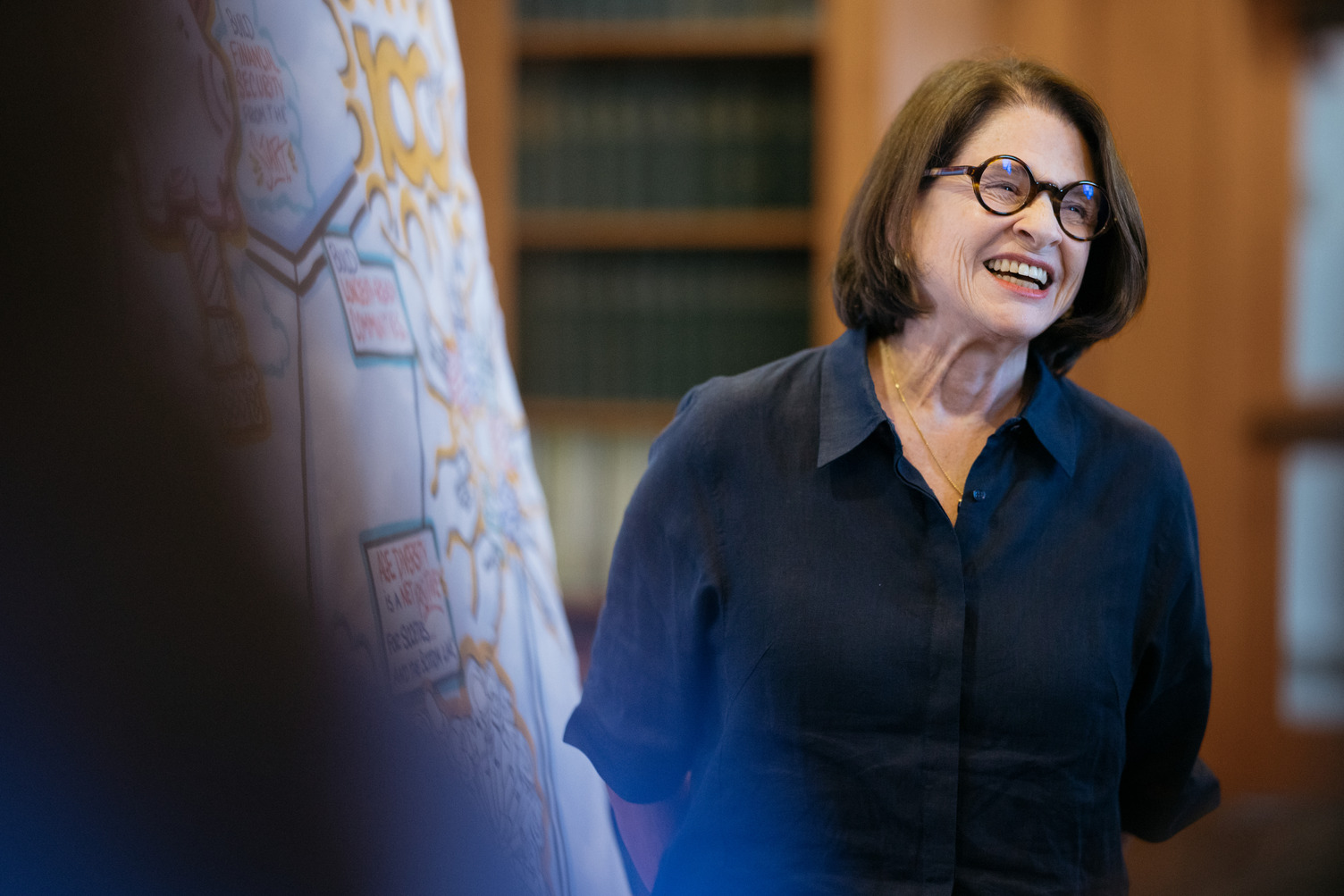
When a child becomes fixated on a topic, you never know where it might lead. For Stanford scholar Amy Zegart, a childhood fascination became a lifelong calling.
Zegart remembers being 11 years old and watching the evening news in Kentucky during Chinese leader Deng Xiaoping’s historic 1979 trip to the United States. The sight of Xiaoping donning a cowboy hat at a Texas rodeo transfixed her.
“I was mesmerized. I was like, ‘What is this country?’ ‘Who is this man?’” she recalls.
Her mother, an antique dealer with a knack for finding anything, connected her with a nearby Taiwanese graduate student who taught her Mandarin over after-school lessons and home-cooked Chinese food.
Zegart then went to Phillips Academy, a boarding school in Andover, Massachusetts, partly because it was one of the few U.S. high schools that taught Mandarin. She spent the summer after her junior year in Beijing, just a few years after normalization of U.S.-China relations, a time when visiting the country was still quite difficult for Americans. She majored in East Asian Studies at Harvard and received a Fulbright Scholarship to travel to China to study the Tiananmen Square protests that called for political reforms toward democracy, freedom of speech and press, and an end to corruption and inflation. The Chinese government violently cracked down on protestors, and on the night of June 3-4, 1989, resulting in a brutal massacre with hundreds, if not thousands, of people killed.
Zegart interviewed dissidents and learned to protect her sources – early lessons in stealth and tenacity that would prove invaluable when her research later pivoted to international security and intelligence.
Coming to Stanford
As a Stanford graduate student in 1991, Zegart took a course co-taught by political science professors Terry Karl and Condoleezza Rice, now the Tad and Dianne Taube Director of the Hoover Institution. On paper, the two professors held widely different political views; in class, their differences sparked a dynamic that pushed Zegart to think in completely new ways.
“I got hooked,” Zegart said.
Rice became her mentor and PhD advisor, and Zegart’s dissertation on the creation of the national security state set her career trajectory.
After joining UCLA as a public policy professor, she wrote Spying Blind: The CIA, the FBI, and the Origins of 9/11(Princeton, 2007), the first scholarly study of the intelligence failures preceding the Sept. 11 attacks. She found that the CIA and FBI had spent half a century combating the Soviet threat and were still operating with a Cold War playbook throughout the 1990s, leaving them unable to adapt to the new threat of international terrorism. In the weeks and months before 9/11, the CIA and FBI identified 23 opportunities to penetrate and possibly stop the plot, but failed to capitalize on any of them.
Researching that book meant fighting for access to information in a field designed to be clandestine and difficult to penetrate. Declassified materials yielded insights only if you knew where to look. “You have to be really good at reading footnotes – there’s so much gold there,” she said. “It’s like hunting for treasure.”
Even so, her official requests for information were often ignored or rebuffed. When she requested a specific set of unclassified documents from the FBI that were not publicly available, Bureau officials promised they would be forthcoming and then mailed her photocopies of the website. When she finally secured an interview with the FBI director, she was told there was nothing worth studying.
But anonymous sources at the FBI and CIA told a different story, and she conducted some 70 interviews – corroborating, probing, and weighing motives. At one point, she even received a threatening phone call from a government official urging her to stop. Instead, she hired a First Amendment lawyer.
She felt there was just too much at stake. “This was the worst terrorist attack in American history, and I had people who risked their careers to tell me what they thought were weaknesses they were desperately trying to fix,” recalled Zegart. As a junior faculty member without tenure, she knew she was putting her own career at risk.
When the book was finally published, it was met with critical acclaim and was later adopted for FBI new-agent training. “Sometimes, you can move the needle in the right direction,” she said.
Understanding the implications of technology on national security
Zegart returned to Stanford in 2011 as a senior fellow at the Hoover Institution, where she has become a leading expert on U.S. intelligence and national security. She has testified before Congress and advises agencies on adapting to rapid technological change.
Her most recent book, Spies, Lies, and Algorithms (Princeton University Press, 2022), shows how technology is challenging every aspect of intelligence today, from the threats that spy agencies confront to the “customers” intelligence must serve (which now include tech leaders and voters) to the rise of competitors using commercial satellites and the Internet to find new insights from “open-source intelligence.”
She has also taught a course on the topic for five years, bringing former senior U.S. intelligence officials, policymakers, and open-source intelligence leaders to brief students on real-world challenges.

In 2023, Zegart co-launched the Stanford Emerging Technology Review (SETR), the first collaboration between the School of Engineering, the Human-Centered AI Institute (HAI), and the Hoover Institution. SETR brings together leading scientists, engineers, social scientists, and policy analysts across 40 Stanford departments and institutes to educate public and private sector decision-makers about emerging technologies and their implications. SETR’s annual flagship report is briefed to senior U.S. officials in the Pentagon, Intelligence Community, White House, Commerce Department, and Congress. And SETR has now held emerging technology workshops with 25 U.S. governors’ chiefs of staff, as well as international allies and partners.
As Zegart points out, technological advancements are occurring at an unprecedented pace and policymakers – often lacking sufficient technical expertise – struggle to keep up with the implications of these developments.
Few institutions, she argues, can match Stanford’s ability to combine engineering expertise, policy scholarship, and proximity to Silicon Valley.
For more than a decade, Zegart has helped organize congressional boot camps on cybersecurity and AI through her affiliations with SETR, the Stanford Institute for Human-Centered AI (HAI), and the Center for International Security and Cooperation (CISAC).
“Bringing new ideas to people who are genuinely interested in finding solutions to policy problems and figuring out how the latest developments in science, engineering, or social science can actually change the course of history has been really inspiring,” Zegart said.
Now in its fifth year, Stanford HAI's Congressional Boot Camp on AI has been bridging the critical gap between Silicon Valley and Capitol Hill. | Stanford HAI
Making connections, building bridges
Throughout Zegart’s life, she has always felt like a bridge builder, a role she assumed after feeling like an outsider for much of her early life: growing up as the only Jewish family in an antisemitic Kentucky neighborhood (where her nextdoor neighbors set fire to some of her family’s belongings), standing out as a Southerner at a New England prep school, and later being an American researching the democracy movement in Beijing months after Tiananmen.
“I’ve always felt like I want to understand and cross different communities,” Zegart said. “I am very passionate about doing that as an educator at Stanford.”
In 2013, she launched a mentorship program pairing Stanford undergraduates with high-ranking U.S. military, intelligence, and State Department fellows in residence at the university. Now known as the Robert and Marion Oster National Security Affairs Fellows Program, the fellowship program has produced nearly 200 distinguished alumni. Zegart admits undergraduates to the mentorship program who may have no prior exposure to U.S. national security but who want to learn and engage with different perspectives. This year, students come from 12 majors (a large percentage are engineers), 16 states, all four class years, and represent a wide spectrum of political views, from very conservative to very liberal. It’s all by design – to bring different communities together. She also hopes the program can show students that public service can take many forms.
“I want students to understand that a life of public service – however they choose to define it – does not mean you have to be in government to contribute to your country,” Zegart said. “I want national security and service to go with them, wherever they end up working.”

In the classroom, Zegart is a contrarian by design. She assigns readings that argue with her own research. She pushes students to challenge their assumptions, broaden their perspective, and ask what would change their minds.
“My goal is not to teach them what I think,” she said. “It’s to teach them to challenge what they think.”
Her former mentor Rice remains a close collaborator; the two taught a Stanford GSB course together for many years and co-wrote Political Risk: How Businesses and Organizations Can Anticipate Global Insecurity (Twelve, 2019). They are currently writing a second book together.
Writer
Melissa De Witte