In brief
- Stanford researchers estimate wildfire smoke emissions caused 41,380 excess deaths per year during 2011 to 2020.
- Rising temperatures could increase U.S. deaths from wildfire smoke more than 70% by 2050.
- Aggressively cutting greenhouse gas emissions could prevent tens of thousands of deaths from climate-related smoke waves.
- The economic cost of deaths from wildfire smoke with roughly 2 C of warming may exceed costs from all other climate-driven damages in the U.S. combined.
Although wildfires have long been part of life in the Western U.S., warmer, drier conditions are fueling bigger blazes that occur more often and for longer. Smoke from these blazes is spreading farther and lingering longer than in the past. In a Sept. 18 study in Nature, Stanford University researchers estimate that continued global warming could lead to about 30,000 additional deaths each year nationwide by 2050, as climate-driven increases in fire activity generate more smoke pollution across North America.
“There’s a broad understanding that wildfire activity and wildfire smoke exposure are changing quickly. This is a lived experience, unfortunately, for folks on the West Coast over the last decade and folks on the East Coast in the last few years,” said senior study author Marshall Burke, a professor of environmental social sciences in the Stanford Doerr School of Sustainability. “Our paper puts some numbers on what that change in exposure means for health outcomes, both now and in the future as the climate warms.”
The researchers found no U.S. community is safe from smoke exposure. When monetized, deaths related to wildfire smoke could reach $608 billion in annual damages by 2050 under a business-as-usual emissions scenario where global temperatures rise about 2 degrees Celsius above pre-industrial levels. That estimated toll surpasses current estimates of economic costs from all other climate-driven damages in the U.S. combined, including temperature-related deaths, agricultural losses, and storm damage.
“What we see, and this is consistent with what others find, is a nationwide increase in wildfire smoke,” said lead study author Minghao Qiu, an assistant professor at Stony Brook University who worked on the study as a postdoctoral researcher in Burke’s lab. “There are larger increases on the West Coast, but there’s also long-range transport of wildfire smoke across the country, including massive recent smoke events in the Eastern and Midwestern U.S. from Canadian fires.”
Uniquely dangerous pollution
Deaths from wildfire smoke result from inhaling a complex mix of chemicals. Wildfires can expose large numbers of people to these toxic pollutants for days or weeks at a time, contributing to deaths up to three years after the initial exposure, according to the new study.
Within wildfire smoke pollution, researchers often focus on fine particulate matter, known as PM2.5, which penetrates the lungs and enters the bloodstream. While the health effects of PM2.5 from other sources are well studied, less is known about the specific dangers of PM2.5 from wildfire smoke. Some recent research shows that wildfire smoke can contain a range of toxic chemicals harmful to human health. Qiu, Burke, and colleagues used U.S. death records to assess these additional risks from smoke.
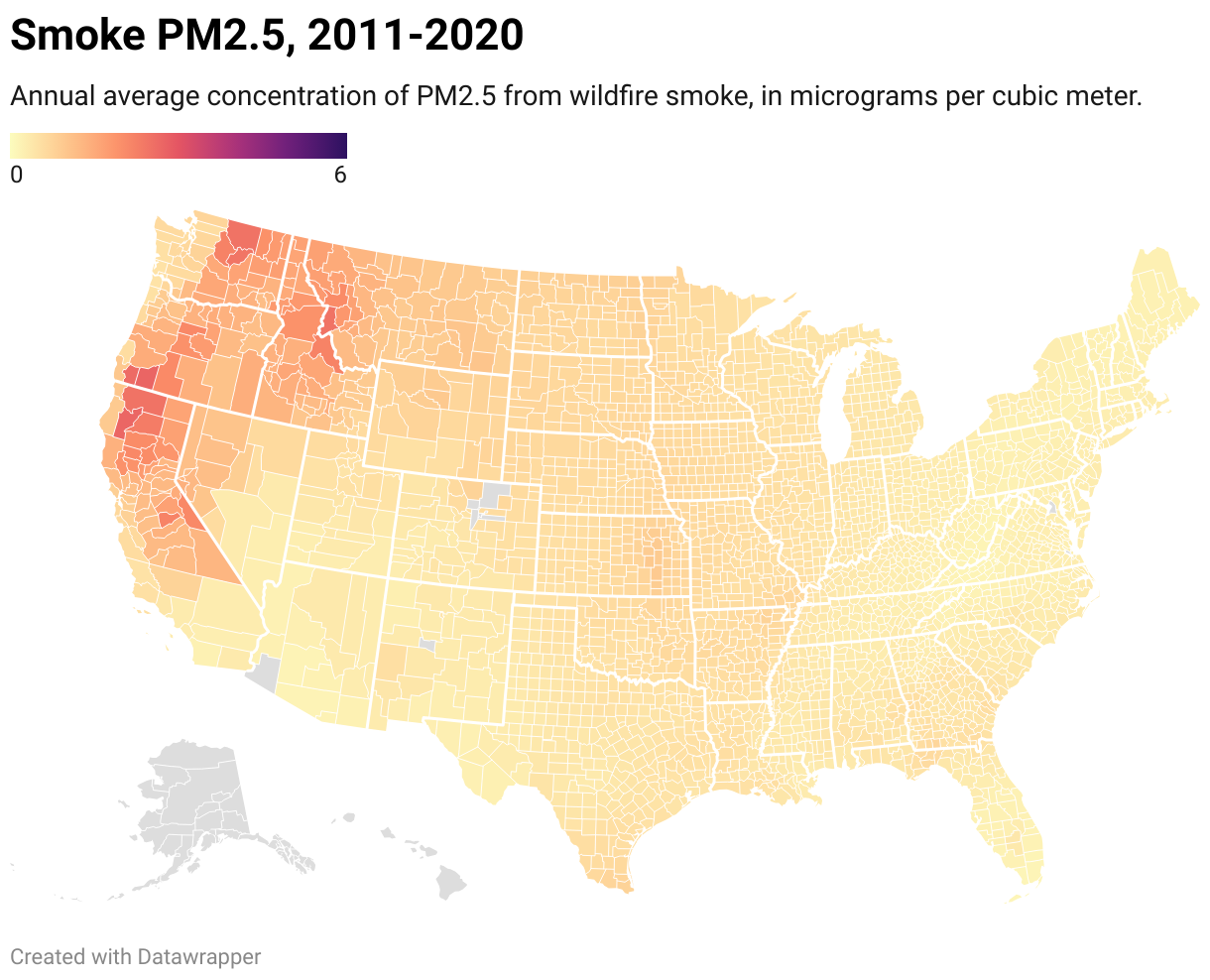
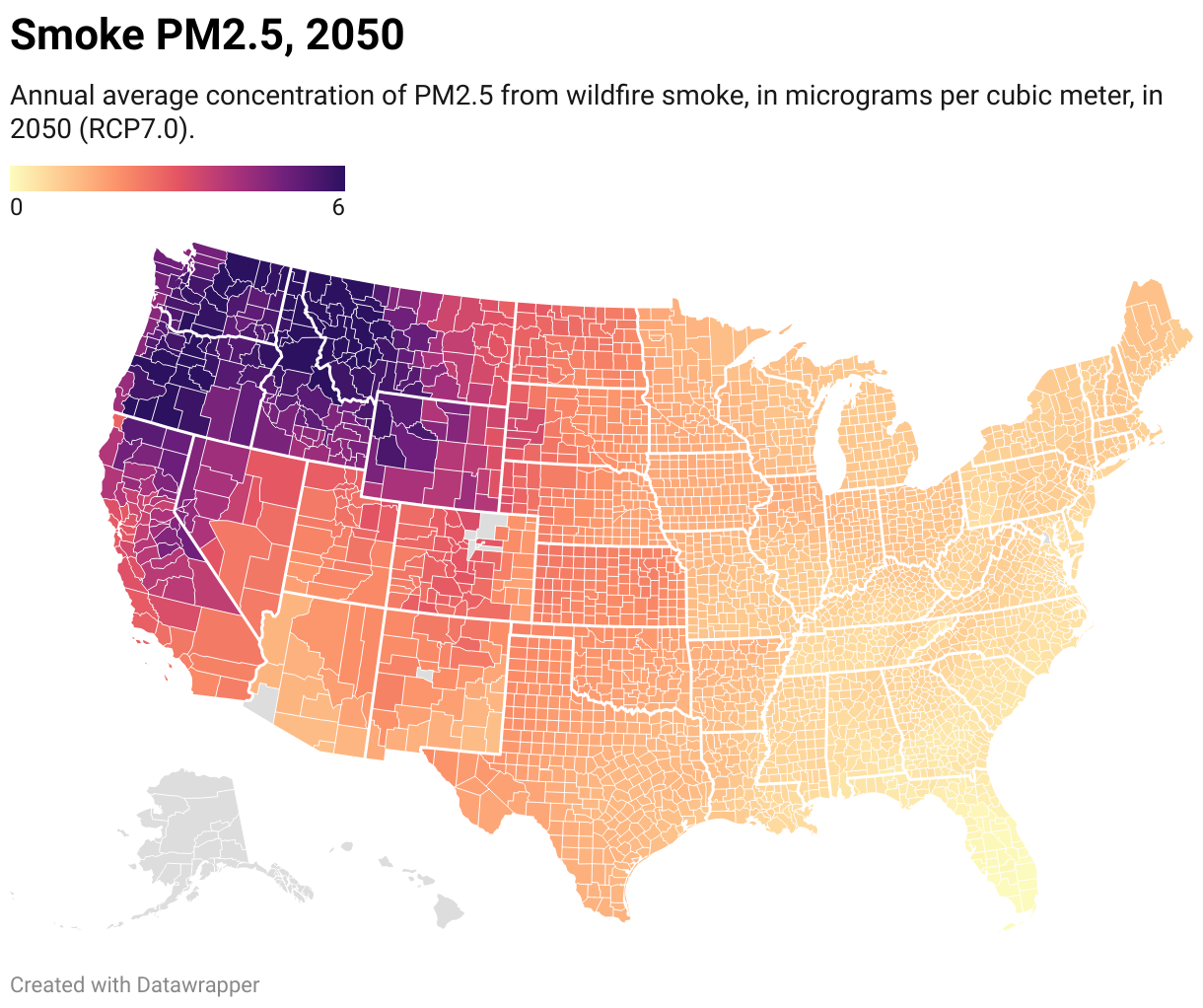
The researchers combined county-level data on all recorded U.S. deaths from 2006 to 2019 with measurements of ground-level smoke emissions, wind variation, and the movement of airborne particulate matter, using machine learning to predict how wildfire emissions changes in one area affected smoke concentrations in another. They linked changes in smoke concentrations to variation in historical mortality and used global climate models to project future fire activity, smoke levels, and health impacts under different warming scenarios through 2050.
The results show that excess deaths from smoke PM2.5 exposure under a business-as-usual emissions scenario could increase more than 70% to 70,000 per year from roughly 40,000 annual deaths attributed to smoke from 2011 to 2020. The largest projected increases in annual smoke exposure deaths occur in California (5,060 additional deaths), New York (1,810), Washington (1,730), Texas (1,700), and Pennsylvania (1,600).
Understanding climate impacts
By quantifying economic damage from smoke-related deaths, the findings uncover a hidden tax on families and businesses. The researchers found that even if the world cuts emissions rapidly enough to stabilize global temperatures below 2 C by the end of the century, deaths from climate-driven smoke exposure in the U.S. alone would likely still exceed 60,000 per year by 2050.
“If you look at the leading climate impact assessment tools that are used to inform policy, none of them incorporate how changes in climate could influence wildfire smoke and related human mortality,” Qiu said. “Our study shows climate models are missing a huge part of the climate impacts in the U.S. – it’s like leaving the main character out of a movie.”
A shared burden
Actions by public health officials and communities can mitigate this growing threat. For example, investing in better indoor air filtration can help reduce exposure for vulnerable individuals or communities. Prescribed burns or other fuels management approaches can help to reduce the severity of wildfires and resulting smoke waves.
“Our understanding of who is vulnerable to this exposure is much broader than we thought,” Burke said. “It’s pregnant people, it’s kids in schools, it’s anyone with asthma, it’s people with cancer. We look at one specific health outcome in this study – mortality – and unfortunately find a shared burden of exposure for individuals across the U.S.”
Explore environmental hazards in your county
Burke’s group at Stanford has created a public tool to help individuals and policymakers understand the environmental risks in their county, how these risks impact health and livelihood, how they are changing over time, and what actions and interventions can reduce these risks.
Developed with support from the Doerr School of Sustainability and Stanford Impact Labs, the new “Environmental Hazard Adaptation Atlas” includes information on risks from wildfire smoke and extreme heat and cold for all counties in the contiguous United States. The team plans to expand the atlas to cover additional countries and health threats in the coming months. Evaluation of risk-reducing interventions will also be updated over time as new evidence on intervention efficacy becomes available.
For more information
Burke is also a professor (by courtesy) of Earth system science; deputy director at the Center on Food Security and the Environment; and a senior fellow with the Stanford Institute for Economic Policy Research (SIEPR), the Woods Institute for the Environment, and the Freeman Spogli Institute for International Studies.
Additional Stanford co-authors include Jessica Li, a research data analyst at the Center on Food Security and the Environment; Renzhi Jing, a postdoctoral researcher in primary care and population policy; Makoto Kelp, a postdoctoral researcher in Earth system science; Jeff Wen, a PhD student in Earth system science; Mathew Kiang, assistant professor of epidemiology and population health; Sam Heft-Neal, a senior research scholar at the Center on Food Security and the Environment; and Noah Diffenbaugh, the Kara J Foundation Professor and Kimmelman Family Senior Fellow. Other study co-authors are from the University of California, San Diego, the University of Washington, Princeton University, the National Oceanic and Atmospheric Administration, and the National Bureau of Economic Research.
This research was supported by the Keck Foundation, Stanford’s Center for Innovation in Global Health, Stony Brook University, the Harvard University Center for the Environment, and the Stanford Research Computing Center.
The story was originally published by the Stanford Doerr School of Sustainability.
Writer
Danielle Torrent Tucker