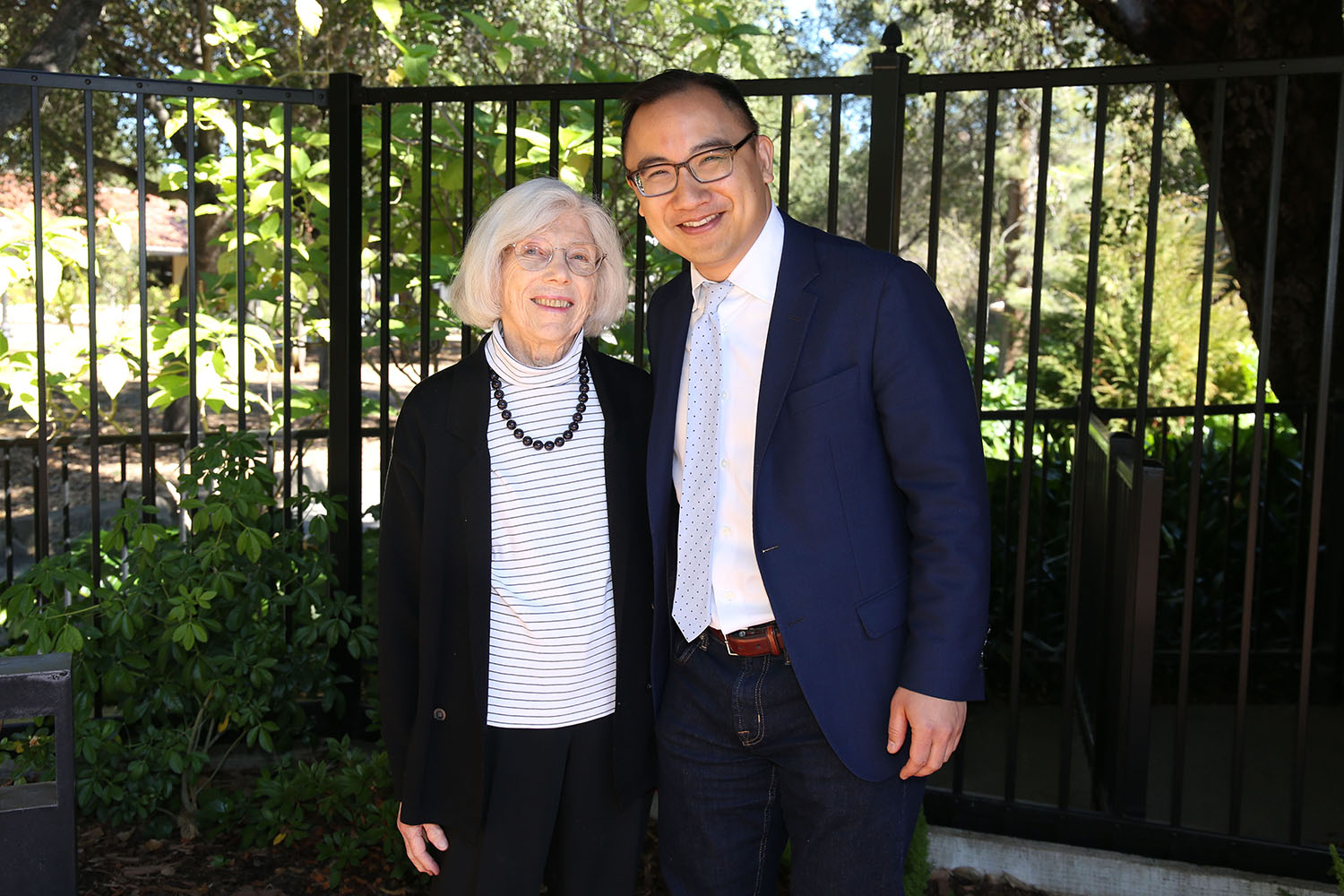
For David Chang, work and community service are deeply intertwined.
As the section chief of community partnerships in Stanford Medicine’s Primary Care and Population Health division, Chang helps place doctors in local clinics and connects medical students with research and service learning opportunities in the local community. He is also an assistant health officer in the San Mateo County public health department, and he treats patients in his primary care clinic on campus and in community settings including the Peninsula Healthcare Connection, Hotel De Zink, and Hope’s Corner.
“I like being able to practice in all of these different settings because it allows me to see everybody – all the people who are living and working in this community,” he said.
Chang, a clinical associate professor of medicine, shared what it’s like to treat patients in the town where he grew up, and the critical role of community partners in training the next generation of physician-leaders.
How did you become involved with community health at Stanford?
We have a program in our primary care division started by Sang-ick Chang, Baldeep Singh, and Jonathan Shaw in 2017, where we partner with local community health clinics that need doctors. It’s just sometimes hard to recruit and retain doctors to work in that very high-stress, high-volume, high-patient-needs setting. Then about five years ago, I started working at the Opportunity Center clinic at the Peninsula Healthcare Connection, seeing patients who were unstably housed or unhoused. That grew into leading a Stanford contingent of doctors who work there, and then to seeing patients in shelters.
And then the last bit is that it’s personal – I’m a member of this community. I grew up here. We go to church here. My kids go to school here. There’s some overlap between my personal life and serving folks at Hotel De Zink, which is a rotating shelter here in Palo Alto that our church supports. It’s really cool when work life and personal lives intersect.
How are Stanford students participating in this work?
I co-direct the community health scholarly concentration at the School of Medicine with Dr. Janine Bruce. We try to connect students with opportunities to do community research and service learning with organizations that work in community health, including homeless health care and social services spaces.
When I started working in the shelter setting, some medical students wanted to join me, so I invited them to come along. Then some of these students started their own groups working with community partners. There’s one group called the Stanford Housing Equity Project (SHEP), and they are making a tremendous impact in our community. They’ve formed relationships with LifeMoves, which is the largest shelter provider here on the Peninsula and in the South Bay, and United Effort at Hope’s Corner in Mountain View.

David Chang, clinical associate professor of medicine, engages Julia Li in a conversation about new opportunities in his program, which emphasizes public health initiatives for unhoused and low-income communities and fosters strong student participation. | Andrew Brodhead
We are now teaching classes around things like how to take care of folks who are unhoused. We have grant-funded research projects that the Office of Community Engagement has helped us fund to look into hard issues like substance use disorders and mental health disorders in shelter populations.
These are really cool things that I could never have planned as just one person seeing a need. Students are following and saying, “We want to learn and also want to engage meaningfully.” Then they are actually making a big difference.
What’s something you’ve learned about working effectively with local organizations?
You have to be thoughtful. You wouldn’t teach a class without planning how you are going to do it. You wouldn’t design a syllabus or start a research project without first understanding what’s been done and figuring out your methods and how you’ll do the analysis. It’s the same thing with working with the community. You have to figure out what is really of value to the community and partner with them to work on those issues together.
What’s an example of an issue you’ve worked with community partners to address?
Housing is probably the number one public health issue in the Bay Area – the cost of housing and zoning, people being displaced and people living on the streets or in their RVs, and all the downstream consequences, like substance use disorders, mental health disorders, and increased rates of chronic disease.
We are actually chipping away at it in a way that’s responsive to the needs of organizations, and so many groups at Stanford have contributed. The Haas Center for Public Service, the Office of Community Engagement, the Knight-Hennessy Scholars, and recently the Center for Innovation in Global Health have all supported this effort. It’s very cool to see how many different parts of campus have come together and sprouted all these different partnerships.
Students are saying, ‘We want to learn and also want to engage meaningfully.’ Then they are actually making a big difference.
How does this work make the Stanford community stronger?
Our students learn from working in community settings. And these clinical settings are absorbing our learners because they want to train clinicians who will understand how to work in underserved settings. The community partners are the ones working directly with many of these students and telling them what the needs are. Then research projects arise out of this. In some cases the interaction just continues and grows organically on its own.
Our engagement with the community has made the university better and stronger. I can’t say enough about how wonderful our community partners are. They’re playing an important role in advancing research and training the new generation of physician-leaders.
Writer
Chris Peacock