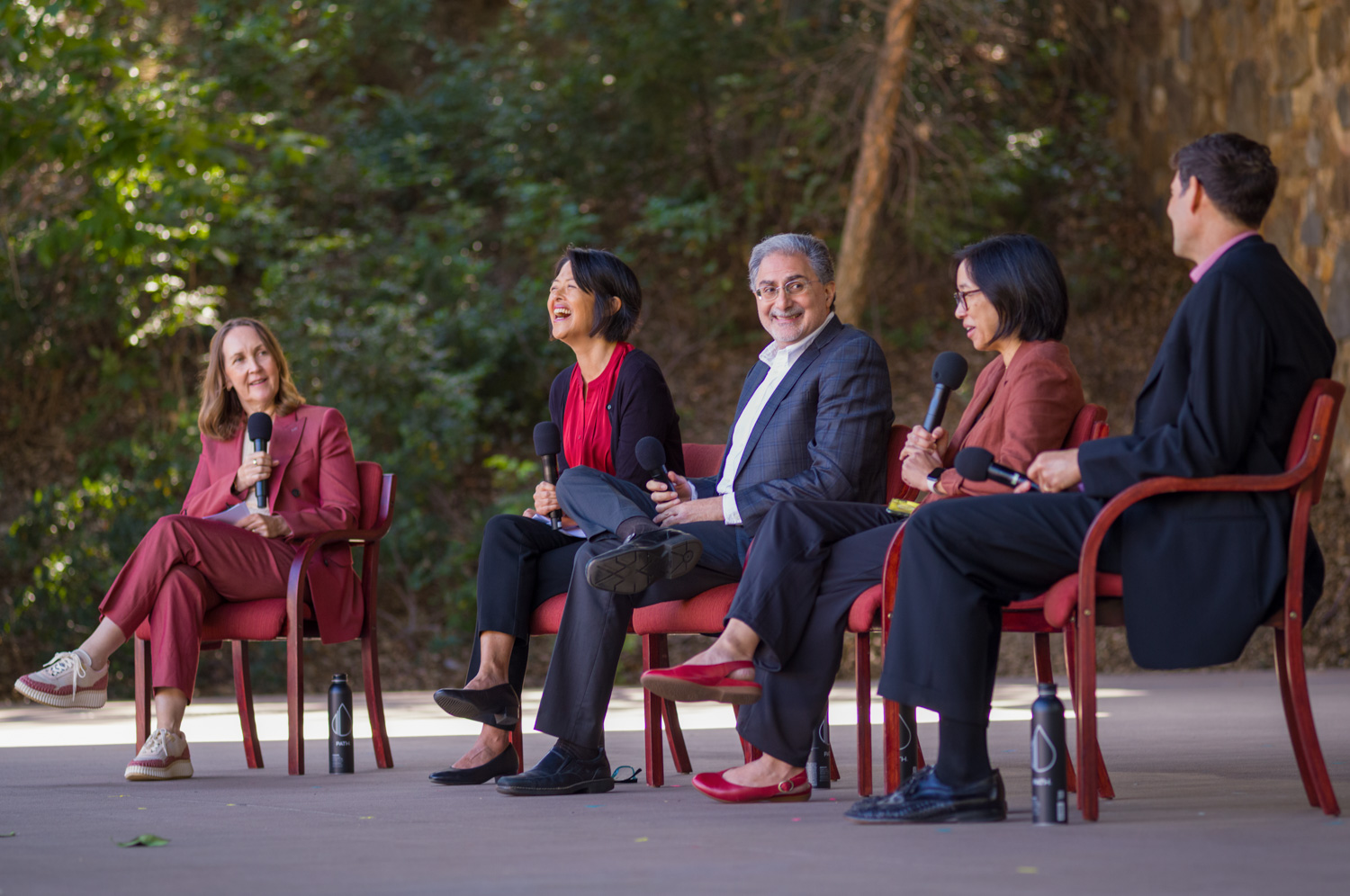

About half an hour into a conversation with Stanford Provost Jenny Martinez last week, retired Supreme Court Justice Stephen Breyer reached into his tan suit pocket and pulled out a small, folded copy of the U.S. Constitution.
“You will have to maintain the rights of the Constitution,” he told the audience in Memorial Auditorium, holding the document aloft for emphasis. “This isn’t mine anymore. This is yours. And what you do [with it] is up to you.”
It was a gesture he repeated several times during a wide-ranging conversation that touched on everything from Roe v. Wade and Brown v. Board of Education to the Little Rock Nine, Rosa Parks, Martin Luther King Jr., and Bush v. Gore. Breyer, who served on the Supreme Court from 1994 until his retirement in 2022, reflected on his undergraduate years at Stanford and emphasized the importance of civic responsibility, judicial independence, and listening to opposing viewpoints. He also offered advice to today’s students.
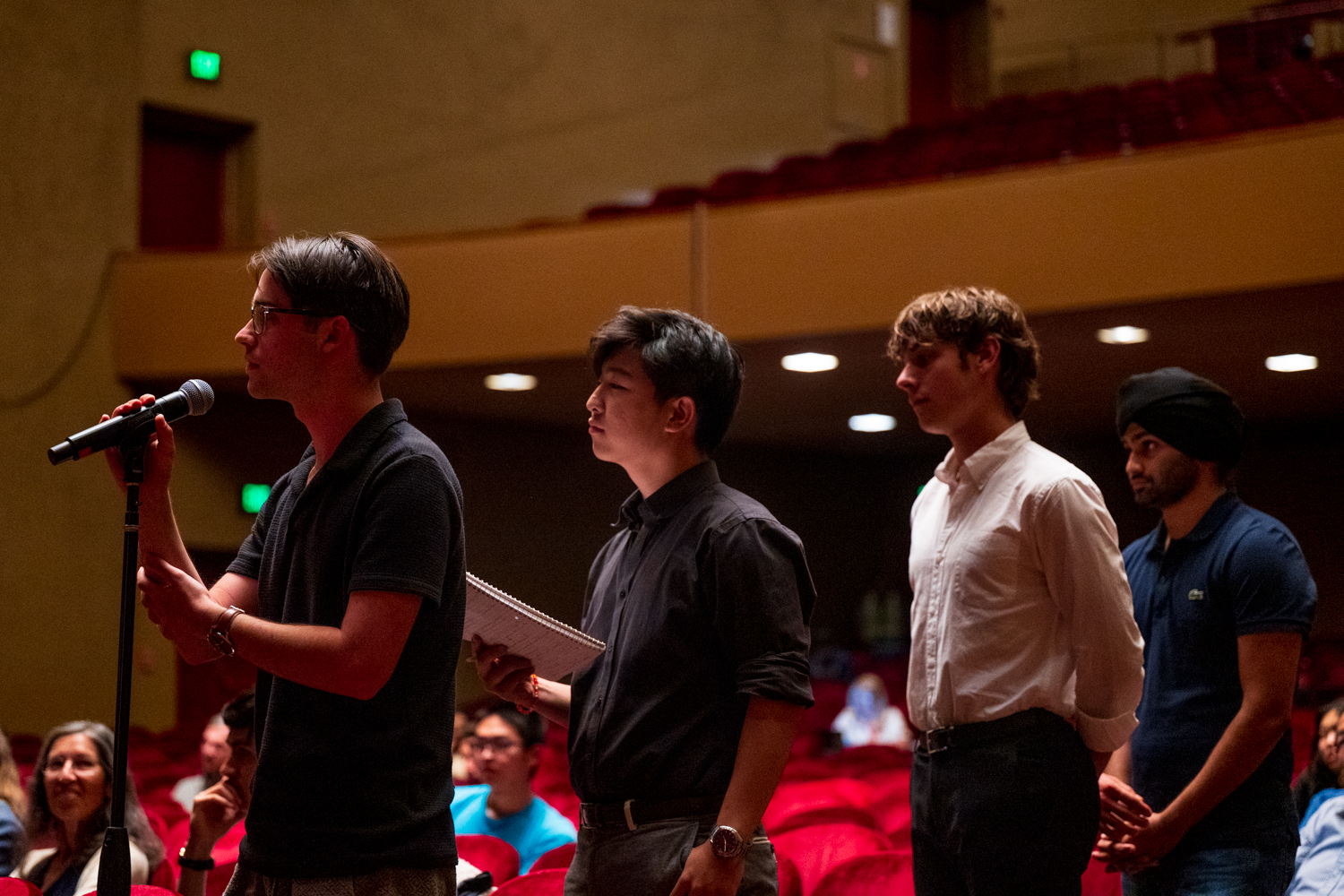
The May 22 event was hosted by the COLLEGE program and included a student Q&A following the conversation.
‘Your life will wrap itself around the decisions you make’
Breyer was born in San Francisco, where he grew up in a civically engaged family. His father was an attorney for the San Francisco Unified School District and his mother was active with nonprofit organizations, including the League of Women Voters. Breyer said the city’s diverse social fabric, though imperfect, encouraged interaction across ethnic and racial lines.
Breyer enrolled at Stanford and graduated in 1959 with a bachelor’s degree in philosophy, a field he said taught him about language and context in ways that later shaped his judicial career. He reflected on advice he received from Bayless Manning, former dean of Stanford Law School, who told him that, when it’s time to make a really important decision, about the job you want or whom you love, “you’re not going to know more than 2% of what you should know, and you can’t find out.”
“So the answer is lighten up. Relax. Make a decision,” Breyer recalled him saying. “It'll probably be a sensible decision, and your life will wrap itself around the decisions that you make.”
Breyer encouraged students to study a foreign language or literature to gain access to people, ideas, and attitudes they wouldn’t otherwise encounter, and urged them to not worry whether they’re pursuing the correct classes or career paths, “because there is no right answer.”
“Find something you actually like to do, and can do, and then work on that,” he said. “Mozart did that. That worked out for him.”
‘We don’t always agree’
Breyer studied at Oxford University and Harvard Law School, where he served on the faculty from 1967 to 1980. What drew him to the law, he said, was that it requires both intellect and empathy. “You have to have a head and you have to have a heart.”
Breyer also served in multiple roles on Capitol Hill, including as counsel to the U.S. Senate Committee on the Judiciary where he worked with Senator Ted Kennedy. Breyer described the legislature as a fast-paced and highly political environment where lawmakers are often occupied with the expectations of their constituents.
“[The judiciary] is a different world,” he said. “It’s not a political world.”
Referencing Harvard Law scholar Paul Freund, Breyer said the court’s decisions aren’t made according to the temperature of the day, but rather reflect the climate of the era.
On the Supreme Court, he said, judges have ample time to consider their cases. Once oral arguments have concluded, the justices retreat to a private conference to decide the case. “We don't always agree. We agree about 40% of the time,” he said.
When the nine justices are in conference, he said, “nobody speaks twice until everybody has spoken once. Very good rule for a small group.” And when the back-and-forth begins, Breyer emphasized that listening – rather than out-debating – is the key to productive discussion.
Breyer said that in the court’s private conferences, coming in with the mindset that your argument is better than someone else’s is counterproductive – others will pick up on it immediately and push back just as strongly. A more effective approach, he said, is to “listen to what they say and see if you can’t work with that.”
He shared advice from Senator Kennedy about approaching disagreements: when talking to someone you believe completely disagrees with you, listen carefully. Eventually, they will say something you can agree with. “As soon as that happens, you say, ‘What a good point you made.’ And, ‘Let’s see if we can work with that.’”
The goal, Breyer emphasized, is not to get 100% of what you want, but to make progress by finding areas of agreement, even if it’s just 30% or 50%.
What makes him optimistic about the work of upholding the rule of law going forward, he said, is that he sees that younger generations are interested in hearing about this process and learning about what they can do to move toward consensus.
Question and answer
Following the discussion, Breyer participated in a question-and-answer session with students. A student asked Breyer for his opinion on term limits for Supreme Court justices. “You can do it. No problem,” he said, noting that many other countries have them.
One student asked about the Supreme Court justices’ interpersonal relationships amid strong ideological differences.
“I’ve never heard in that conference a voice raised in anger,” Breyer responded. “I have never heard one judge say something insulting or rude, not even as a joke, about another. It’s very professional.”
He said relationships among the justices are good. “Does that mean I’m going to convince Clarence Thomas to join my next opinion? Probably not. But is he my friend? Yes.”
When a student asked what lesson from Breyer’s life or career he’d share with today’s generation of students, Breyer’s answer was simple: “Listen to people who disagree with you.”
Writer
Alex Kekauoha