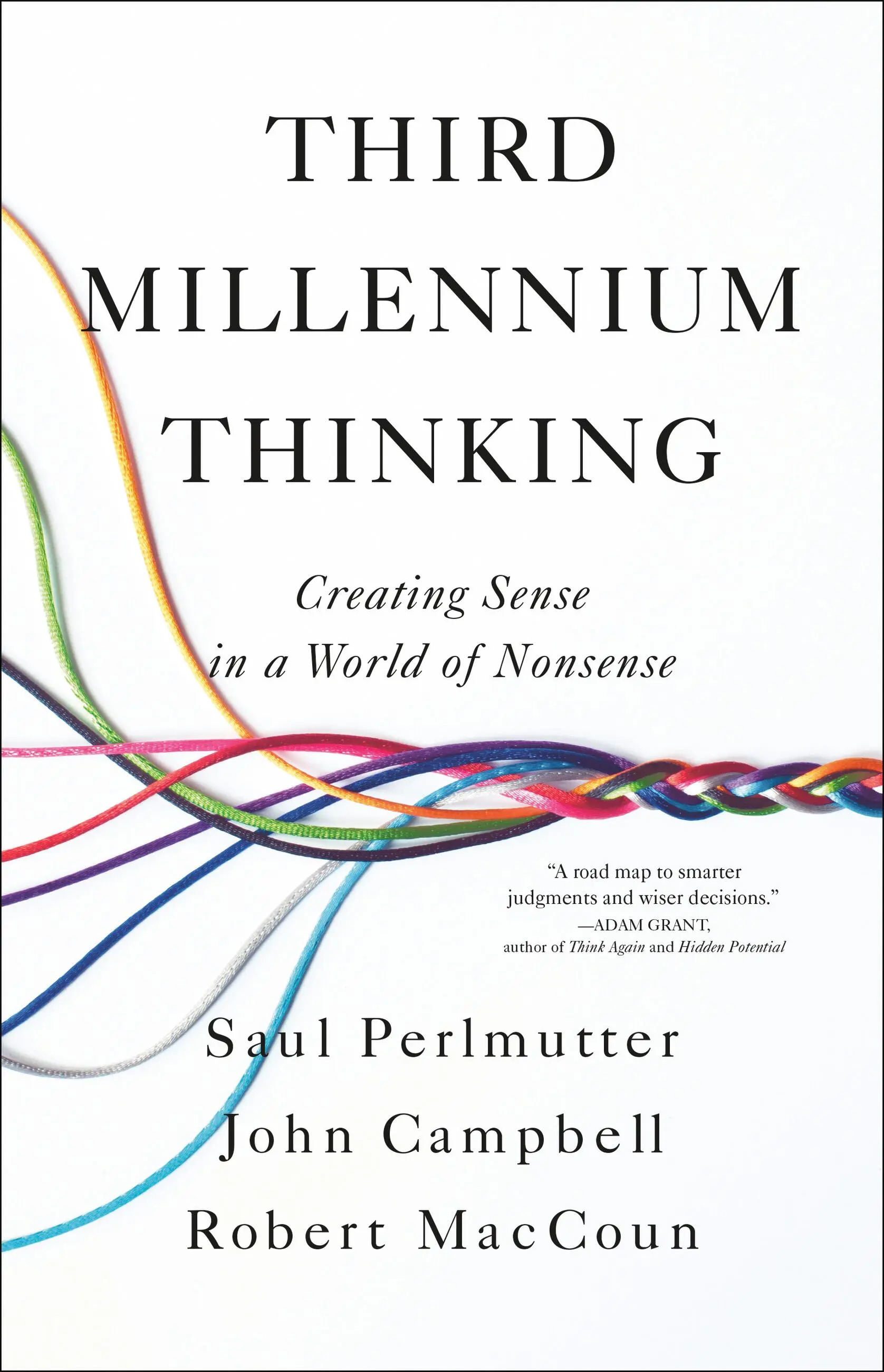
This excerpt is adapted from the book Third Millennium Thinking by Saul Perlmutter, John Campbell, and Robert MacCoun, with the permission of the publisher.
What is the longest time you’ve ever spent trying to solve an intellectually challenging problem or a puzzle? Is it ten minutes, two hours, a day, a month, a year, a decade? Most people we have asked have trouble thinking of examples of problems and puzzles they’ve spent more than a few hours on; perhaps, at most, a few days. But how many tough problems in the world can be solved in less than a few days? The world isn’t that easy! For that matter, less than a month doesn’t really do justice to a problem worthy of the readers of this book.
Sticking to a problem long enough to solve it is a challenge that comes in all sizes. How long are you going to keep trying to land a man on the moon if you are leading NASA in the 1960s? How long are you and your spouse going to keep trying to put together that IKEA cabinet for your study? (There aren’t that many ways to misinterpret the illustrations.)
The thing is, we humans are inherently lazy. It’s not our fault; we probably evolved that way to conserve our energy. And, oddly enough, it feels like we use a lot of energy to think hard, so we avoid it when possible, just like we avoid walking up a steep hill if we can go around it. But we generally need to think hard to solve important problems. Among other demands on our slothful brains, we have seen that it takes some appreciable mental work to recognize when we are likely to fool ourselves by mistaking a spurious pattern for a signal in noise, or to construct a list of possible sources of systematic uncertainty that will bias a crucial measurement.
To make things worse, not only are we lazy, but even one of our positive attributes, our wonderful curiosity about new things, exacerbates matters. After a day or so a problem doesn’t seem that new, and we’re inclined to move on to being curious about something else. In addition, while we apparently really like our curiosity to be rewarded by obtaining a new understanding of the world, and our desire for that reward is a good incentive for us to focus on a problem, we also get frustrated when we don’t make quick progress and get this reward after a minimum of effort – an unfortunate intersection of our curiosity with our laziness!
So what are we going to do about this very human inability to stick to a problem? This is where a rarely discussed, hidden tool of science comes into play. It consists of a simple mental trick that the culture of science invented along the way that we will call scientific optimism. This isn’t your everyday, garden-variety optimism. Scientific optimism is basically a can‑do spirit, the expectation that the problem at hand is going to be solvable – by you, or by you and your team. When a complicated problem comes along, you’re much more likely to solve it if you approach it as if that solution is within your grasp. Essentially, scientists have invented ways to fool themselves into believing that they can solve a problem, just long enough to actually do so – the one time in this book that the goal isn’t to avoid fooling yourself!
There are many examples in history where, apparently, people thought something was not doable, but then a rumor went out that somebody somewhere in the world had figured it out and suddenly lots of people were able to do it. They would start saying, “Wait, those folks know how to do it, it’s got to be doable,” and they would just keep trying. “Oh, maybe they did it this way … No, that didn’t work. Maybe it was this other approach …” Once they saw that it was possible to solve the problem, they found the motivation not to give up. And in the end, they may have figured out a completely different way of solving the problem than those who first solved it did.
Scientific optimism is basically a can‑do spirit, the expectation that the problem at hand is going to be solvable – by you, or by you and your team.Third Millennium Thinking
You can think of this as the mental equivalent of all those athletic records that people thought would never be broken, like the four-minute mile. We have all heard the stories of how these seemingly unbeatable human limits were almost routinely surpassed once one person finally showed it was possible. Translating this to our more cognitive problem-solving situations, simply imagine the difference between trying gamely to build a cabinet out of a box full of parts from various bits of discarded IKEA cabinets, versus building one from a new IKEA cabinet kit that several of your friends also bought and told you they had successfully assembled. Certainly, the second situation would keep you going much longer than the first. But the extra twist in scientific optimism is that we temporarily adopt the belief that we can succeed even when we don’t know that this is a complete IKEA cabinet kit that works, and in this way we give ourselves enough time to tackle a difficult problem. The scientists need scientific optimism because they are trying to reach new discoveries, but we all need it because we often have to approach problems without a guaranteed solution. (A dramatic contrast to scientific optimism is the phenomenon of “learned helplessness.” Apparently, both humans and other animals will give up on trying to resolve an uncomfortable or painful situation if they have too much experience of such situations being outside their control. Even if they could actually remedy the current situation, they have learned not to even try.)
One of the most amazing examples that we know of, of how thinking that a problem is solvable made it possible to solve, is Fermat’s last theorem. In 1637, mathematician Pierre de Fermat wrote this in the margin of a book:
“It is impossible to separate a cube into two cubes, or a fourth power into two fourth powers, or in general, any power higher than the second, into two like powers. I have discovered a truly marvelous proof of this, which this margin is too narrow to contain.”
For the next 358 years, mathematicians worked on this problem because they all thought, based on Fermat’s claim, that it was solvable. And in 1995, the problem was solved. Probably not at all the way Fermat did it, but it was Fermat’s confident claim that it was doable that kept people working on the problem – for 358 years!
Saul first started to notice the importance of scientific optimism as a graduate student. He was trying to choose a research group and came across one that had an amazing can‑do spirit that the professor leading the group, Richard Muller, had instilled. Any exciting project was fair game in Professor Muller’s group. There was a sense that if you needed a new tool, you could simply invent it. If you needed to build something, you built it. If you needed to learn a new area, a new field, you learned it, whether complex electronics or DNA manipulation techniques. This can‑do spirit inspired the group to enthusiastically take on a wide variety of problems and challenges. At that time, the group was working on a technique to measure the deflection of light bent by the gravity of Jupiter, inventing a mini tabletop cyclotron, measuring carbon in the atmosphere above the oceans to help understand the Earth’s carbon cycle, and developing the first automated telescope system to discover relatively “nearby” supernovae. This scientific tradition of being comfortable taking on whatever challenges a compelling problem presents is perhaps one of the greatest strengths that science offers us, whatever our walk of life.
Saul began his graduate student research with that last project, the automated supernova search. Eventually that project led to an even more challenging one when it became clear that the same techniques could be used to find vastly more distant supernovae that could reveal the history of the universe’s expansion – and predict its eventual fate. This was going to be an immensely challenging project. Saul and his team estimated it would take three years to find the dozens of such distant supernovae they needed to find in order to measure changes in the universe’s expansion rate. Three years later, zero of these distant supernovae had been found. (Tip: When at all possible, avoid fields where your success depends on clear weather!) After five years, the first one was discovered. After seven years, the team had really figured out how to do the project, and they were finding distant supernovae in batches of half a dozen or so. Nine years in, they had the dataset in hand, but still hadn’t figured out how to analyze it at the level required. After ten years, they had an answer – and a big surprise: the universe’s expansion is accelerating.
Interestingly, at every stage of the ten-year supernova project, the team was pretty sure that the project was doable. Scientific optimism did keep them going – but it is important to see how this works in practice. At every step of the project, the team could see what successes had been accomplished and what was needed next to keep moving toward the goal. This iterative advancement is key to so much of this can‑do story; it’s not that the scientists are counting on accomplishing their goal in one fell swoop.
Making progress on hard problems, problems that can take months, years, or decades, usually requires such iterative advancement, meaning we do better and better with each attempt and build on what we learned in the previous attempts. As we unpack some of the practical implications of scientific optimism, this concept of iterative advancement is one that should resonate with all planners. To illustrate with just one example: policymakers and legislators drafting a major welfare reform bill or education improvement bill or crime reduction bill could – and should – build into it the assumption that it will need to be iteratively improved every few years as we learn what works and what doesn’t. Such policy-updating mechanisms are not unheard of, but they are certainly not a prominent, visible feature of our government programs, at least in the United States. Perhaps if they were, we would have more of a sense of the degree of progress on any of these societal goals.
Copyright information
Adapted from “THIRD MILLENNIUM THINKING” by Saul Perlmutter, John Campbell, and Robert MacCoun. Copyright ©️ 2024 by Saul Perlmutter, John Campbell, and Robert MacCoun. Used with permission of Little, Brown Spark, an imprint of Little, Brown and Company. New York, NY. All rights reserved.