A few months before Diego Zambrano started law school in 2010, BP’s Deepwater Horizon oil rig exploded, killing 11 workers and causing the largest marine oil spill in U.S. history. Around 134 million gallons of oil flowed into the Gulf of Mexico, severely harming local ecosystems, businesses, and human health. In the aftermath of the disaster, Zambrano noticed that government agencies weren’t the only ones taking BP to court. More than 100,000 private plaintiffs filed nearly 3,000 lawsuits – most of which were later consolidated – that ultimately led to a $13 billion payout from BP and its partners.
“It was strange to observe these two things going on at the same time: robust federal government reaction and a bunch of lawyers independently pursuing their own cases,” says Zambrano, now a professor, faculty director of the Neukom Center for the Rule of Law, and associate dean of global programs at Stanford Law.
Zambrano later learned that Americans could sue companies for violations far beyond environmental law – even if they had not been directly harmed. Federal and state statutes allowed private parties to help enforce virtually every important area of regulation: employment, antitrust, civil rights, consumer protection, and more. No other country, he discovered, relied as much on private individuals and organizations – not just government bureaucrats – to deter bad actors.
“Americans realize that we have a lot of lawyers and that federal courts settle important controversies,” Zambrano says. “But I don’t think they realize that litigation is deliberately used by the state legislatures and Congress as a way to regulate misbehavior.”
In his new book, How Americans Enforce the Law (Stanford University Press, October 2026), Zambrano details how this unique system, known as private enforcement, came to be. Grounding his argument in comparative case studies, historical analysis, and artificial intelligence research, he outlines when this approach succeeds and when it can backfire. “Diego’s book is unique in the extent to which it is both precise and comprehensive,” says Amalia Kessler, MA ’96, PhD ’01, the Lewis Talbot and Nadine Hearn Shelton Professor of International Legal Studies and director of the Stanford Center for Law and History. “He offers a capacious account of how we arrived at the present moment and how our current approach to enforcement compares – for good and for ill – with those applied elsewhere.”
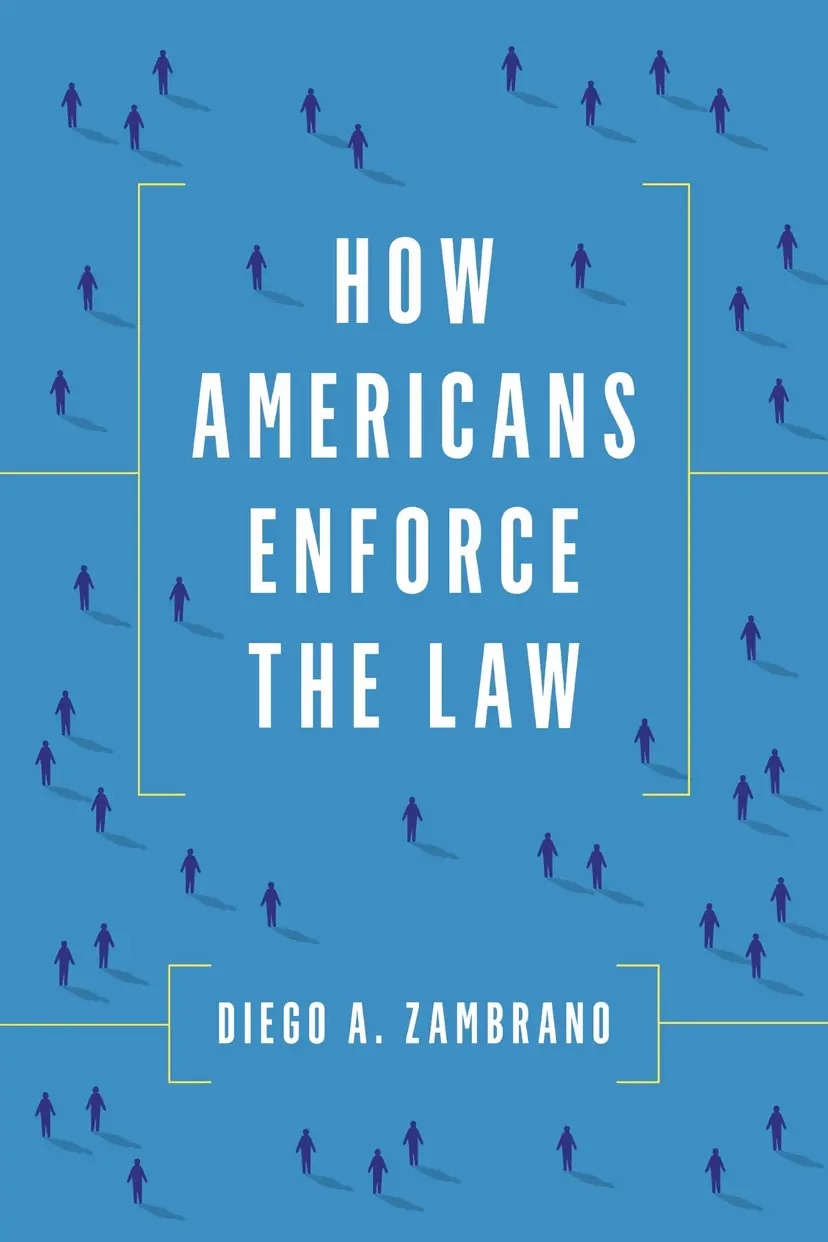
Stanford University Press, October 2026
When legislators pass laws in hopes of addressing societal harms, they typically enforce them in two ways: They task government employees with issuing rules and licenses, performing inspections, and filing legal actions, or they allow anyone to sue violators – not just to seek compensation for personal harm but also as a way to regulate misconduct. The United States does both, but Zambrano points out that the country is uniquely amenable to private enforcement – what he describes in the book as “a vast regulatory system hiding in plain sight.”
Using machine learning tools, Zambrano discovered that federal laws include more than 350 private rights of action. At the state level, he identified over 10,000. People can sue for major wrongdoing, from securities fraud to racketeering to discrimination, and for minor violations, such as selling mislabeled cigarettes or damaging a relative’s grave.
Many of these statutes are widely invoked. Zambrano’s book cites a study that found private parties filed an average of 165,000 lawsuits annually in the 2000s to enforce federal laws, a number that he notes has grown since then. “Across major areas of federal regulation, private parties are typically the main enforcers, filing 98 percent of civil rights claims, around 90 percent of antitrust claims, and a significant chunk of employment, environmental, and securities claims,” he writes.
Americans realize that we have a lot of lawyers and that federal courts settle important controversies. But I don’t think they realize that litigation is deliberately used by the state legislatures and Congress as a way to regulate misbehavior.
Private enforcement
Prior to Zambrano’s research, the dominant theory explaining the popularity of private enforcement in the United States pointed to the separation of powers: Legislators want the laws they pass to have teeth regardless of which party holds executive office. Yet, in a study Zambrano and his collaborators conducted, they found no evidence that state lawmakers are more likely to enact private rights of action when the governor is from a different political party than the legislative majority.
Instead, Zambrano posits that private enforcement has deep roots in U.S. history. Since medieval times, English law allowed citizens to sue under “penal statutes” that governed everything from alcohol sales to horses found roaming on public land. Plaintiffs could collect money even if they had not suffered personal injury as a result of a violation – it was enough simply to show that the public statute had been breached. Zambrano argues that lawmakers in the U.S. colonies and young nation continued this tradition because it was familiar and didn’t require a costly bureaucracy. In 1914, two landmark antitrust bills – the Clayton Act and the Federal Trade Commission Act – enshrined a norm of including both government and private enforcement in major statutes. An influential lawyers’ lobby reinforced this system, and powerful civil procedure tools – such as class actions and broad discovery powers – made private rights of action more formidable. “It has a self-sustaining nature,” Zambrano says. “You have layers building on each other.”
Zambrano takes a balanced view of private enforcement. “I celebrate it in some areas and critique it in others.” He argues that the system works well when it compensates for state agencies that are weak or compromised. Private litigants can react quickly, unearth information hidden from the government, and require no government funding.
Zambrano points to a 2024 federal law that required the Chinese company ByteDance to sell TikTok’s U.S. operations or face a ban. “Congress spoke overwhelmingly with bipartisan veto-proof majorities; the Supreme Court held that the law was constitutional; and the Trump administration simply did not enforce the statute. If you had a private right of action, that wouldn’t happen.” (In January 2026, ByteDance closed a deal transferring TikTok’s U.S. operations to a joint venture controlled by American companies.)
Wasteful lawsuits
On the other hand, private enforcement is triggered only after violations take place. This arrangement prioritizes private interests over public ones and lacks coordination. Furthermore, Zambrano argues that it can lead to costly, wasteful lawsuits that ultimately harm the public. He believes it has been particularly damaging in the sphere of environmental law. “We have litigation getting in the way of building housing, infrastructure, and mass transit,” he says.
Private enforcement can also be weaponized for political purposes. Zambrano refers to a 2021 Texas statute that allowed anyone to sue someone who had “aided or abetted” an illegal abortion. “It was unconstitutional then to regulate abortion, so it was a technical way of getting around the prohibition,” Zambrano says. “I’m completely against the bad faith use of private enforcement.”
Zambrano is currently researching the role of cultural factors, such as individualism and trust in government, in driving America’s unique system, as well as how elite lawyers and politicians view private rights of action.
“Most of the time, there’s a role for private enforcement,” Zambrano says. “What you’re looking for is getting the optimal amount.”
For more information
This story was originally published by Stanford Law School.
Writer
Katia Savchuk