You can learn a lot from an emergency drill at the SLAC National Accelerator Laboratory.
That was the idea on Wednesday, Aug. 19, when scores of employees from the SLAC National Accelerator Laboratory, volunteers, first responders, and local fire and law enforcement officials took part in an emergency drill to test their responsiveness to a hypothetical crisis.
Beforehand, employees were kept in the dark and did not know what scenario would unfold. It served as a reminder to prepare for the unforeseen, even with affiliated units. SLAC is a national laboratory operated by Stanford University for the U.S. Department of Energy. SLAC’s facility is located off Sand Hill Road in Menlo Park, about 2 miles from the university’s main campus.
Repeat, this was only a drill, but here is what occurred at 10:13 a.m. yesterday morning when Stanford first sent out an AlertSU (test only) update: “An explosion has been reported at the SLAC National Accelerator Laboratory. Emergency responders are headed to the scene.”
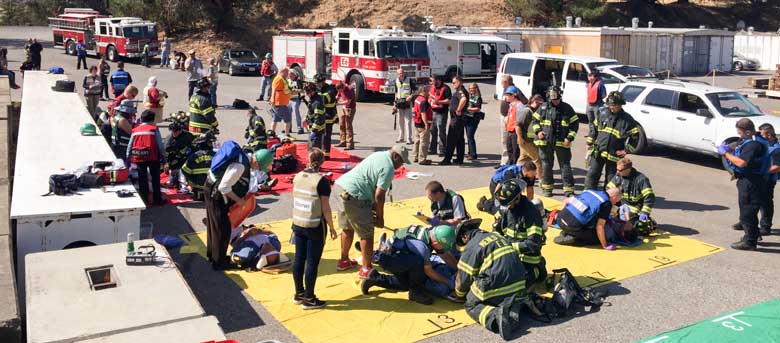
SLAC’s emergency operations kicked into action, with the help of a few units from the central university, and the drill began with volunteers being assigned different roles, as emergency, management and communications officials joined the effort, along with makeup artists who used some Hollywood-style special effects to dress up the “wounded victims.”
Soon after the “explosion,” a triage area was built in the parking lot outside the emergency room at Stanford Hospital – as a precautionary measure, two yellow decontamination tents were hoisted.
Ambulances drove in, and hospital workers carried off the victims on stretchers into the tents as medical workers and public safety officials milled about in their roles.
During a real crisis, the public and media are directed to visit the university’s emergency information website at emergency.stanford.edu. SLAC also has an emergency information site. The aim behind such emergency updates is to quickly post the facts people need to stay safe and informed.
By the time the event wrapped up shortly before noon, role-playing victims had been treated, and both SLAC and University Communications had sent numerous mock alerts and simulated social media postings.
The SLAC facility has 1,700 staff, and thousands of additional research scientists from around the world come to the facility to conduct research each year. A wide variety of research is conducted at SLAC. Current projects include efforts to discover new drugs, new materials for electronics and new means of producing clean energy.
Testing systems, training staff
Lance Lougée, the assistant fire marshal and emergency manager for SLAC who orchestrated the drill, said about 160 people total participated in it.
“It pays to test and validate systems,” he said. “Until you run a test, you don’t know what works and what doesn’t.”
Debriefings across SLAC and elsewhere continued through Wednesday afternoon, but for Lougée, the early takeaway lesson was this: “We have some very committed emergency responders.”
He noted, “People understood the importance of it. They don’t just give lip service to this.”
Brian Sherin, the director of SLAC’s environment, health and safety division, agreed: “This is all part of our preparedness plan. It went very well, the coordination was good.”
It was a chance to strengthen the public safety and communication bonds between Stanford and SLAC.
Stanford University spokeswoman Lisa Lapin said, “Our top priority is the safety and security of the Stanford community, and we want to be prepared to communicate effectively under any scenario.”
Every drill, said Lapin, the associate vice president for university communications, is a chance for Stanford to test its protocols, train new staff members and innovatively employ new technology to share vital information as quickly and accurately as possible.
Units involved in the emergency drill on Wednesday included SLAC’s communications, human resources, information technology, and director’s office units; the university’s office of Environmental Health & Safety; the Stanford Medical Center; U.S. Department of Energy liaisons; City of Menlo Park Office of Emergency Services; San Mateo County Emergency Management Services and Sheriff’s Office; Woodside Fire Department; Menlo Park Fire Protection District; Stanford University Communications; and officials from Lawrence Livermore National Laboratory, among others.
Author
Clifton B. Parker