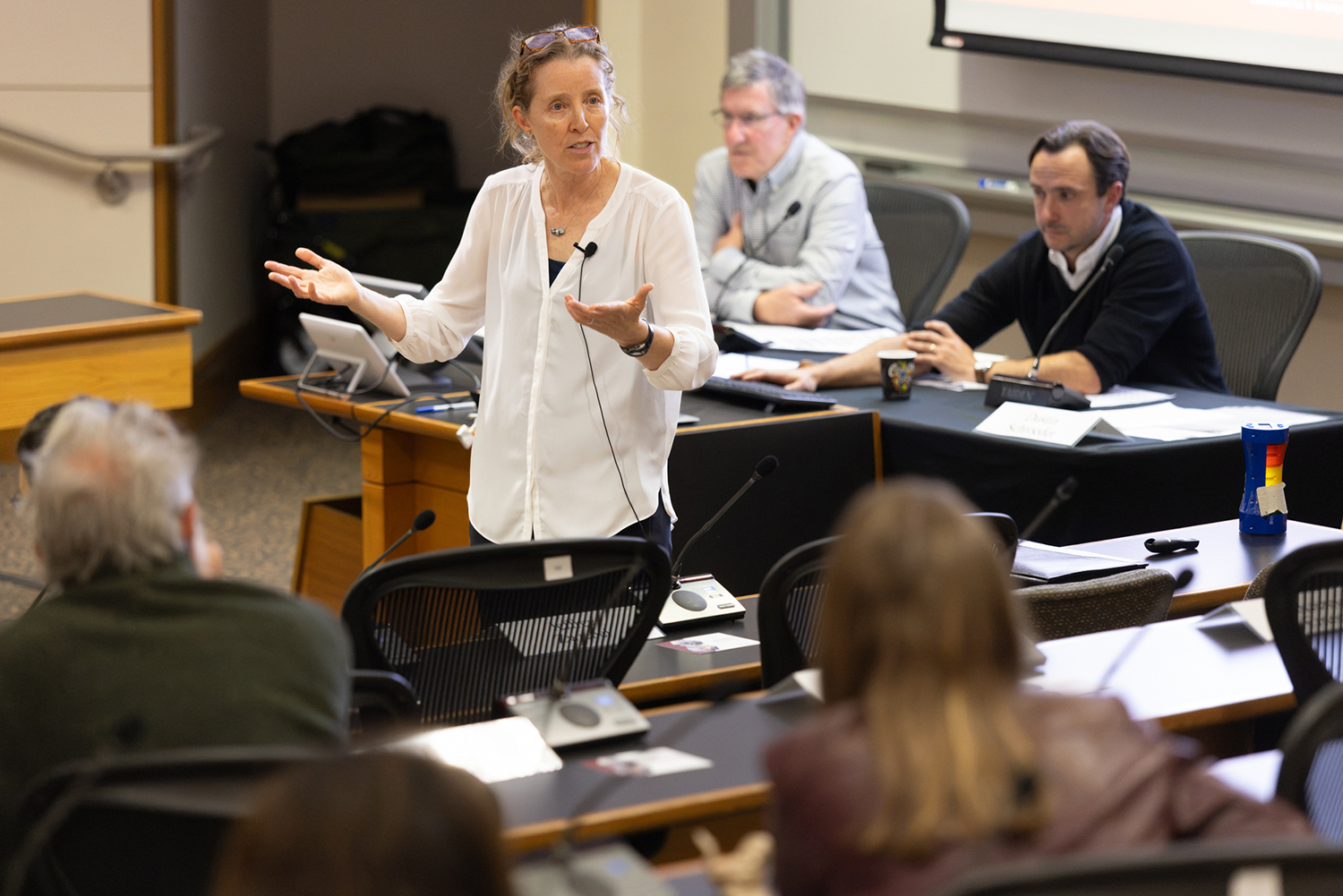
Stanford employees can learn more about the new Staff Career & Job Classification Program by reviewing the resources available on Cardinal at Work, a new online resource, which features a video overview, a glossary and explanations of the program components. (Image credit: Kathleen Hinkel)
In recent weeks, managers at Stanford have shared information about the university’s new Staff Career & Job Classification Program by delivering letters to their employees, reviewing new job descriptions, answering their questions in one-on-one conversations, and telling them about the new career self-management tools.
Managers have told employees about the many features of the new program, which goes into effect today.
They also have referred employees to the program’s online job description library, which provides information on more than 500 jobs, and includes charts showing the differences between positions within a job series, such as Graphic Designer 1, 2 and 3.
Nereyda Salinas, director of Stanford EdCareers, the career resources center at the Graduate School of Education, said the job series charts offer useful side-by-side job descriptions, including job title, core duties, and minimum requirements for the position, including education, job experience, knowledge, skills and abilities.
“Most of the people I oversee are classified at various levels of the student services officer positions, and the online library shows what delineates those positions,” Salinas said. “With the new program it’s easier to understand what’s required at each level. It also helps staff understand the responsibility level that merits a higher classification. The career progression is much clearer than ever before.”
Stephany D. Prince, manager of the Program in Science, Technology, and Society in the School of Humanities & Sciences, said the school’s human resources staff guided managers through the process of implementing the program.
“Our human resources team always performs at such a high level of excellence, so the process went smoothly,” she said. “Once we had the letters and job descriptions in hand it made it very easy to walk our employees through the new program.”
She said the main question staff members asked was whether the new classification system would affect their salaries.
Career Guidance Tools
When Stanford announced the program in March, University Human Resources (UHR) reinforced that salaries would not be reduced or otherwise changed as a result of the initiative. UHR also said the program also would not affect an individual employee’s job responsibilities, reporting relationships, current performance goals or “working titles,” the titles that appear on business cards and in the university directory.
Prince said the new program would help bring more consistency to the way jobs are classified across the university.
“I see this as a great step in the right direction,” Prince said.
Katie Dooling, a student services officer in Theater & Performance Studies (TAPS), said the job description library provides an easy way to see the career trajectory within student services, which has seven job titles with ever-increasing levels of responsibility, as well as seeing other job families on campus.
Dooling, who recently moved to TAPS from the English Department, said she was curious, but not concerned, about the new classification system.
“The new classification system was out before I started my new job, so I knew what was coming,” she said. “My new manager provided me with the official information, talked me through it and answered my questions, which was all very helpful.”
Where to find out more
In addition to the Job Description Library, staff members now have access to two sets of online tools: My Career Guidance, which includes self-assessments, planning tools and e-learning, and My Career Navigation, which offers potential career paths from one job to another. Staff also have access to a greatly expanded Career Counseling Network, where they can spend up to $500 of their annual $800 STAP funds to get private coaching and counseling related to their career goals at Stanford.
In coming months, UHR will expand its Career Services program to include career-development workshops, and networking opportunities to facilitate staff connections with other colleagues who share similar jobs or who are in similar phases of their careers.
Stanford employees can learn more about the new program by reviewing the resources available on Cardinal at Work, a new online resource, which features a video overview, a glossary and explanations of the program components.
In addition, Axess now includes a section, also called “Cardinal at Work,” on the “employee” tab with links to the online job description library, the new career tools and the staff classification structure.
Author
Kathleen J. Sullivan