
In brief
- Stanford researchers and collaborators at Renmin University of China found that China’s sharp 1990s fertility decline was driven in substantial part by stronger enforcement incentives, not just the one-child policy’s initial introduction.
- A policy called the one-vote veto, which tied local officials’ career advancement to meeting birth control targets, accounted for nearly half of China’s fertility decline during the 1990s.
- Researchers say the findings highlight how bureaucratic incentives, not just policy design, determine whether government policies change behavior at scale.
China’s one-child policy is widely considered one of the most stringent public policies in modern history. Yet researchers have long debated how much it actually contributed to the country’s dramatic fertility decline.
China’s fertility rate changed relatively little following the policy’s introduction in 1979-1980. It was not until a decade later in the 1990s that fertility fell sharply, dropping by more than one-third, from approximately 2.5 to 1.6 births per woman – below “replacement rate” fertility.
“China has experienced three major declines in fertility since the 1970s, but their timing does not line up neatly with the introduction of the one-child policy,” said Lingsheng Meng, PhD, lead co-author of a new study published in Nature and a senior research scholar at the China Labor, Income and Population (CLIP) research program at Stanford. “This raises an important question: What actually drove these declines, particularly the dramatic drop in the 1990s?”
The new research by Meng and colleagues at Stanford and Renmin University of China helps resolve this longstanding puzzle. They found that the delayed fertility decline was driven in substantial part by stronger incentives for local government officials to enforce the one-child policy.
The key was the introduction of the one-vote veto (OVV) policy, which strictly prohibited career advancement for local officials if they didn’t meet birth control targets, creating powerful personal incentives to enforce the one-child policy.
By comparing provinces that adopted OVV at different times, the researchers found that the policy accounted for nearly half of China’s fertility decline during the 1990s, helping push fertility below the replacement rate of approximately 2.1 births per woman.
The researchers also examined how stricter enforcement affected reproductive behavior. They found that OVV led to increased use of intrauterine devices (IUDs), particularly those recommended by local government officials. The study also documented an increase in induced abortions in later years following OVV implementation, although this increase did not closely coincide with the initial decline in births.
“For decades, one of the biggest puzzles about China’s fertility decline has been why the one-child policy appeared to have so little impact when it was first introduced, yet fertility fell sharply more than a decade later,” said Hongbin Li, PhD, a study co-author, a senior fellow at the Stanford Institute for Economic Policy Research (SIEPR), and a professor, by courtesy, of economics.
“Our research helps resolve this puzzle by showing that the policy became much more effective when local officials faced strong career incentives to enforce it,” said Li, who is also the faculty director of CLIP.
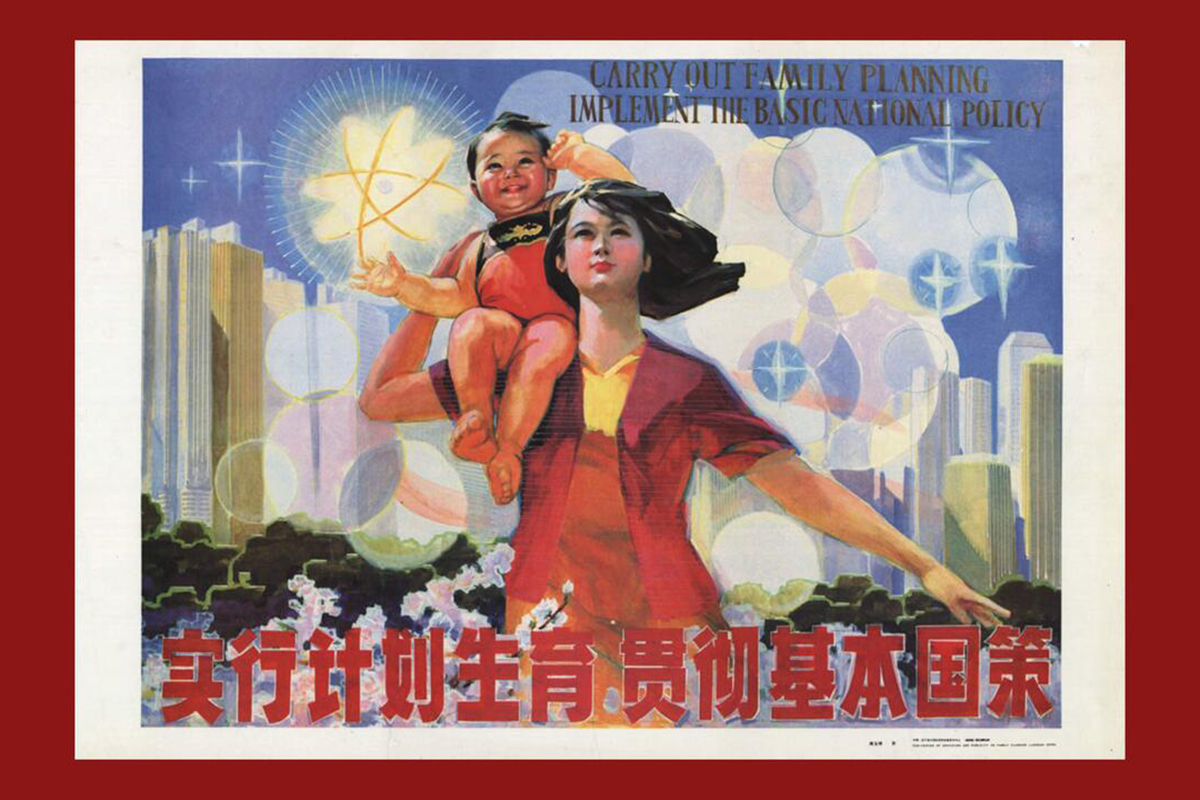
International Institute of Social History / Zhou Yuwei, 1986
One child per couple
China adopted the one-child policy out of a conviction among its leaders that population growth was going to swallow the economic gains they were making. The country’s population had nearly doubled in three decades, from about 540 million in 1949 to close to a billion by 1980, and planners projected the population could exceed 1.3 billion by 2000 if nothing changed. The policy remained in effect until 2015, when China’s central government raised the allowable number of children per couple to two; the country’s population today is around 1.4 billion.
The new findings highlight the powerful role of bureaucratic incentives in shaping public policy outcomes. Even a policy as stringent as the one-child policy may have limited effects without strong incentives for those responsible for implementing it.
The study also contributes to a broader debate about the causes of China’s fertility decline.
“While economic development and other social changes played important roles, we show that stricter enforcement of population policy accounted for a substantially larger share of the decline than much previous quantitative research had suggested, and more than population policy has been shown to explain in many other settings around the world,” said Grant Miller, PhD, another co-author of the Nature study. Miller is the Henry J. Kaiser, Jr. Professor in the School of Medicine, a professor of health policy, and a senior fellow at SIEPR and the Freeman Spogli Institute for International Studies.
Researchers have generally concluded that government population policies play only a small role in falling birth rates, with economic and social change doing most of the work. Even China, with the most aggressive policy in history, seemed to fit that pattern, since its birth rate barely moved for a decade after the one-child policy began. This paper argues that view is wrong: the policy had a large effect once it was seriously enforced.
“The broader lesson extends beyond population policy,” said Hanmo Yang, an assistant professor of population economics at Renmin University of China and a former Lazear-Liang postdoctoral scholar at Stanford’s Graduate School of Business. “We show that the effectiveness of government policies depends not only on their design, but also on the incentives of the officials responsible for carrying them out.”
For more information
This story was originally published by Stanford Health Policy.
Writer
Beth Duff-Brown