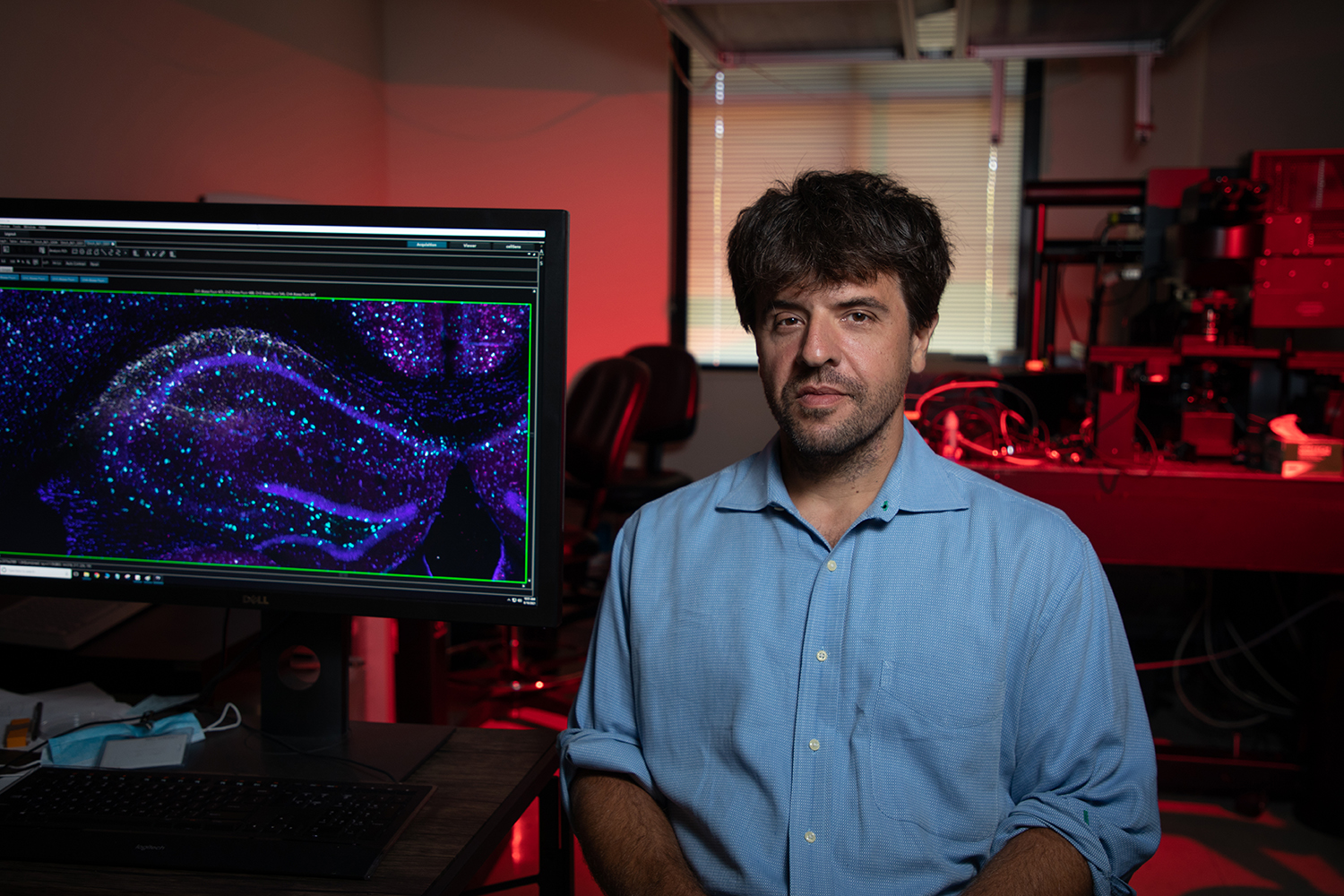
Karl Deisseroth, MD, PhD, has devoted the better part of two decades of his career to the development and promulgation of optogenetics, which has immeasurably improved scientists’ ability to probe the neural basis of sensation, cognition, decision, and action. He has identified new kinds of light-activated proteins called opsins from microbes, deciphered their high-resolution structures at the level of individual atoms, and discovered how these structures give rise to properties of ion flow in response to light.
Now a professor of bioengineering and of psychiatry and behavioral sciences in the Stanford University schools of medicine and of engineering, Deisseroth was one of three scientists who won the Nobel Prize in physiology or medicine Monday for their work in optogenetics.
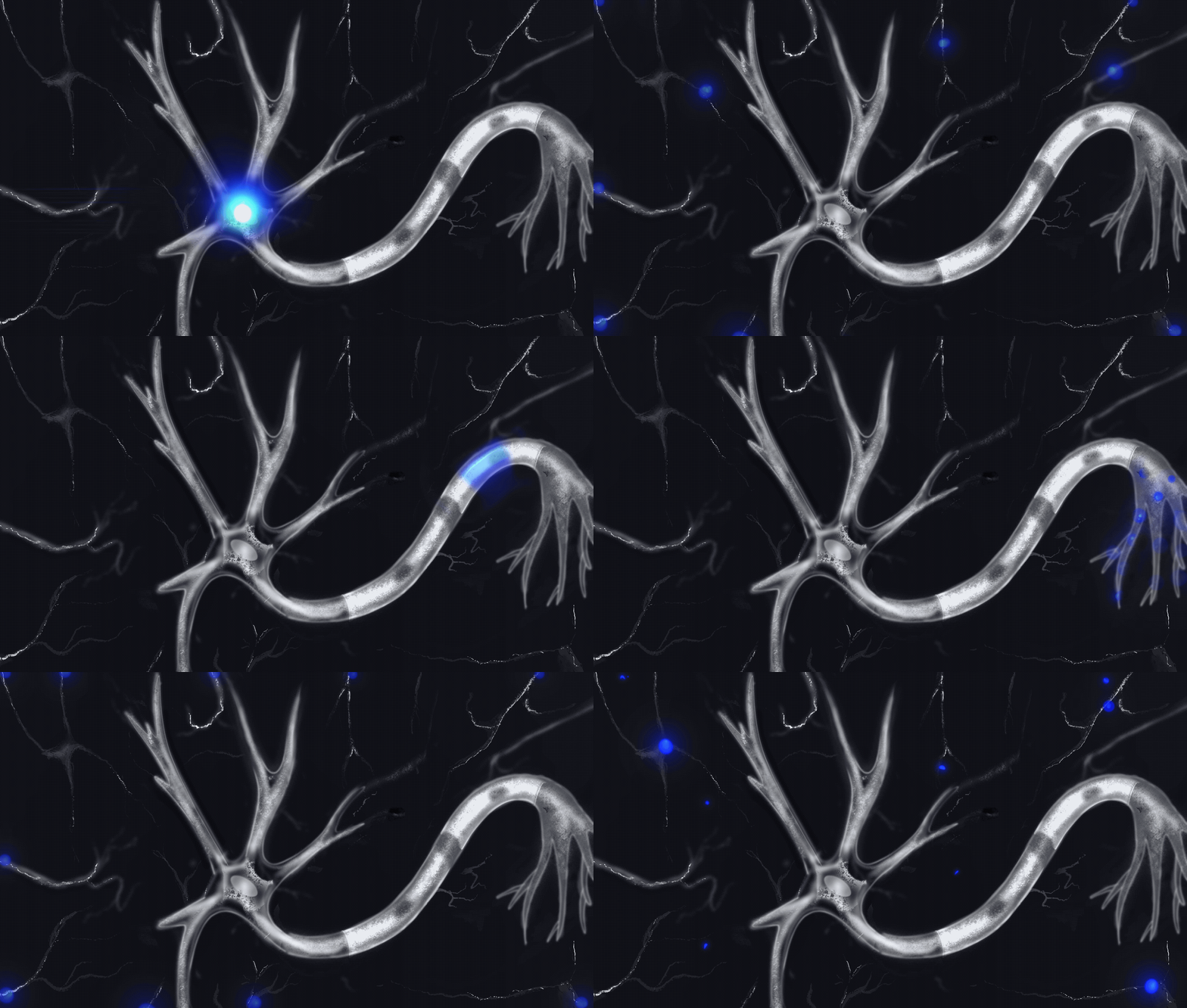
He has spearheaded ways to position these proteins on the surfaces of specific neurons so they can be independently activated or inhibited in a fraction of a second by pulses of laser light. He has also designed a method of delivering those light pulses via fine fiber-optic cables surgically implanted in the brains of living animals, making it possible to watch their behavior change at the flip of a switch.
Light-activated proteins can be activated or inhibited with pulses of laser light. But making it all work was a challenge, explains new Nobel Prize laureate Karl Deisseroth. | Emily Moskal
Opsins are pore-like proteins that open in response to particular wavelengths of light, allowing currents consisting of electrically charged particles to flow either in or out (depending on the particular type of opsin) across cell surfaces.
In 2004, Deisseroth and a pair of graduate students began work on the optogenetics project. In theory, opsins were made to order for Deisseroth’s approach. In practice, few had tried it and nobody had pulled it off, for plenty of reasons.
In living cells, proteins are created using recipes carried on genes. These days, plucking a gene (say, for an opsin) from one organism and plunking it into another organism’s genome is a standard technique. But getting that gene into a living organism’s brain without deleterious consequences is hardly a no-brainer. And it doesn’t guarantee the protein the gene specifies will get made. (All your cells have virtually the same DNA inside them, yet skin cells, for instance, make entirely different batches of proteins than liver or blood cells do.)
Plus, the opsin molecules have to show up not just anywhere inside of neurons, but on their surfaces where all the electronic impulse-passing action is. Proteins aren’t pets. Once made, they don’t simply go where you want them to because they love to make you happy. They go where myriad biochemical imperatives direct them. Whether microbial opsins would really wind up on the surfaces of mammals’ neurons – the only place where they could do any good – would be a bit of a crapshoot.
On top of all that, proteins are complex and finicky, working well only under the right conditions (heat, acidity, and the companionship of chemicals called cofactors). Mammalian cells’ biochemistry differs in numerous ways from that of microbes. Would an opsin molecule work as well in a mammalian neuron as it does in a pond-scum cell?
Another nail-biter: Microbial proteins on mammalian cell surfaces are sitting ducks. If the immune system, which abhors foreign substances, sees them, it just might chew the neurons they’re sitting on into shreds, or at least produce profound inflammation.
It added up to one risky proposal. “I was turned down for funding by a lot of people who thought this couldn’t possibly work,” said Deisseroth, the D. H. Chen Professor. “They figured if it worked it would have been done already. People had known about opsins for decades.”
But he wanted to take a shot at it.
Deisseroth’s team surmounted every hurdle. They succeeded in virally delivering opsin-encoding genes into rodents’ nervous tissue. They were able to restrict opsins’ production to neurons, or even just a selected type of neuron. The protein popped up on nerve-cell surfaces as hoped, and they bioengineered it further so it would do so more readily.
Optogenetics is routinely used in thousands of labs all over the world. But the creativity, precision, and persistence that lit the sparks of this technology and brought it into being should not be taken for granted.
Writer
Bruce Goldman