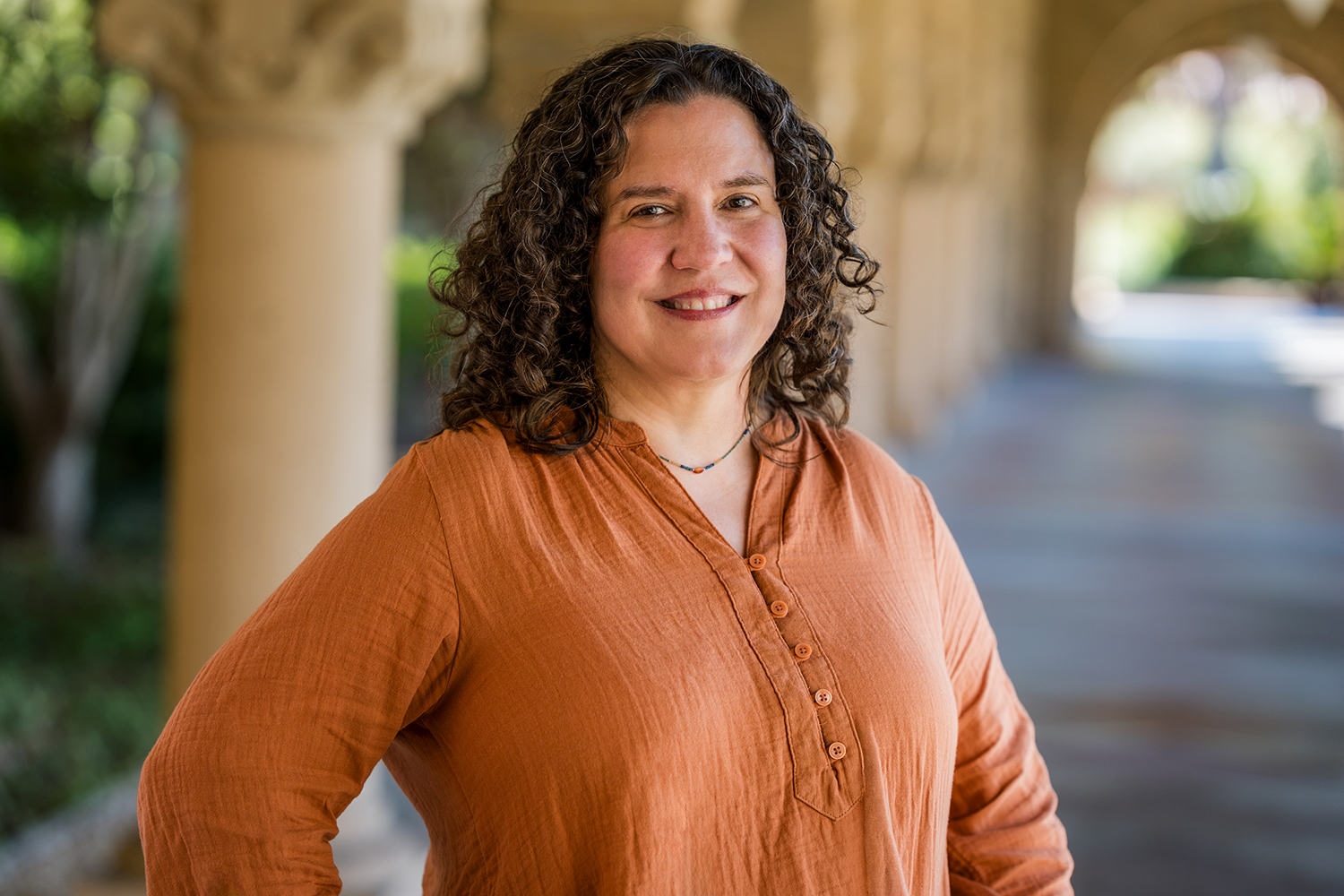
Lara Tiedens, a former Stanford University professor and president of Scripps College, has accepted an appointment as director of the Center for Advanced Study in the Behavioral Sciences (CASBS). Tiedens takes a position endowed in 2015 by Sara Miller McCune, the philanthropist and founder of Sage Publishing, and will hold the title of Sara Miller McCune Director. Tiedens begins her tenure as permanent director on Sept. 1, 2026, following a year as CASBS interim director.
“Lara’s expertise in the behavioral and social sciences, coupled with her outstanding experience leading academic institutions, positions her perfectly to lead CASBS at this moment,” said David Studdert, Stanford’s vice provost and dean of research. (CASBS is a unit within the vice provost and dean of research office.) “She has already proven that in her year as interim director, and I am confident that in this permanent role she will continue to make CASBS a leader in producing and translating world-class social science research.”
Tiedens begins her tenure with deep knowledge of the center’s landscape and operations. She spent a year in residence as a CASBS fellow in 2008-09. She joined the center’s board of directors in 2023, serving as co-chair of its development committee. As the 2025-26 interim director, she was deeply involved in the fellows program. In an end-of-year tribute, members of the class wrote, “Her visionary leadership in the behavioral sciences and her expertise in creating an intellectually vibrant and socially impactful environment for behavioral scientists to thrive are exceptional.”
As CASBS interim director, Tiedens conceived, launched, and advanced three successful initiatives. One is a practitioner fellow program in which nonacademics who use behavioral science in their work join the traditional fellows class and serve as a bridge between social science inquiry and pressing real-world challenges. The 2025-26 pilot of the program continues this year; five practitioner fellows are part of the 2026-27 cohort. A second initiative, CASBS Convenes, augments the center’s legendary convening power by providing and hosting more social and behavioral sciences-related workshops and conferences, bringing a wider set of scholars, practitioners, and changemakers to the center. During the spring of 2026, CASBS Convenes delved into an array of topics including science and democracy, belief change, the risks associated with chatbot relationships, and human rights data. Third is the introduction of a summer institute, the Institute on AI Methods for Social Scientists, for which Tiedens served as co-director. The inaugural field-building institute, held in July 2026, featured world-class presenters, attracted hundreds of applications for 22 participant slots, and has already spurred multiple interdisciplinary projects that will advance the use of AI in the social sciences.
“CASBS has always been where behavioral science does its most ambitious thinking, and I’m honored to lead it into its next chapter,” said Tiedens. “We’re at a moment that demands the rigorous interdisciplinary approaches CASBS brings to understand the problems of an information-challenged age, the shifting relations between humans and machines, and the pressures facing democracies. I’m excited to build on the momentum of this past year and am grateful for the confidence the board and the university have placed in me.”
Lara Tiedens is a social psychologist, earning a PhD at the University of Michigan. She served on the faculty of the Stanford Graduate School of Business (GSB) for 18 years, the last 10 as the Jonathan B. Lovelace Professor of Organizational Behavior, and the last four as senior associate dean of academic affairs. Her research explores the psychological dynamics that produce and maintain interpersonal social hierarchies, the ways in which emotions influence and are influenced by social roles, and the effects of emotions on decision-making. Her most recent work bridges behavioral science with emerging technology, investigating AI’s capacity to diagnose social relationships and group dynamics. Her research has been published in leading journals, including Journal of Personality and Social Psychology (where she also served as an associate editor), Journal of Experimental Social Psychology, Organizational Behavior and Human Decision Processes, and Administrative Science Quarterly. She co-edited the book The Social Life of Emotions (Cambridge University Press, 2004). In recognition of her contributions to the science of personality and social psychology, she was named a fellow of the Society for Personality and Social Psychology.
Tiedens also brings extensive experience leading higher education and research institutions. She served as the Morgan Stanley Director of Stanford GSB’s Center for Leadership Development and Research from 2011-12, then served as GSB senior associate dean of academic affairs from 2012-16. In 2016, she became the ninth president of Scripps College in Claremont, California, assuming the title of the W.M. Keck Foundation Presidential Chair. While at Scripps, Tiedens created the Centennial Strategic Plan for Scripps College, completed the largest campaign in the college’s history, redesigned financial aid, spearheaded racial equity initiatives, and formed new partnerships to advance science and technology education and community engagement. From 2021-24, she served as executive director of Schwarzman Scholars, a postgraduate program inspired by the Rhodes Scholarship and designed to build a community of future leaders who will deepen understanding between China and the rest of the world.
In addition to her service on the CASBS board, Tiedens’ additional board and trustee experience includes the Center for Creative Leadership, The Claremont Colleges, AlixPartners, IES Abroad, and the Webb Schools.
“Lara combines scholastic accomplishment and a stellar track record as an academic leader, including her recent leadership of the Center with distinction,” said Abby Smith Rumsey, chair of the center’s board of directors. “We are confident that Lara is the right person to lead the center into the future, extending its reach during a time of tremendous challenges and opportunities. The board welcomes her appointment and looks forward to working with her.”
For more information
This story was originally published by Center for Advanced Study in the Behavioral Sciences.
Writer
Mike Gaetani