
When Emmanuel Mignot, MD, PhD, began studying narcolepsy four decades ago, sleep and its disorders were not considered serious subjects of scientific inquiry. His long, curly hair and the fact that he spent his days, and some of his nights, in a basement laboratory tending to a colony of very sleepy pooches didn’t burnish his reputation.
But years of dogged pursuit, unflagging curiosity, and compassion for patients living with narcolepsy eventually yielded a series of discoveries that have clarified our understanding of sleep and wakefulness.
Mignot, now the Craig Reynolds Professor in Sleep Medicine and director of the Center for Narcolepsy at Stanford Medicine, will receive this year’s Albert Lasker Basic Medical Research Award, one of the most prestigious science prizes in the world. He shares the prize, and the $250,000 honorarium, with Masashi Yanagisawa, MD, PhD, of the University of Tsukuba. They are honored for discovering that the absence of orexin, a brain peptide that maintains wakefulness, causes many cases of narcolepsy.
An estimated 1 in 3,000 people suffer from Type 1 narcolepsy, a neurological disorder characterized by excessive daytime sleepiness and rapid transition into REM sleep, the sleep phase in which dreams occur. People with the condition also have sudden attacks of muscle weakness, known as cataplexy, that can be triggered by strong emotional excitement. The lack of orexin – which Mignot discovered is due to the autoimmune destruction of orexin-producing neurons in the brain – is the crux of Type 1 narcolepsy. (The causes of Type 2 narcolepsy, distinguished by no cataplexy, are less well understood, though some patients go on to develop Type 1.)
Today, narcolepsy is often diagnosed in childhood or young adulthood. But when Mignot entered the field in the late 1980s, many adult patients he saw in clinic had spent decades undiagnosed, their symptoms blamed on laziness and weakness of will. The disorder was thought to be extremely rare, and few treatments existed beyond stimulants and antidepressants. Mignot’s work helped open the door to a new understanding of narcolepsy and better ways to treat it. Among them is oveporexton, the first medication that mimics the effects of orexin in the brain, giving patients with Type 1 narcolepsy near-normal levels of wakefulness. It was approved by the U.S. Food and Drug Administration in August 2026.
“Dr. Mignot’s pioneering research has transformed the field of sleep medicine and provided hope to the millions of people globally living with narcolepsy,” said Lloyd Minor, MD, the Carl and Elizabeth Naumann Dean of the School of Medicine and vice president for medical affairs at Stanford University. “His work illustrates the promise and potential of curiosity-driven research, dedicating decades to an intractable problem before uncovering the protein at the center of the mystery. It is a remarkable and inspiring story of science in action – one befitting this prestigious honor.”
Searching for a narcolepsy gene in dogs
In 1989, Mignot embarked on a search for the gene that causes narcolepsy in dogs. He was a visiting assistant professor working in the lab of the late William Dement, MD, PhD, known as the father of sleep medicine. Dement had raised a colony of dogs that shared the hallmarks of Type 1 narcolepsy in humans: excessive sleepiness and cataplexy. A particularly funny joke can trigger a person with the disorder to go limp for several seconds. In the dogs, the same thing happened when they played together or were offered their favorite food.
In certain dog breeds, including Dobermans and Labradors, canine narcolepsy was clearly a genetic disease caused by a recessive gene – a puppy had to inherit two copies of the mutated gene, one from each parent, to develop the disorder. That wasn’t the case in humans, where there were clues that the disease had immunological origins. Nevertheless, and despite his skeptics, Mignot was determined that finding the narcolepsy gene in dogs would reveal something essential about the disease in humans.
“If that gene could be identified, it would provide insight into the mechanisms underlying hypersomnia, cataplexy, and other abnormalities related to REM sleep,” said Seiji Nishino, MD, PhD, emeritus professor of psychiatry and behavioral science who was then a postdoctoral fellow in Dement’s lab. Nishino collaborated closely with Mignot on narcolepsy for many years. “We shared the conviction that this was an important question that someone needed to solve, whether or not it was us.”
Hunting for an unknown gene was a daunting endeavor at the time, long before there were fully sequenced genomes of any animal. It was one year before the Human Genome Project was even underway.
“Probably it was a little bit of naïveté because I was not a geneticist,” Mignot said. “I was trained as a psychiatrist, but I became a geneticist. It took me 10 years to find the gene.”
It was like looking for a needle in a haystack, except you didn’t know what a needle looked like. Scientists didn’t have a map of the genome, only a selection of genetic markers, like random signposts they had identified throughout the genome. Mignot employed positional cloning, a painstaking method that involved comparing these genetic signposts among many dogs with and without the disease, gradually narrowing down the location of the gene, first to a particular chromosome, then to smaller and smaller regions on the chromosome until it was pinpointed.
I was trained as a psychiatrist, but I became a geneticist. It took me 10 years to find the gene.Emmanuel MignotThe Craig Reynolds Professor in Sleep Medicine
“There were a lot of disappointments because you often just hit a wall and you restart and you restart and you restart,” Mignot said. “It was like bumping against a wall 20 times until the wall finally collapses, and you find the answer.”
The gene turned out to control a receptor for a neuropeptide, commonly known today as orexin, which had been recently discovered by scientists at the Scripps Research Institute and separately by Yanagisawa in Japan, though it was not initially linked to sleep. “At the time of Mignot’s discovery, little was known about the peptide and its function in the brain,” recalled Alan Schatzberg, MD, the Kenneth T. Norris, Jr. Professor in Psychiatry and Behavioral Sciences, who was chair of the department at the time.
Mignot published his findings in Cell in 1999, showing that narcolepsy was caused by the disruption of the orexin system in the brain. Around the same time, in parallel work in mice bred to lack orexin, Yanagisawa had come to the same conclusion.
The cause of human narcolepsy
As Mignot had hoped, the plodding, 10-year hunt in dogs unlocked a key insight into human narcolepsy. Progress was swift. In humans, narcolepsy is not a straightforward genetic condition, but people with a particular variation in an immune gene are more susceptible. That suggested that human narcolepsy could be the result of an autoimmune attack on orexin-producing neurons in the brain – analogous to Type 1 diabetes, in which the immune system attacks insulin-producing cells in the pancreas.
Indeed, when Mignot’s team analyzed cerebrospinal fluid from people with narcolepsy and healthy controls, the difference was striking: Orexin was easily measurable in all controls, but undetectable in seven out of nine patients with narcolepsy.
“That’s the kind of discovery you make once in your entire life,” Mignot said. “It was the most exciting finding because suddenly you knew the cause of a human disease.”
He remembers sharing the results with Schatzberg, the department chair, who, equally stunned, asked him repeatedly if he was sure. “It was absolutely the right reaction,” Mignot said.

A young Emmanuel Mignot | Courtesy Stanford Medicine
Mignot’s lab went on to show that the 70,000 orexin-producing neurons that normally reside in the hypothalamus were absent in the brains of patients with narcolepsy, destroyed by their body’s own immune system.
Further investigations found that certain strains of influenza, such as H1N1, may set off the autoimmune confusion, slightly increasing the risk of developing Type 1 narcolepsy. With colleagues in China, Mignot reported that new cases of narcolepsy followed a seasonal pattern, peaking five to seven months after peak flu season and increased threefold after the 2009-2010 H1N1 swine flu pandemic.
The revelation of orexin’s role in promoting wakefulness and blocking REM sleep paved the way for new sleep therapies targeting the orexin system, first in the form of insomnia drugs that blocked orexin receptors, and recently in life-changing narcolepsy drugs that mimic orexin.
Mignot has also studied the role of autoimmunity in other neurodegenerative disorders, such as Alzheimer’s and Parkinson’s diseases. More recently, with James Zou, PhD, associate professor of biomedical data science, he has developed an artificial intelligence model that uses physiological recordings during sleep to predict a person’s risk for dozens of health conditions.
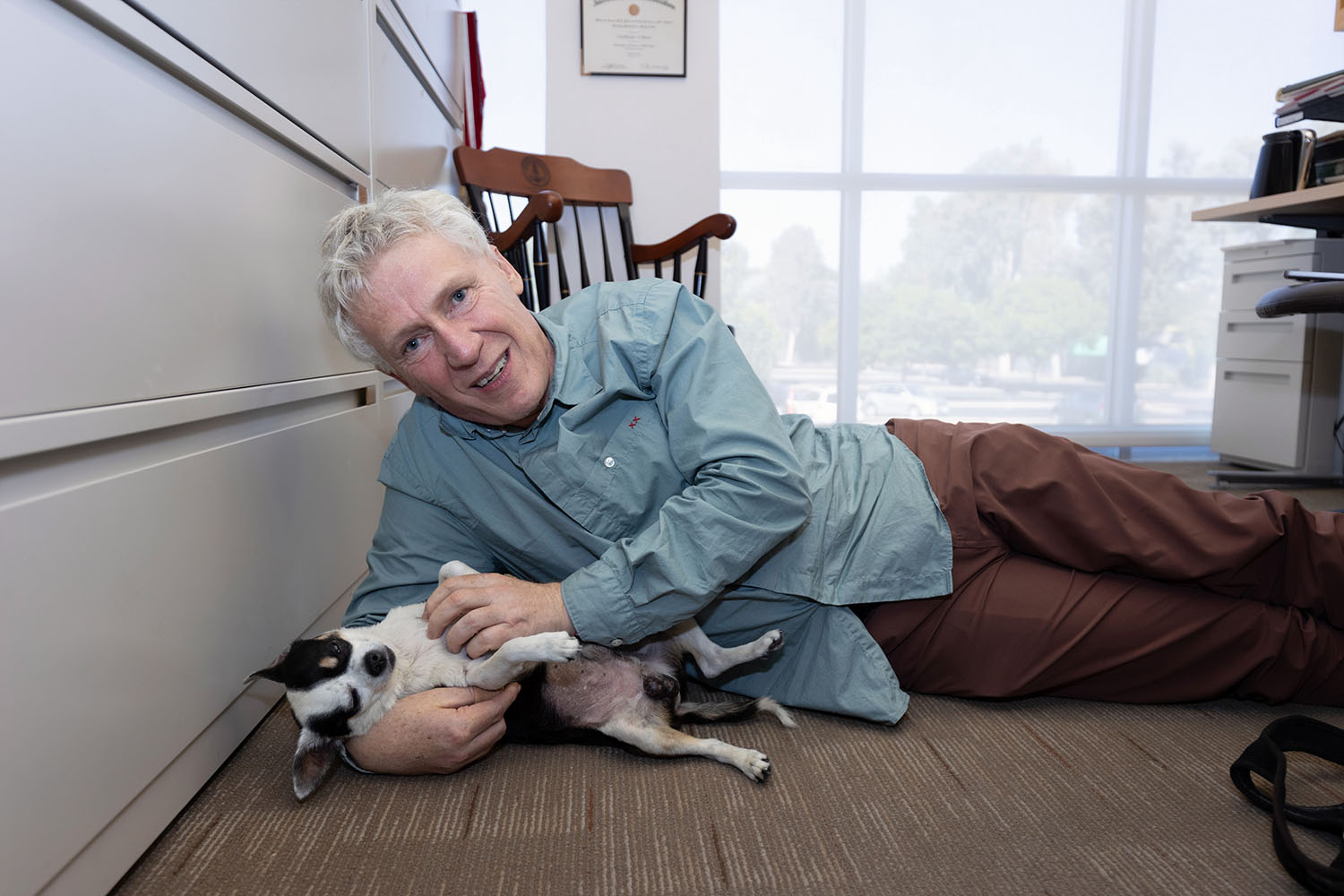
In his narcolepsy clinic, Mignot still sees several hundred patients each year. Occasionally, he brings a canine assistant, his pet Chihuahua, Watson, who has narcolepsy, to help explain the disease to his younger patients.
Getting to know Mignot – and Watson
Emmanuel Mignot discusses what drew him to narcolepsy research, his work with Watson, his narcoleptic Chihuahua, and what keeps him motivated after four decades of scientific pursuit.
“Looking back on Dr. Mignot’s subsequent work, spanning clinical studies in humans and immunology, one can clearly see his remarkable creativity and his perseverance in pursuing scientific truth,” Nishino said. “His rare ability to connect meticulous observations in patients and animal models to fundamental biological questions, his deep commitment to patients, and his dedication to training the next generation of sleep researchers are achievements every bit as important as his many scientific discoveries.”
Early explorations
Mignot traces his penchant for scientific exploration to a rather unsupervised youth in Paris, where he grew up the youngest of six children. “When you’re the last kid, your parents leave you alone,” he said. “As a consequence, I could be in my room doing all kinds of chemistry experiments.” As a teenager, Mignot liked to ride his Peugeot 103 moped a few hours outside the city, which sits in a vast sedimentary basin, to dig for ancient fossils and minerals, accumulating a collection he still treasures.
He gravitated toward science, but his parents, convinced he would never make a living conducting research, pushed him toward medicine. He earned an MD from the Rene Descartes School of Medicine and a PhD in pharmacology from the Pierre and Marie Curie University, followed by a residency in psychiatry. By then, he was running out of time to fulfill his mandatory military service – either a year in the army or 16 months as a physician in a former French colony. There was a rarely granted third option: doing research abroad that would benefit France. Serendipitously, his pharmacology colleagues had recently introduced him to modafinil, a new narcolepsy drug being developed by a French pharmaceutical company. He secured funding from the company and convinced the government that, as his military service, he should be sent to the premier sleep research program in the world to study the drug.
Mignot arrived at Stanford Medicine in 1986. He studied modafinil in Dement’s colony of narcoleptic dogs and found that it worked in a manner similar to existing amphetamines – a disappointment for the pharmaceutical company.
But the experience set the course of Mignot’s scientific career. He was immediately fascinated by narcolepsy. First, it was a problem that affected people; he saw how it upended the lives of patients he cared for in clinic. “I thought it would allow me to help people,” he said. “I believe that is important in life – to do something that matters to people.” Second, narcolepsy seemed like “the quintessential sleep disorder,” holding clues to the fundamental mechanisms governing sleep. Third, he saw it as a question that was answerable.
“I knew that somewhere in the genome of these dogs, there was one change that was enough to cause all the symptoms of narcolepsy, this complete disruption of sleep, wake, dreaming – and it only needed to be found,” he said.
Mignot, now 66, still sees good scientific questions everywhere waiting to be answered. He is ever-curious, often attending conferences outside his field to spark new ideas. “I have absolutely no doubt that research has a very bright future,” he said. “My only regret is that I’m not 30 years old and starting my scientific career.”
In addition to the Lasker Award, Mignot has been honored with a Breakthrough Prize and a lifetime achievement award from the National Sleep Society. He is an elected member of the National Academy of Medicine and the National Academy of Sciences. He served as director of the Stanford Sleep Medicine Center from 2009 to 2019.
For more information
This story was originally published by Stanford Medicine.
Media contact
Lisa Kim: 650-723-6696, likim@stanfordhealthcare.org
Writer
Nina Bai