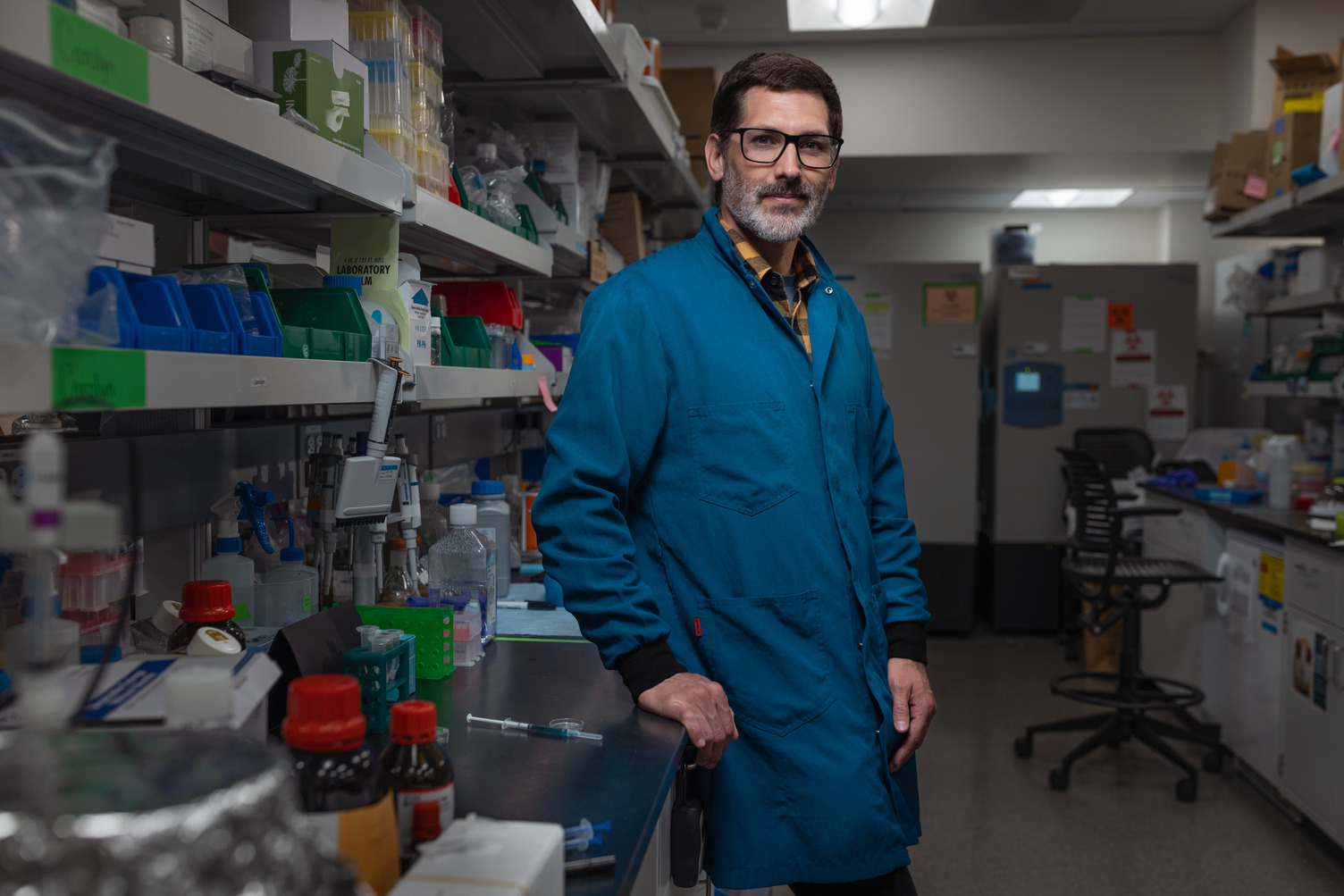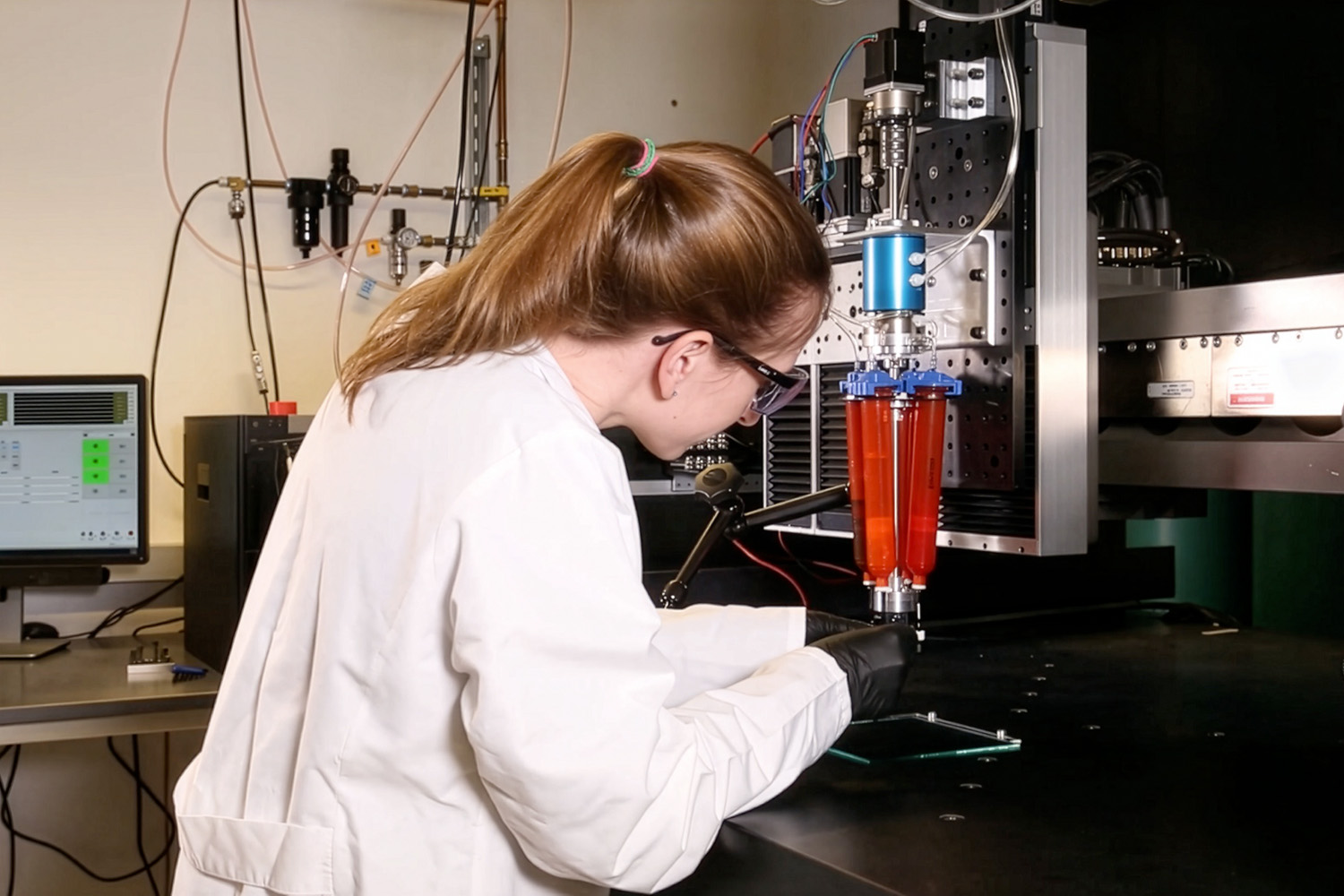
From crafting friendship bracelets as a kid to studying aerospace manufacturing as an undergraduate student, Natalie Larson has always loved making things. Now an assistant professor of mechanical engineering in the School of Engineering at Stanford, she leads a 3D printing research lab that aims to revolutionize manufacturing for multiple industries, including health care, agriculture, aerospace, transportation, defense, and robotics.
Larson’s lab focuses on innovating printing techniques that dispense multiple materials into intricate geometries to support complex functions. What look like kaleidoscopic toothpaste trails are actually multimaterial extrusions designed to mimic patterns observed in organic structures like elephant trunks and octopus arms.
Beyond the research in her lab, Larson is deeply passionate about how 3D printing empowers individual creators and hobbyists to design and build custom projects at home. “3D printing offers a whole new way of thinking about how we make things,” said Larson. “I think it's incredibly exciting that it's become so accessible that people can design and build diverse parts and assemblies in their own homes or local hobby spaces. It's a massive field with many applications, and it creates a common language that people can get excited about.”
Stanford Report talked to Larson about her research, 3D printing as a broad practice, and its implications for shifting how our society produces the items it needs.
What is 3D printing and what differentiates it from other types of manufacturing?
3D printing is also called “additive manufacturing.” It is similar to how we use Legos to build something up brick by brick. This is in contrast to subtractive manufacturing, which is like carving a statue out of stone. More generally, 3D printing is a process used to join materials together to make objects layer by layer, or voxel by voxel, from 3D model data. (A voxel is a 3D pixel or a unit of 3D space.)
What types of materials can 3D printers use?
The range of materials that we can print is now pretty spectacular, which makes this a really exciting time in 3D printing research. Across the entire field, people have printed plastics, ceramics, and metals, as well as composites like concrete. Many researchers are now focusing on multimaterial 3D printing, or combining different classes of materials with different properties or different functions into a single part.
Researchers are even 3D printing living cells, which could enable us to one day print custom living organs or cultivated meat at scale.
Can you elaborate on 3D printed meat?
Conventional meat production requires substantial land, water, and feed resources, and is responsible for 14.5% of global greenhouse gas emissions. 3D-printed cultivated meat is made by sourcing a small sample of cells from an animal, multiplying them, patterning them into meat-like structures using 3D printing, and then culturing them so that they can mature and form tissue with an appealing texture. Our work in this area is being supported by the Stanford Sustainability Accelerator.
There are several challenges in cultivated meat production, including a lack of sustainable material sources, a lack of scalability, and poor consumer appeal. To address these, I am working with an interdisciplinary team of collaborators, including Sarah Heilshorn, Helen Blau, and Ellen Kuhl. Together, we are developing sustainable, non-GMO ingredients and a scalable 3D bioprinting process to construct complex, thick, steak-like cuts with enjoyable textures. PhD student Sofia Madrigal Gamboa is the central integrator, bringing together expertise across the four different labs.
Professor Blau’s lab is leading the development of renewable, non-GMO bovine cell sources. Professor Heilshorn’s lab is leading the production and characterization of engineered protein biomaterials, and Professor Kuhl’s lab is leading the sensory characterization of cultivated meat tissues.
In my lab, we are developing a new multimaterial 3D bioprinting method with “subvoxel” control. With subvoxel bioprinting, we can simultaneously extrude all the materials needed to make cultivated meat, including muscle and fat bio-inks, alongside sacrificial inks that will be used to form open channels for nutrient delivery during cell culture. By patterning these materials using a single large nozzle, we aim to create meat with the right size, shape, and internal structure to provide an appealing alternative to whole-cut steaks.
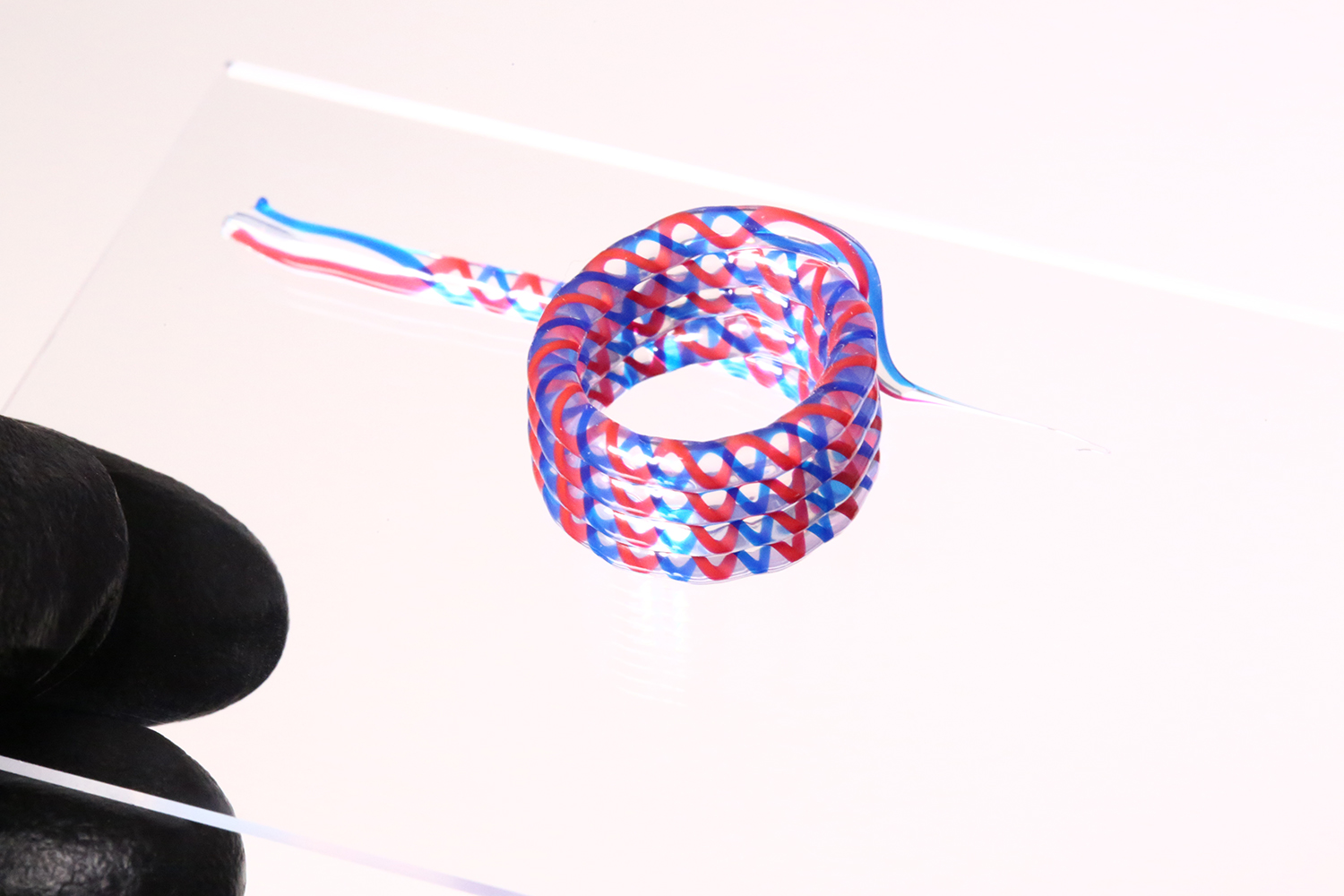
A hierarchical “helix of helices” 3D printed using rotational multimaterial 3D printing with subvoxel control. | Lori Sanders, Lewis Lab, Harvard SEAS, publication: N.M. Larson et al., Rotational multimaterial printing of filaments with subvoxel control. Nature 613, 682–688 [2023]
Cultivated meat aside, your lab also works on robotics. How does 3D printing improve robotics?
Our research involves 3D printing materials for “soft” robots, made of squishy materials, which offer distinct advantages compared to rigid metal or plastic robots. One advantage of soft robots is they can more easily interact with delicate systems without damaging them. This is relevant for the health care industry, for example, because many human tissues are relatively soft. Another example would be picking tender fruits, like berries.
Humans excel at these delicate tasks because we have soft pads on our fingertips with sensory feedback to our brains, allowing us to carefully grip soft objects with unique geometries. With multimaterial 3D printing, we aim to achieve similar performance by manufacturing multifunctional soft materials with embedded sensors and actuators in programmable complex geometries for target applications.
Is 3D printing becoming a standard production method for any industry? How sustainable is it compared to other manufacturing methods?
Yes! It has become the standard in certain areas where you need highly customized but low-volume parts, like hearing aids, dental aligners, or dentures. 3D printing can allow us to make many of these custom devices faster and with a more comfortable fit for patients.
Sustainability for any given manufacturing method depends on many factors, including the specific application and the scale. For custom, complex, or low-volume parts, 3D printing can offer several benefits in terms of sustainability. First, there is no need to use molds, which cost time, energy, money and materials to produce, and limit the design to the geometry of the mold. Additionally, parts can be manufactured when they are needed, reducing the number of parts sitting in warehouses that might end up as trash. Another benefit is that parts could be manufactured where they are needed. This is often referred to as “distributed manufacturing.” If every household or community could print parts on site, this could significantly reduce waste and energy consumption associated with shipping.
3D printing also gives us the ability to create more complex geometries, enabling us to design lighter-weight components. In aerospace applications, for example, these lighter components could translate into better fuel efficiency for the vehicle.
As another example, in my lab we’re starting a new project on 3D printing of structural battery composites in collaboration with my colleague Associate Professor Adam Boies, with a grant from the Precourt Institute for Energy and the Sustainable Mobility Center. Structural battery composites are emerging as a potentially transformative technology in sustainable transportation because they are designed to do two jobs at once: provide rechargeable energy storage and mechanical load bearing. The goal is to replace current structural composites, like the carbon fiber composites used in lightweight land and air transport vehicles, with structural battery composites that offer enhanced system-level efficiency. The result could be a 3D-printed part that is simultaneously a battery and the structural wall of a vehicle.
If every household or community could print parts on site, this could significantly reduce waste and energy consumption associated with shipping.
What does the future of your 3D printing research hold?
Our overarching goal is to advance manufacturing processes to enable new classes of multifunctional materials. One key element of our approach involves creating new printers that enable more complex and precise subvoxel control. To support this, our lab was recently awarded an Office of Naval Research Young Investigator Program Award to advance multimaterial 3D printing of helically architected metamaterials and antennas for defense applications.
The second key element of our approach involves developing new techniques for 4D (3D space + time) imaging and computer vision to study and ultimately automate multimaterial 3D printing with subvoxel control. This initiative is a collaboration with my colleague, Professor Eric Darve, and is being spearheaded by PhD student Elise Yang. With automation, we aim to accelerate innovation and improve sustainability by reducing waste associated with long calibration processes and failed parts.
With our advanced printers and automation techniques, we aim to make it possible to create functional and living materials that we can currently only dream of.
For more information
Larson is also a member of Stanford Bio-X.
The Sustainability Accelerator and the Precourt Institute for Energy are both part of theStanford Doerr School of Sustainability.
The Sustainable Mobility Center is an industrial affiliate program. Stanford industrial affiliate programs are funded by membership fees from companies. View current Stanford Doerr School of Sustainability affiliate members.
Writer
Kari Goodbar