


In brief
- At a SIEPR Policy Forum, business leaders, academics, and policymakers discussed how money today travels the globe with unprecedented speed.
- New technologies are reshaping finance in ways that offer the prospect of enhanced access, increased competition, and greater efficiency.
- Experts say understanding the risks – and needed safeguards – of emerging technologies like algorithmic trading and digital currencies is essential to protect consumers and the financial system.
The news roiled the banking industry and its regulators. Anthropic, the artificial intelligence juggernaut, announced one of the most powerful AI tools ever to help companies and governments ward off cyberattacks.
What seemed on its face to be good news earlier this spring was anything but: Anthropic’s not-yet-released model, called Claude Mythos, promises to spot previously undetectable vulnerabilities in software with remarkable speed and skill but could, in the wrong hands, wreak havoc on banking systems worldwide.
Mythos is upending how banks and governments think about cyber risks. Mythos will make it “very, very easy” for criminals to strike, said Michael Hsu, who served as acting comptroller of the currency from 2021 to 2025. Hacking has always been labor intensive. Not so with Mythos. “The game of cat and mouse has been accelerated,” he said.
Hsu delivered this assessment at the Spring Policy Forum hosted by the Stanford Institute for Economic Policy Research (SIEPR) on 21st-century innovations in how money is created and deployed across the global economy. The May 27 event, titled “From Digital Assets to AI,” focused on the opportunities and risks presented by emerging technologies like AI and digital payment systems like stablecoins. The gathering of business leaders, academics and policymakers also explored signs of instability among private credit markets, a key source of corporate financing behind AI’s growth.
The policy forum featured keynote appearances by Lisa Cook, the Federal Reserve governor and chair of the central bank’s committee on financial stability, and Randal Quarles, a former Fed governor who served as the Fed’s first vice chair for supervision – a role that grew out of the 2008 financial crisis.
Images by Christine Baker

Federal Reserve Governor Lisa Cook joined SIEPR Director Neale Mahoney in conversation after her opening keynote.

Kristin Johnson, a former commissioner at the U.S. Commodities Futures Trading Commission, said this will be one of the most transformational periods for financial markets.
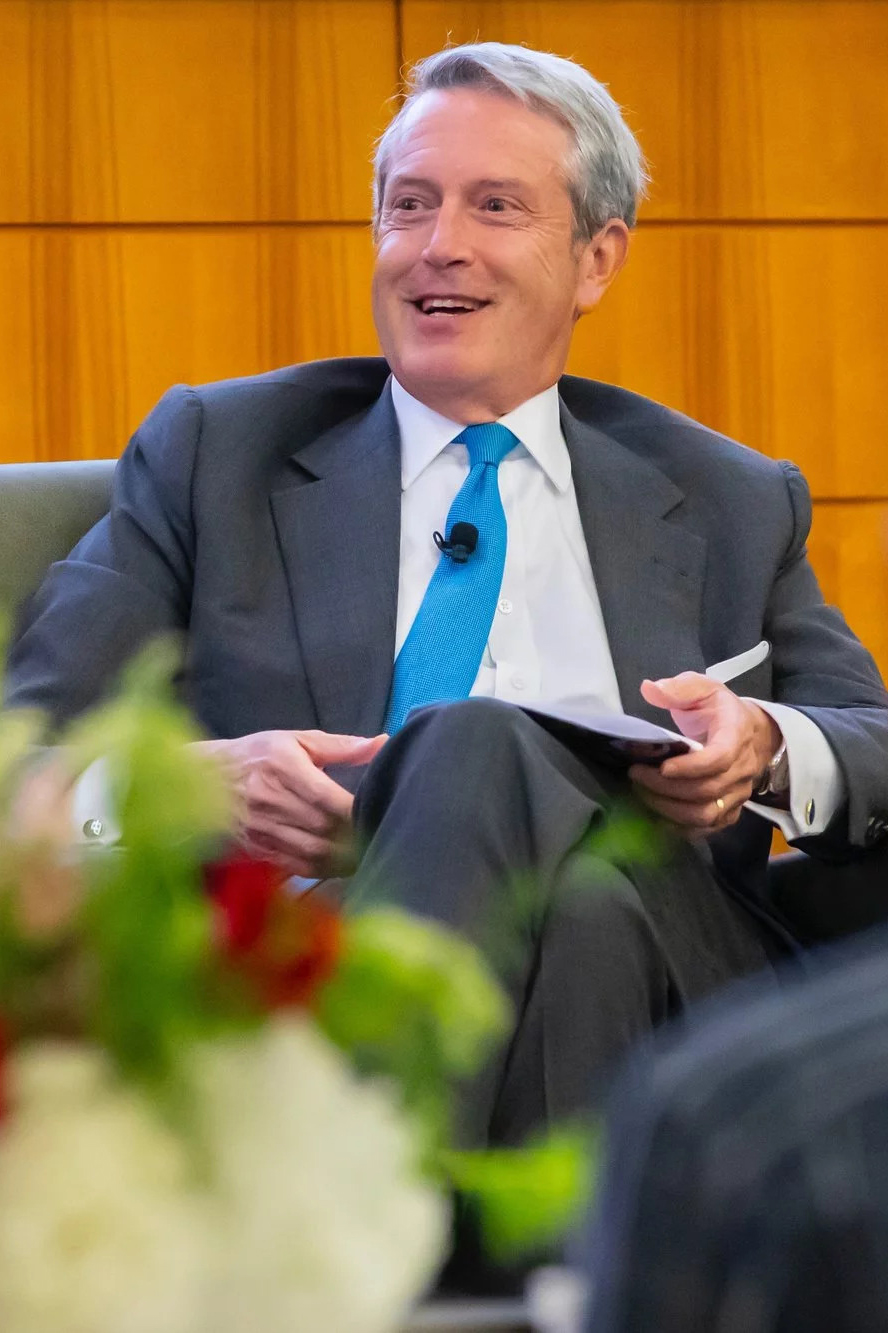
Former Fed governor Randal Quarles compared the need for stablecoins to choosing between salmon and cod. If there’s a preference for one over the other, he said, the only real issue is to “make sure there’s not mercury in it and that it’s not dangerous to eat.”

Attendees like Teresa Kong, an expert in investment management, participated during the Q&A portions of the policy forum.

Attendees had the opportunity to mingle with featured speaker Randal Quarles.
Neale Mahoney, the Trione Director at SIEPR, opened the day’s discussions by noting the “fascinating moment” for the financial industry.
“Right now, all around us, new technologies are reshaping finance in ways that offer the prospect of enhanced access, increased competition, and greater efficiency,” said Mahoney, who is also the TG Wijaya Professor of Economics in the Stanford School of Humanities and Sciences.
At the same time, he said, these technologies raise questions about the policy trade-offs required to protect consumers and the financial system. “The purpose of today’s conference is to go beyond the soundbites and the headlines,” Mahoney said.
Financial services on steroids
One thread unifying the conversations: Money traverses the globe at unprecedented speeds, with implications that are good and – as the Mythos handwringing signals – bad for financial stability.
Speakers at the policy forum zeroed in on some of the most promising, and perilous, innovations in capital flows. This includes digital assets like stablecoins, which promise to move money around the world instantly and cheaply. Another is private credit, a lightly regulated source of financing for companies that can’t easily or quickly tap traditional lending. Then there’s AI, which, as Governor Cook noted in remarks highlighting the technology’s rewards and risks, will help amateur investors identify new opportunities in financial products earlier and regulators spot emerging threats.
Kristin Johnson, a former commissioner at the U.S. Commodities Futures Trading Commission (CFTC) and a policy forum speaker, captured how AI is changing the game: Not long before President Trump announced a military strike on Iranian infrastructure on March 23, bets on future access to crude oil supplies spiked, suggesting that someone knew what was coming and also that AI helped others quickly pick up on the gamble. But that sudden increase in trading activity was also, she said, spotted by regulators.
“We’re talking about a deeper integration of innovation than we’ve ever seen before in the history of financial markets,” said Johnson, now a law professor at George Washington University. “I think there is little doubt, little debate, little controversy that this period will be one of the most powerful and transformational periods in terms of financial markets.”
But the velocity of new money flows also means that crises can arise faster than ever, and the implications of that for financial stability was another focus of the policy forum. Silicon Valley Bank collapsed almost overnight in 2023 in part because “modern communications fueled a panic whose speed was multiples of anything that anyone had seen before in the history of the country,” said Quarles, now chairman of wealth manager The Cynosure Group, in his keynote appearance.
Salmon vs. cod … or both?
So, what do these innovations mean for financial stability? You can watch the conversations.
Here’s a summary of some key takeaways:
- Private credit: A market that grew fast and is lightly regulated is showing strain because investors are worried about loans made to software companies whose products could be replaced by AI and the enormous debts taken on by data-center developers looking to profit from AI. While the general consensus at the policy forum was that private credit’s troubles don’t threaten the U.S. financial system, the industry’s “fuzziness and opaqueness” is highlighting the need for more formal structures, said Jared Ellias, a Harvard Law School professor. Nina Boyarchenko, a financial research advisor at the Federal Reserve Bank of New York, said private credit’s pain could spread to traditional banks and insurance companies, potentially “pos[ing] a financial stability concern.”
- Digital assets: Stablecoins, the digital currency designed to have a fixed value, are a response to problems in the volatile crypto ecosystem. But even though last year’s GENIUS Act provided a regulatory framework for stablecoins in the U.S., their ultimate success depends on overcoming big challenges that were explored at the policy forum. A major obstacle is the lack of global regulatory framework that allows instant payments across borders while providing consumer protections and a coordinated crisis response, said Horacio Diaz Adda, the CFO at Paxos, a stablecoin issuer. Then there’s the “last mile” problem in need of a practical solution: To work as a form of payment, stablecoins ultimately need to be converted into local currencies and deposited into a bank account. “The digital asset world and traditional finance are not binary anymore,” said Homam Maalouf, co-founder of Lead Bank. “They have to coexist and work in a seamless manner.”
- AI: “The urgency is real,” Governor Cook said of the need for policymakers to identify and respond to the many ways that AI could undermine financial stability, including from AI-driven algorithmic trading, the enormous debts taken on by companies to finance data-center buildouts and debilitating cyberattacks. She then described several ways that the Fed is adopting AI and improving its ability to monitor financial stability risks. “We already see tangible benefits,” she said, “By using AI ourselves, we can improve our analysis of the financial sector and are better able to highlight vulnerabilities, whether they are new ones introduced by AI or old ones that we may have missed.” In a separate panel session on AI, speakers talked about the need for better coordination among federal regulators overseeing the financial industry and to develop an agreed-upon framework for model risk management. Ultimately, though, a real-world incident might be the necessary impetus, Hsu said. “We have to wait for the incident, which will happen, and then we have to figure out what went right, what went wrong, and who’s responsible,” he said.
The policy forum conversations were weighty, but not without lighthearted moments. Take, for instance, this exchange with Quarles, the former Fed governor: He likened stablecoin risks to those posed by money-market mutual funds. Are stablecoins a game-changing innovation? No, Quarles said.
“I don’t know that there’s a crying need for stablecoins,” he said. But neither, he continued, is there a crying need for to choose cod over salmon when both are on the menu. If there’s a preference for one over the other, the only real issue is to “make sure there’s not mercury in it and that it’s not dangerous to eat.”
For more information
This story was originally published by the Stanford Institute for Economic Policy Research.
Writer
Krysten Crawford