Aging dams pose growing safety and economic challenges. As debates intensify over projects like removal of Northern California’s Potter Valley dams, two Stanford experts discuss the challenge of fixing up or taking down dams when there is too little funding – public or private – to do either.
Dan Reicher is a senior research scholar at the Stanford Woods Institute for the Environment and former assistant secretary of energy in the Clinton administration.
Felicia Marcus is the William C. Landreth Visiting Fellow with Stanford’s Water in the West program, and is former chair of the California State Water Resources Control Board.
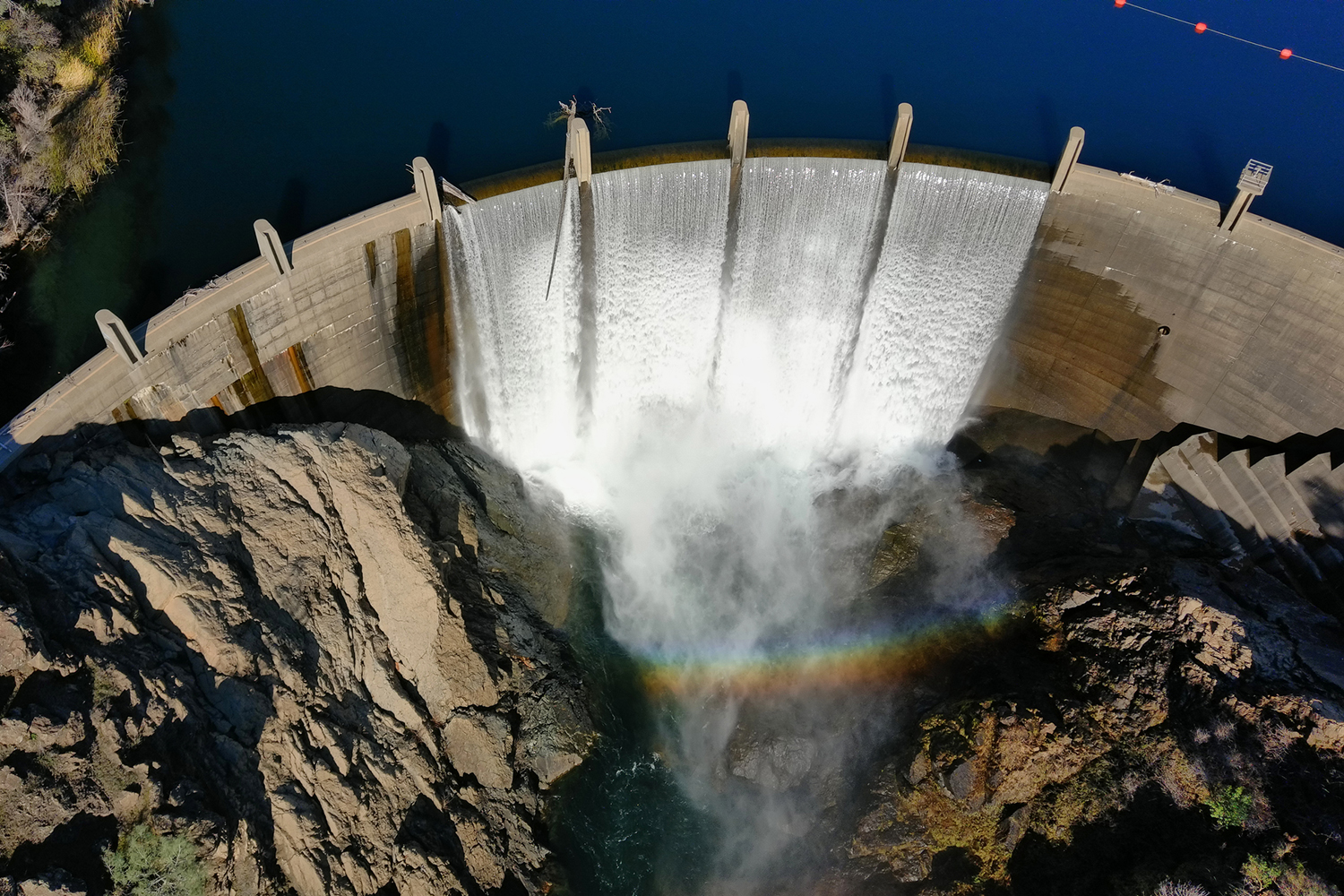
The Potter Valley Project, built over a century ago, uses two dams – Scott Dam and Cape Horn Dam – to divert water from the Eel River basin into the Russian River basin while generating hydroelectricity. Pacific Gas and Electric Co., the project’s owner, has determined the dams are no longer economically viable for power generation, and plans to remove them. However, U.S. Agriculture Secretary Brooke Rollins announced in April that a Southern California water agency had expressed interest in buying the dams to keep them operating.
Why is the Potter Valley Project generating so much controversy right now?
Marcus: What makes Potter Valley interesting is that you actually have this really unlikely set of allies that came together, including tribes, environmentalists, and counties whose economies depend on water. They developed what they call a “two basin solution” that allows for some continuing water diversions while restoring fish passage and acknowledging tribal water rights. But then you have opposition from people who understandably fear losing something, like their lakefront homes or their way of life. The politicization you note comes from treating dam removal as symbolic rather than looking at the actual merits of the particular dam at a particular stage of its existence.
Reicher: I think there’s a fundamental misunderstanding about what dams do. The first misunderstanding is that many U.S. dams make electricity. In fact, of approximately 500,000 U.S. dams, only 2,500 make electricity. In the case of the two Potter Valley dams, PG&E argues that these dams have reached the end of their useful life for electricity generation. On the other hand, the Elsinore Valley Municipal Water District contends that the dams should be kept operating to provide a reliable water supply for regional residents and farmers.
What’s the broader context for dam removal in America?
Reicher: In 40 years, we’ve only taken down 2,200 U.S. dams that had reached the end of their useful life. The rough estimate for fixing up or taking down obsolete dams in the United States is more than $150 billion. In a good year, the federal government allocates maybe $2 billion over several years for what our Stanford Uncommon Dialogue on Hydropower, River Restoration, and Public Safety calls the “3Rs” of U.S. dams: rehabilitate some for safety; retrofit some for power; and remove some for conservation or safety. The challenge is that we simply don’t have the money we need – public or private – to take down or fix up a large number of obsolete dams.
Marcus: We’re in an era of rethinking facilities and infrastructure that was built 50 to 100 years ago for an intended purpose and thinking about how we either take it out or refashion it to meet more and more current objectives during the modern era. It’s not about undoing the accomplishments of the past. It’s about figuring out how to refashion infrastructure for this new era to meet more social goals, including climate adaptation, ecosystem restoration, fisheries, preventing algae blooms, more efficient energy generation, and seismic safety.
The challenge is that we simply don’t have the money we need – public or private – to take down or fix up a large number of obsolete dams.Dan ReicherSenior Research Scholar at Stanford Woods Institute for the Environment
What determines whether a dam should be removed or kept?
Reicher: Safety is first and should be. Too often it is not. One of these days, we’re going to have a large U.S. dam fall down and kill many people. More than 200 people died in a 1972 South Dakota dam failure, almost 6,000 perished in the 2023 failure of two Libyan dams, and 188,000 were evacuated in 2017 when it looked like a California dam’s spillway was going to give way. Critically, the U.S. dams that have killed more people than any other are what are called low-head dams. People don’t see them because they’re submerged, and sometimes there’s a nasty wave at the bottom that can trap and kill swimmers or canoeists. About 50 people perish each year this way.
Marcus: The prime candidates for removal are dams that have passed their useful life for the original purpose they were built. On the Klamath and in Potter Valley, the original owners decided these dams no longer make sense for hydroelectricity production because of other available generating sources. They’re not big producers, and the cost of rebuilding infrastructure that’s outlived its usual life is often too high to make it worthwhile.
What happens to water supplies when dams are removed?
Marcus: In Potter Valley, they’ve actually figured out how to continue some water diversions, but only during high flows, so it helps fish passage while making sure counties get water for their economies. The Round Valley Tribes would hold the water rights, which is historically significant. For a long time, we’ve had a water rights system called “first in time, first in right” but excluded the people who were actually here first.
What’s the path forward?
Reicher: We need to think systematically about which dams to rehabilitate for safety, which to retrofit for more power generation, and which to remove for safety as well as conservation. But we can’t do this with a “bake sale approach” to funding. We need long-term planning and serious financing mechanisms – both public and private – if we’re really going to make progress fixing up or taking down a meaningful portion of the nation’s half-million dams with the resulting benefits.
For more information
This story was originally published by Stanford Woods Institute for the Environment.
Writer
Rob Jordan