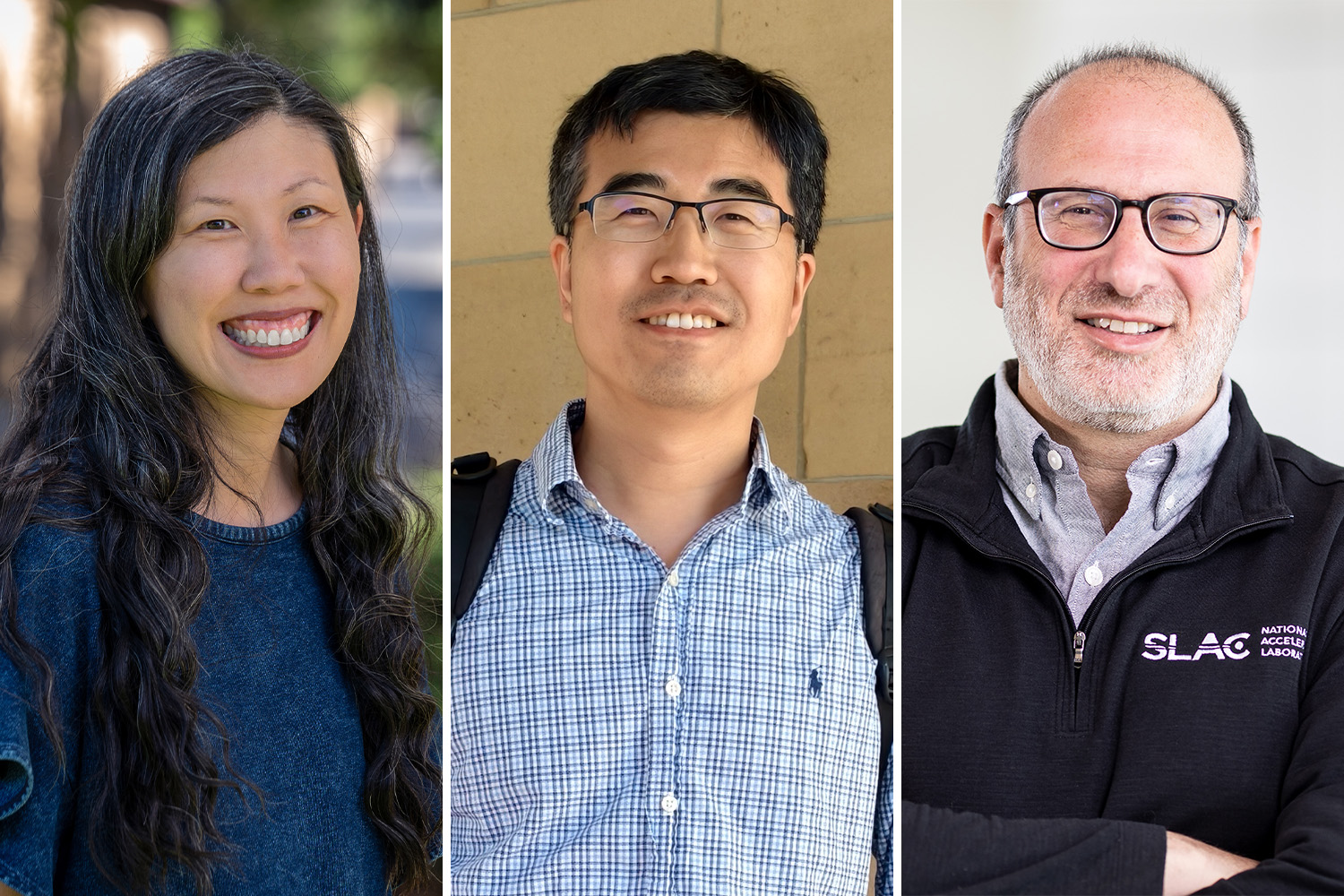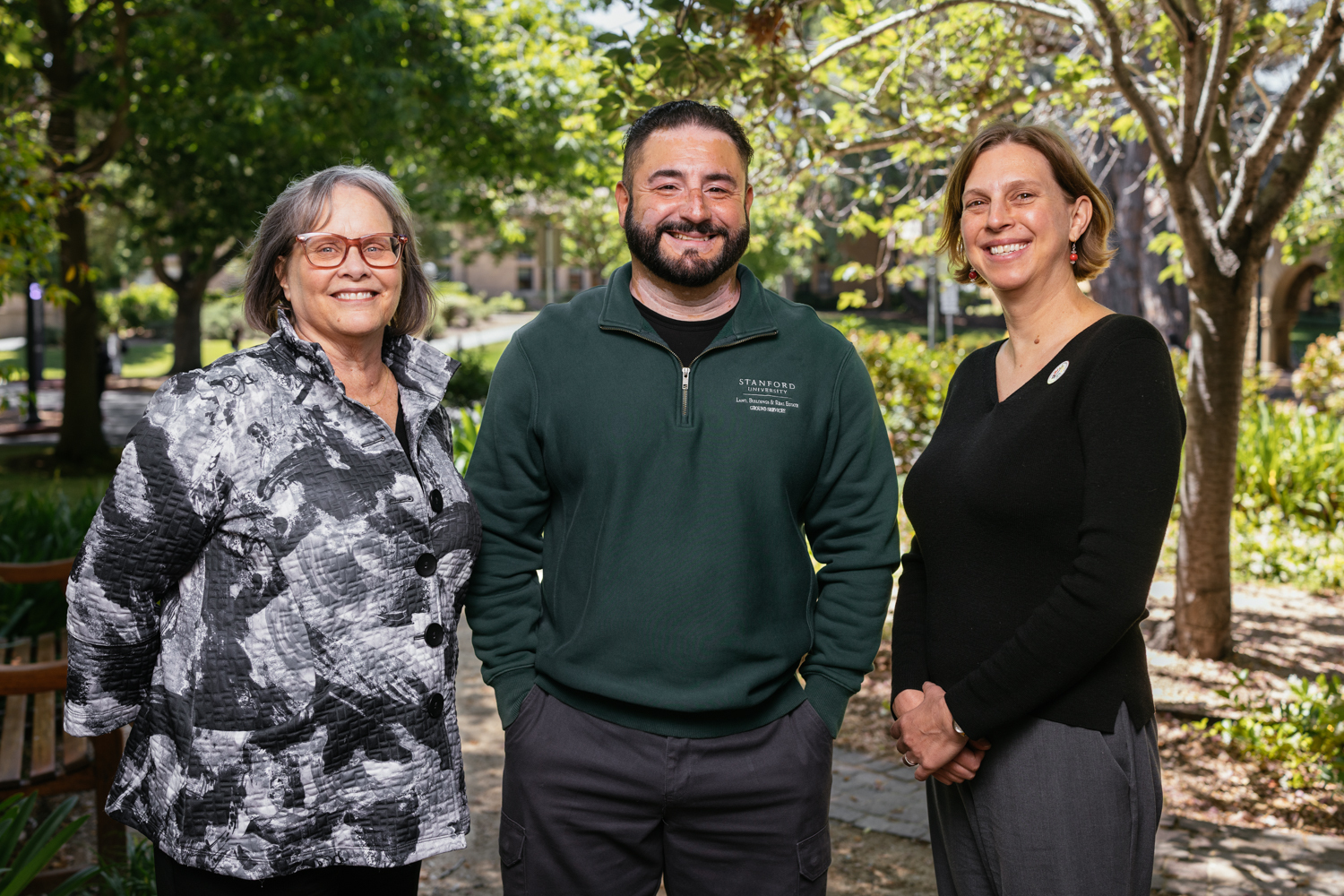
Jose Nabor Escanuela, Crystal Botham, and Karen Cooper are recipients of the 2026 Amy J. Blue Award, which recognizes exceptional staff for their contributions to the university, passion for their work, and support for their colleagues.
This year, the Amy J. Blue Award committee received 483 nominations for 173 individual nominees. Nominators for this year’s winners described them as dedicated, generous, and compassionate – each supporting the university’s mission in their unique capacity.
Amy J. Blue was a longtime Stanford employee who served as an associate vice president for administrative services and facilities. She died of brain cancer in May 1988, about a month before her 45th birthday. The award was established in 1991 to honor her life and work.
The campus community is invited to honor this year’s winners at a ceremony at Lagunita Courtyard on Tuesday, May 12, at 4:30 p.m., hosted by President Jonathan Levin.
‘A remarkable leader’
Karen Cooper is the associate dean and director of financial aid, leading the university’s need-based financial aid program for undergraduates and programs that support graduate students.
Originally from western Pennsylvania, Cooper studied psychology at Allegheny College before earning a master’s in higher education administration from Michigan State University. She came to California for a job at Menlo College. A few years later, in 1992, she landed a job as a financial aid adviser at Stanford.
Today, she leads a team of 20 staff members responsible for the undergraduate financial aid program and for supporting graduate students who need aid. She is described as “a remarkable leader” whose contributions have significantly enhanced the student and staff experience at Stanford. While she mostly works behind the scenes – setting policy and ensuring systems work – her contributions take center stage.
“Put simply, Karen is a phenomenal colleague I trust to deliver on institutional-level solutions for immensely complex problems,” wrote one nominator.
“Karen has dedicated many hours analyzing data and trends to ensure accuracy in budget proposals, forecasting, and policy recommendations as I’ve seen firsthand during budget cycles. Her diligence ensures fiscal responsibility and that students are receiving the appropriate level of support,” wrote another nominator.
Cooper said she never expected to receive an Amy J. Blue Award and is surprised and grateful for the recognition. “Stanford has been a great place to work. It has really allowed me to grow and challenge myself and take on new responsibilities in ways that have been really special,” she said.
Although Cooper never met Amy J. Blue, a colleague “once told me this wonderful story about Amy using every meeting with the Board of Trustees as an excuse to buy a new outfit. And I’ve always taken that advice!” she said. “I think I would have enjoyed working with Amy very much.”
‘Leading with humanity’
Jose Nabor Escanuela works in Land, Buildings & Real Estate, where he is a ground services area management lead, overseeing the grounds and landscaping of prominent portions of campus.
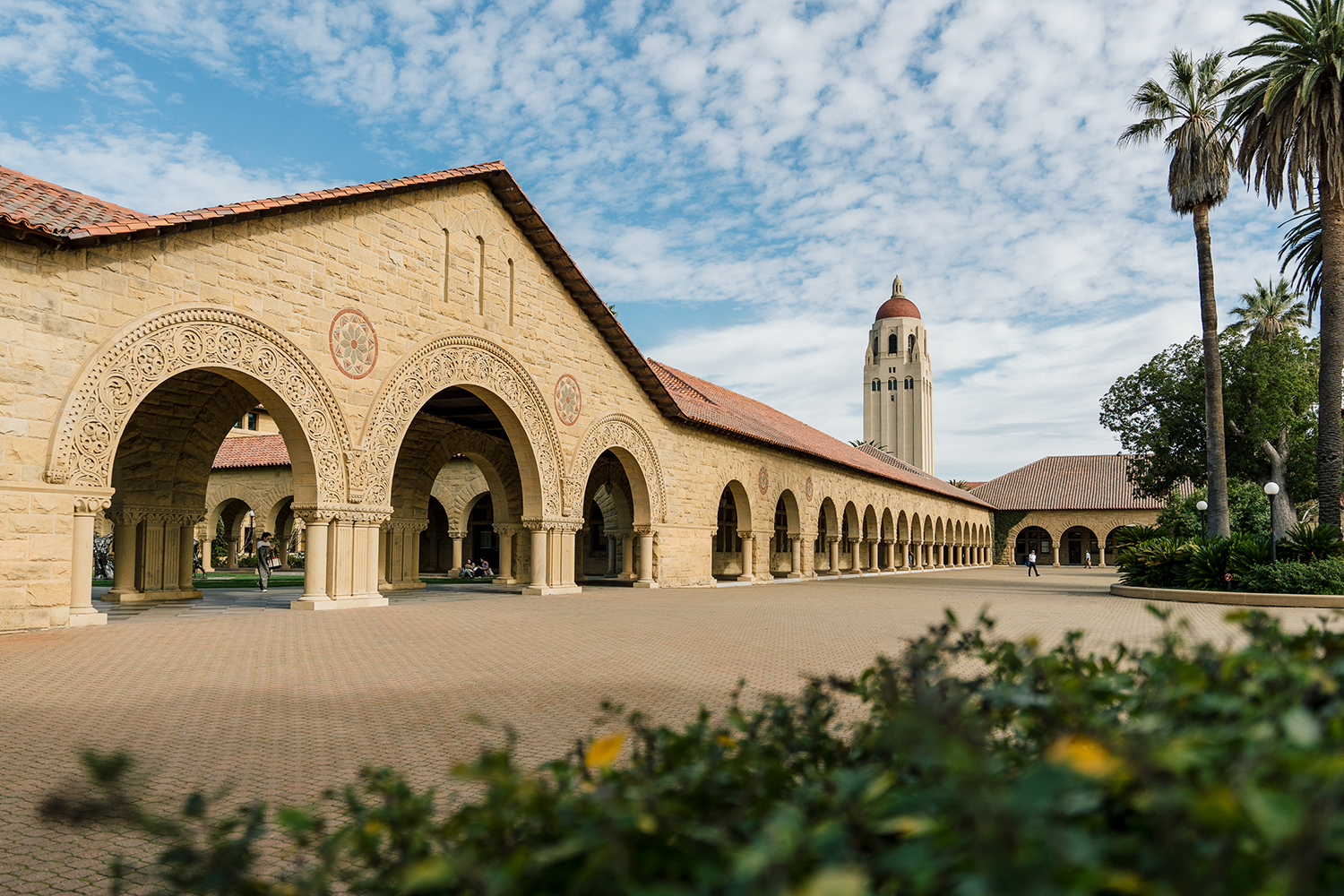
Born in Tijuana, Mexico, Escanuela grew up near Stanford in the small South Bay town of Alviso. His parents were migrant workers who taught him about plants and landscaping. In 2002, he landed a job at Stanford as a groundskeeper for student dorms and faculty and staff housing, including the president’s residence, the Lou Henry Hoover House. Today, he leads a team that’s responsible for maintaining the core areas of campus, including the Main Quad, Tresidder Memorial Union, the Hoover Institution, Stanford Law School, Stanford Graduate School of Education, Meyer Green, and the Stanford Institute for Economic Policy Research (SIEPR).
Escanuela said he and his colleagues take great satisfaction in caring for the campus. “We have that sense of pride, like, ‘These are my buildings, and I’m going to make sure that everything looks great,’” he said.
Escanuela was nominated for his attention to detail, quality, and dedication in his work. “He understands the big picture at Stanford,” wrote a nominator. “When it comes to preparing for major campus events, no stone is left unturned.”
He is described as “deeply trustworthy” and “leading with humanity.” Notably, he is a mentor to his colleagues, regularly helping them navigate work issues, such as benefit forms and timecard completion.
“Jose is a community leader, overflowing with care and compassion for everyone he meets,” they added. “Jose does not just see employees as workers – he sees them as people with full lives and real challenges.”
In the 2000s, Escanuela was assigned to the former human resources building that was on the current site of the Stanford Graduate School of Business. “I maintained the garden there that was named for Amy Blue,” he recalled. “I remember it had a fountain and a bridge – it was really cool and that’s how I learned about her.” The garden has since been moved to an area outside of Memorial Church.
Over the years, stories about Blue’s support for her colleagues have inspired Escanuela. “I’ve taken that and decided it’s my turn to help people,” he said, adding that he loves his job, is proud to be at Stanford, and grateful to be recognized.
‘A huge reason for our success’
As a child during summers spent in Colorado, Crystal Botham loved playing with the green hornworm caterpillars that colonized her grandparents’ tomato plants. Her grandfather encouraged her to ask questions, like how much the creatures ate and how fast they grew, and gather evidence to find the answers. “He wasn’t a scientist, but he was very curious, and he taught me about the scientific process,” she said. “And I still got to play with my bugs.”
Applying a scientific framework while keeping the joy intact proved to be a theme for Botham, a Half Moon Bay native who studied spider silk as an undergraduate, earned a PhD in molecular biology from the University of Oregon, and came to Stanford as a postdoc in 2007. She joined the School of Medicine staff in 2011, and today serves as director of the Office of Pediatric Research Development, where she works with faculty to shape research ideas into funding proposals.
She is also founder and director of the Biosciences Grant Writing Academy, which supports graduate students, postdocs, and faculty in developing research proposals. More than 300 researchers participate in the academy’s bootcamps each year.
Central to Botham’s approach is an idea she and her team arrived at together: that grant writing can be joyful. “We don’t say rejected,” she said. “We say not funded yet.” The framework they developed – reframing, developing skills, and building community – has been shown to measurably shift how researchers feel about the process.
At a recent faculty dinner, Botham walked in to balloons, cake, and nearly all of the department’s assistant faculty waiting to surprise her with the news that she’d won this year’s Amy J. Blue Award. Botham said she was humbled to receive an award named for someone who meant so much to her colleagues. “I’ve been learning more about Amy and the impact she had in her short time here at Stanford,” she said. “I just can’t believe I was awarded.”
Nominators praised Botham’s “deep investment in people” and credited her with “nurturing a passion for research in junior faculty across Stanford Medicine.” Stanford leads the nation in K99 awards – the NIH’s career development grant for postdocs – wrote one nominator, and “it is no exaggeration to say that Crystal is a huge reason for our success.”
Botham said one of the most satisfying aspects of her work is seeing how life-changing grant writing can be at a pivotal point in a researcher’s career. “If you develop the ideas and the proposals and you get the grant, that’s great,” she said. “But you’re going to succeed even if you don’t, because now you've built a plan for your research. Getting the grant is like the cherry on top.”
Writers
Alex Kekauoha
Charity Ferreira