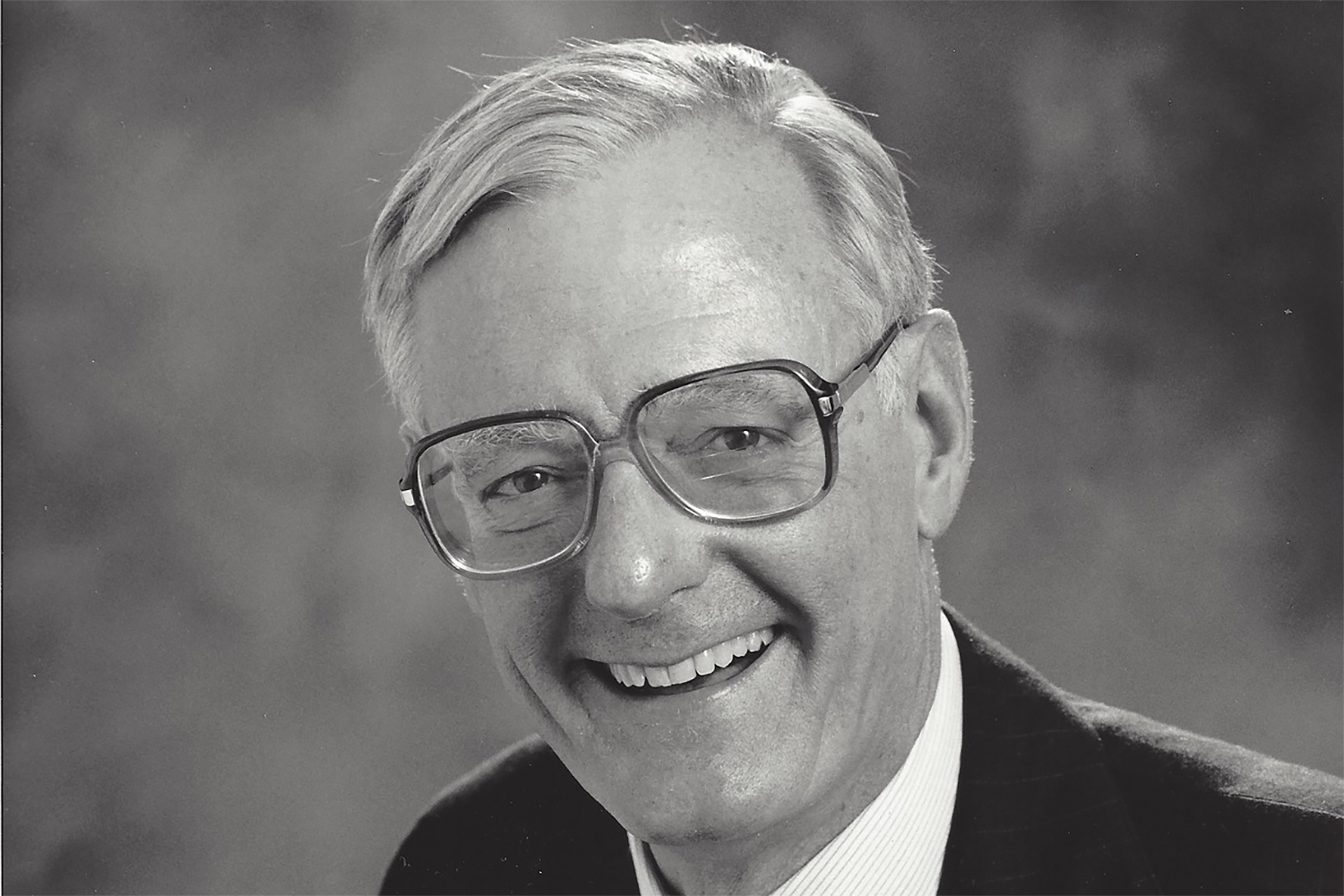
Bowen Hadley “Buzz” McCoy, ’58, a successful investment banker and business ethicist who made the founding gift for the McCoy Family Center for Ethics in Society, died Jan. 25 at age 88.
For more than five decades, McCoy devoted his time, intellect, and generosity to Stanford as a volunteer leader, a champion of ethical leadership, and a philanthropist. He believed that professional success carried a responsibility to serve, which he exemplified through his commitment to community service both at Stanford and beyond. Across business, teaching, and philanthropy, he returned again and again to a guiding question: How shall we live?
That question defined his career and legacy at Stanford.
“Throughout his life, Buzz was committed to bringing ethical reflection to bear on all aspects of human practice, including business,” said Debra Satz, the Vernon R. and Lysbeth Warren Anderson Dean of the School of Humanities and Sciences, the Marta Sutton Weeks Professor of Ethics in Society, and a founding faculty director of the center. “This, along with his commitment to Stanford, was unwavering, and his generous philanthropy helped weave research and teaching about ethics across the university.”
Ethics in action
A native of San Francisco, McCoy graduated from Stanford with a degree in economics in 1958. He served in the United States Army’s Intelligence Branch in Korea and then earned an MBA from Harvard Business School.
He began his 28-year career at Morgan Stanley in 1962, achieving professional success as partner and managing director, and later as president and chairman of Morgan Stanley Realty.
During a six-month sabbatical in 1982, McCoy joined a mountain-climbing expedition in the Himalayas, where he encountered a pilgrim, or sadhu, in distress, forcing him and other climbers to confront an ethical dilemma of whether or not to provide aid under extreme conditions. McCoy documented the experience in a Harvard Business Review essay titled “The Parable of the Sadhu.” In the four decades since its publication, the essay has prompted students and leaders worldwide to wrestle with questions of shared responsibility, institutional accountability, and moral courage under pressure.
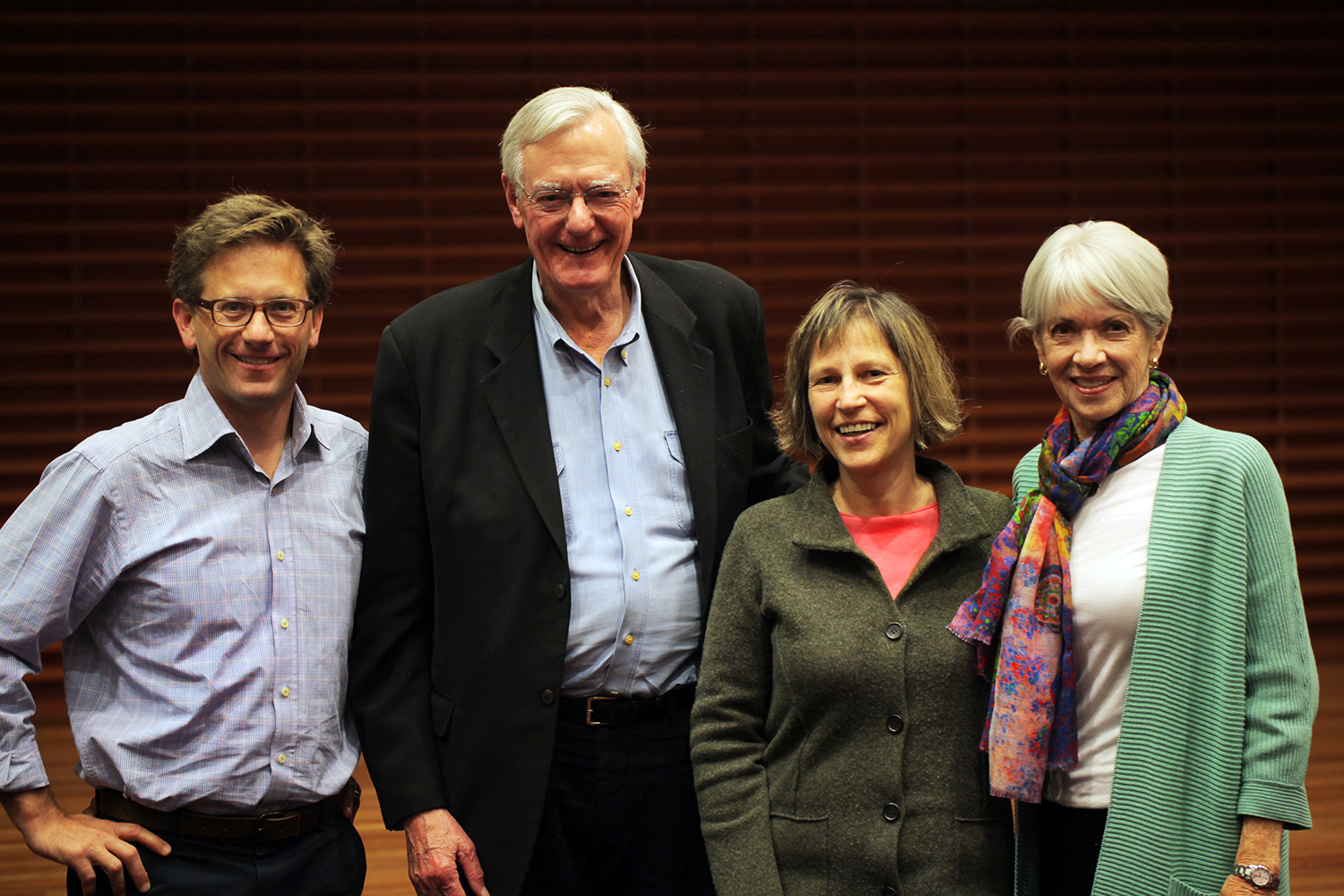
From left to right: Rob Reich, Buzz McCoy, Debra Satz, and Barbara McCoy. | Charles Russo
For faculty at Stanford, the essay became more than a case study. “‘The Parable of the Sadhu’ has been a fixture in my classes for years, reliably sparking rich conversation about the moral dimensions of leadership,” said Rob Reich, current faculty director of the Ethics, Society, and Technology Initiatives at the McCoy Family Center for Ethics in Society and former faculty director of the center.
In the essay, McCoy observed that “the word ‘ethics’ turns off many and confuses more.” He argued that shared values and a clear process for confronting adversity form the heart of ethical life. Leadership, he believed, required the courage to act decisively even in ambiguity.
A life of service and generosity
In the decades following the publication of “The Parable of the Sadhu,” McCoy dedicated himself to demonstrating that professional success and ethical integrity were not only compatible but inseparable. He taught business ethics and Christian theology at graduate business schools, churches, and seminaries, and committed himself to a life of public service and philanthropy.
At Stanford, he served as a member and chair of the advisory board for the Stanford Institute for Economic Policy Research (SIEPR), a distinguished member of the Hoover Institution Board of Overseers, a member of the advisory council for the Stanford Graduate School of Business, president of the Stanford Alumni Association Board of Directors, and chair of multiple reunion campaigns.
In 1989, Stanford recognized his extraordinary volunteer leadership with the Gold Spike Award, the university’s highest annual honor for service.
His philanthropy spanned the breadth of the university, from SIEPR, the GSB, and Hoover to the arts, athletics, and undergraduate education. Among his gifts are the Bowen H. and Janice Arthur McCoy Professorship in Ethics in the Graduate School of Business, held by Benoît Monin; the Barbara and Buzz McCoy University Fellowship in Undergraduate Education, held by Nicole Ardoin; a dissertation fellowship in the School of Humanities and Sciences; and the John Gardner Fellowship in the Haas Center for Public Service.
In 2008, a transformative endowment gift from McCoy and his wife, Barbara, supported the merger of the Program in Ethics in Society with the Center on Ethics, establishing the McCoy Family Center for Ethics in Society. Under the leadership of faculty directors Satz, Reich, and Leif Wenar, the center has since expanded undergraduate and graduate programming, postdoctoral research, and fostered interdisciplinary dialogue and education across philosophy, political science, business, engineering, the sciences, and the humanities.
“It is rare for someone to see beyond the headlines of the day and know that what really matters for the future is character: whether people will think expansively about others, whether they will listen for new voices, whether they will be people of conscience, whether they will have good judgment,” said Wenar, current faculty director of the center. “Buzz McCoy knew that character matters, and because of him, generations will go out into the world with the mission of making it a better place for all to live.”
In a 25th anniversary interview for the Ethics in Society honors program, McCoy described ethical development not as a fixed trait but as an ongoing discipline. Confidence, he suggested, grows from articulating one’s values clearly and defending them thoughtfully, while recognizing the inevitability of trade-offs and the importance of choosing moments of conviction carefully.
“People assume ethics are learned when someone is young, and that they won’t be changed. But my experience in the business world indicates that values can be contextual, and people haven’t thought through the trade-offs that they are going to be asked to make,” he said. “We all trade off from time to time, and it is important to know when to take your stand, and why you take that stand. And that’s one way that people keep growing all through their mature lives.”
McCoy is survived by his wife, three children, three stepdaughters, and six grandchildren. He was preceded in death by his first wife.
For more information
Reich is also the McGregor-Girand Professor in Social Ethics of Science and Technology in the School of Humanities and Sciences. Wenar is the Olive H. Palmer Professor in the Humanities.
Writer
Jennifer Reimer