
1 min readHealth & Medicine

AI tool enhances speed, accuracy, and collaboration for pathologists

Developed at Stanford Medicine, Nuclei.io is designed to improve workflow and diagnosis in cancer and other diseases.

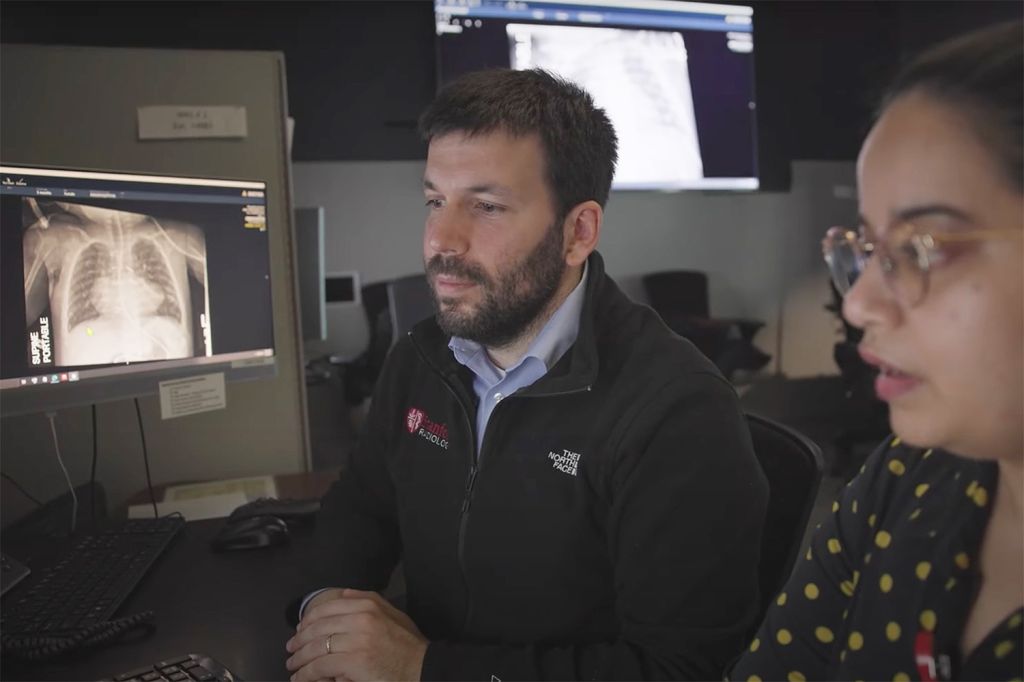
Eric Yang, clinical professor of pathology, works with Nuclei.io, a customizable AI tool for pathologists.

Identifying abnormal cells in blood samples or biopsies can be like finding a needle in a haystack – and most tools take a one-size-fits-all approach. Nuclei.io, an AI-based digital pathology framework developed by James Zou, PhD, and Thomas Montine, MD, PhD, is designed to improve workflow and diagnosis in cancer and other diseases.

Instead of trying to replace pathologists, it learns from them, adapting to individual workflows and offering personalized assistance in spotting cells linked to disease. The tool also allows pathologists to share their models with colleagues – almost like a social network –making it easier to compare results, collaborate, and build on one another’s expertise. And at its core, it uses a human-in-the-loop process: pathologists remain the decision-makers, but AI guides them to make diagnoses more efficiently and with greater accuracy.

Nuclei.io was selected as a Stanford Medicine Catalyst-awarded project, underscoring its potential to reshape digital pathology and transform how pathologists work. As a Catalyst-awarded project, it is part of a program designed to help promising ideas move beyond the lab. Catalyst provides guidance, resources, and access to Stanford’s clinical ecosystem so innovations like Nuclei.io can be refined, tested, and brought into practice – making an impact for both clinicians and patients.
For more information

This story was originally published by Stanford Medicine. 

Lisa Kim
Tel 650-723-6696

Author

Office of Communications

Share this story