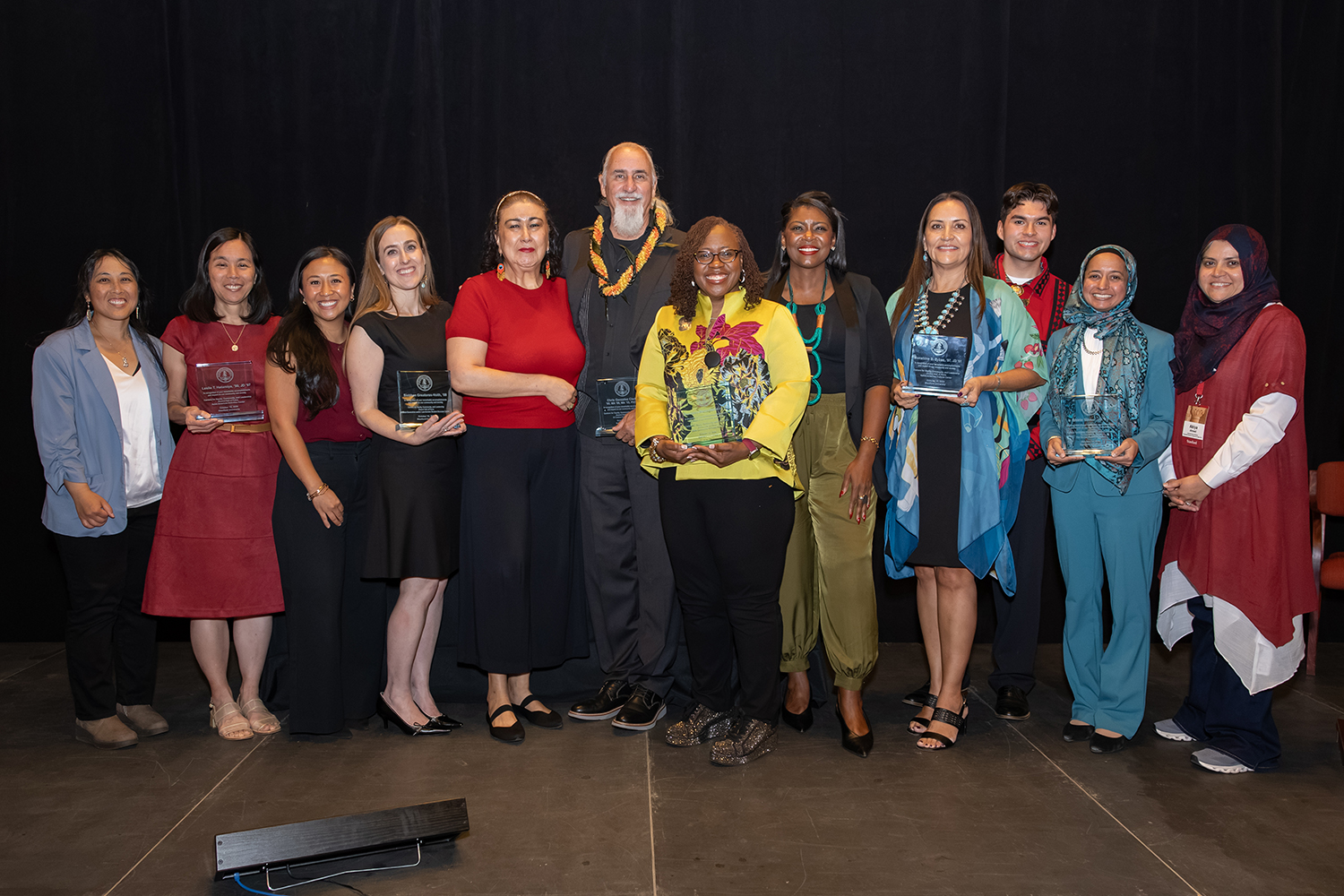
This quarter, the Centers for Equity, Community, and Leadership (CECL) welcomed six new members to its Alumni Hall of Fame.
Every year, CECL recognizes outstanding alumni who have advanced the mission of Stanford’s community centers through their educational, professional, and civic contributions to the university and beyond. All Stanford alumni are eligible for nomination, and winners are selected by each community center.
The honors are presented by the Asian American Activities Center, the Black Community Services Center, El Centro Chicano y Latino, the Native American Cultural Center, the First-Generation and/or Low-Income Student Success Center, and The Markaz Resource Center. They are awarded at a ceremony hosted by the Stanford Alumni Association during Reunion Homecoming weekend.
Following are this year’s honorees:
DeAngela Burns-Wallace, ’96, Black Community Services Center
Dr. Burns-Wallace is president and CEO of the Ewing Marion Kauffman Foundation. Her career has spanned philanthropy, diplomacy, higher education, and government. A former U.S. diplomat and senior higher education leader, she made history as the first African American to serve as Kansas secretary of administration and chief information technology officer. Her honors include recognition as a White House Champion of Change and Penn Graduate School of Education’s Sustained Leadership in Education Award. A life member of the Council on Foreign Relations, her Stanford service ranges from Black alumni leadership to the university’s Board of Trustees. She holds degrees from Stanford, Princeton, and the University of Pennsylvania.
Chris Gonzalez Clarke, ’85, MA ’06, MA ’10, PhD ’13, El Centro Chicano y Latino
Gonzalez Clarke’s Stanford career began after earning his BA in human biology in 1985, followed by staff roles with the Chicano Fellows Program and, beginning in 1993, as the associate director of El Centro Chicano y Latino. He earned master’s degrees and a PhD in higher education from Stanford and with his wife, Gina, served for six years as Resident Fellows of Casa Zapata. In the Office of the Vice Provost for Graduate Education, he grew the EDGE Doctoral Fellowship Program into Stanford’s largest fellowship program. As associate vice provost for graduate education and faculty engagement at Stanford, he leads programs for first-year PhD students, faculty advising, and graduate recruitment. Building community for students from underrepresented backgrounds has been a through line in his career for decades.
Siobhan Greatorex-Voith, ’08, First-Generation and/or Low-Income Student Success Center
Greatorex-Voith is a PhD candidate in sociology and an instructor of psychology at Harvard University. Her research examines how upward educational mobility shapes psychosocial stress and health in adulthood, with attention to variation by race, sex, socioeconomic background, and university environment. Her broader work spans educational inequality and student success, including designing and evaluating initiatives to expand college access and strengthen student support. She holds an MA in sociology from Harvard and bachelor’s degrees in symbolic systems and comparative studies in race and ethnicity from Stanford.
Leslie T. Hatamiya, ’90, JD ’97, Asian American Activities Center
Hatamiya has served as executive director of the San Bruno Community Foundation since 2015. She previously served as executive director of the California Bar Foundation and held management positions at former U.S. Sen. Bill Bradley’s presidential campaign and Senate office, Coro Northern California, and SOMA Networks. She is the author of Righting a Wrong: Japanese Americans and the Passage of the Civil Liberties Act of 1988. A dedicated Stanford volunteer, she served on the university’s Board of Trustees, the Stanford Alumni Association Board of Directors, the Task Force on Minority Alumni Relations, and the Haas Center for Public Service National Advisory Board.
Shirin Sinnar, JD ’03, The Markaz Resource Center
Sinnar has been a professor at Stanford Law School since 2012. Her scholarship focuses on the legal treatment of political violence, civil rights litigation, and institutions’ role in protecting rights and democratic values in national security. She is writing a book on the development of the concept of terrorism in U.S. law. Appointed by Gov. Gavin Newsom, she served on the California Commission on the State of Hate. She has testified before Congress; written for publications including The Washington Post, Slate, and USA Today; served as a civil rights attorney with the Asian Law Caucus and the Lawyers’ Committee for Civil Rights; and clerked at the U.S. Court of Appeals for the Ninth Circuit. She graduated from Stanford Law School, Cambridge University, and Harvard and Radcliffe Colleges.
Sunshine S. Sykes, ’97, JD ’01, Native American Cultural Center
Sykes is a U.S. District Judge for the Central District of California, where she handles civil and criminal matters. Before her federal judicial appointment, she served as a Riverside County Superior Court judge for nearly a decade, deputy county counsel, contract attorney for the Juvenile Defense Panel, and staff attorney for California Indian Legal Services. She is a member of the Navajo Nation and is the first Article III judge in California. Sykes received both her BA, with honors, in English and her JD from Stanford.
Writer
Alex Kekauoha