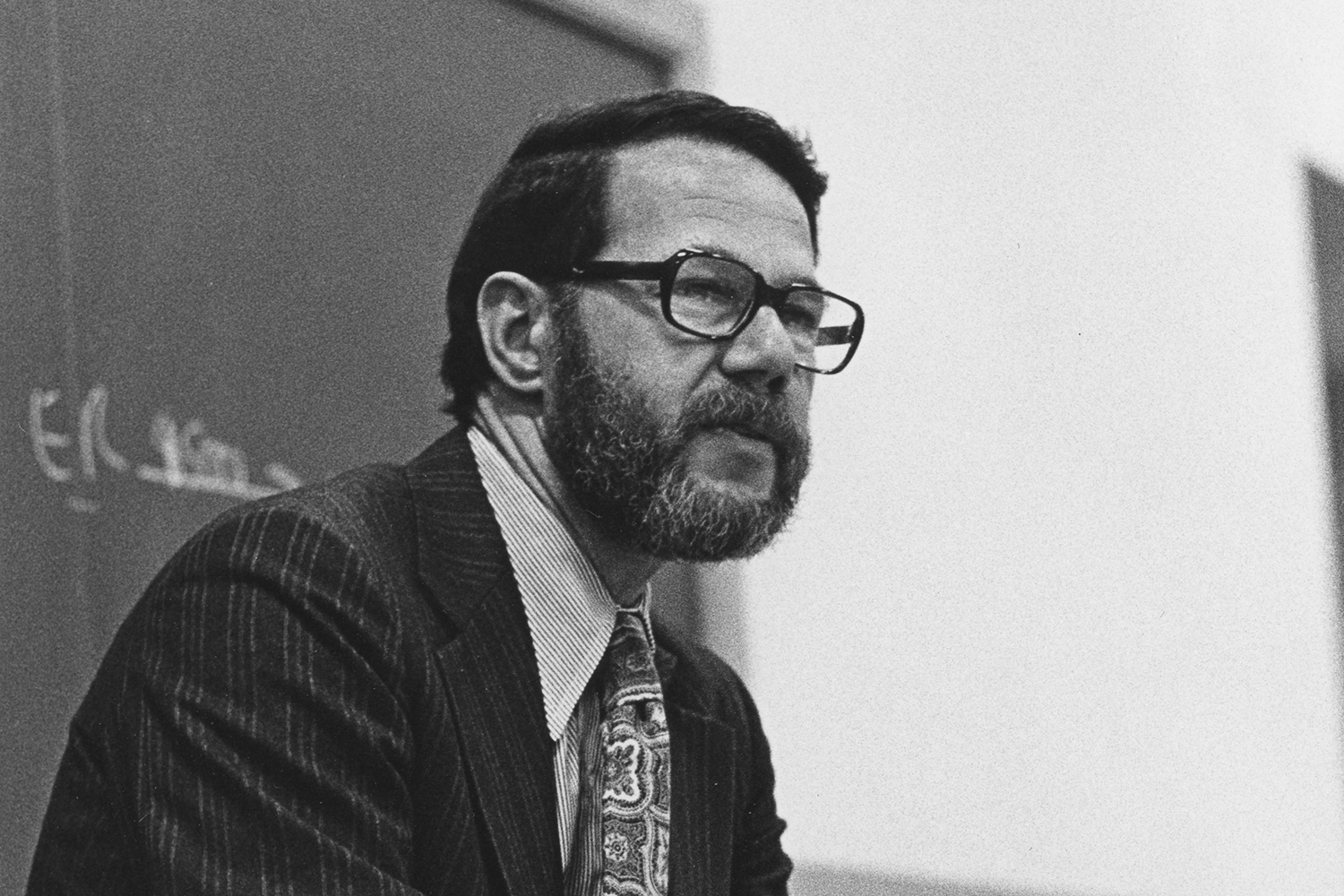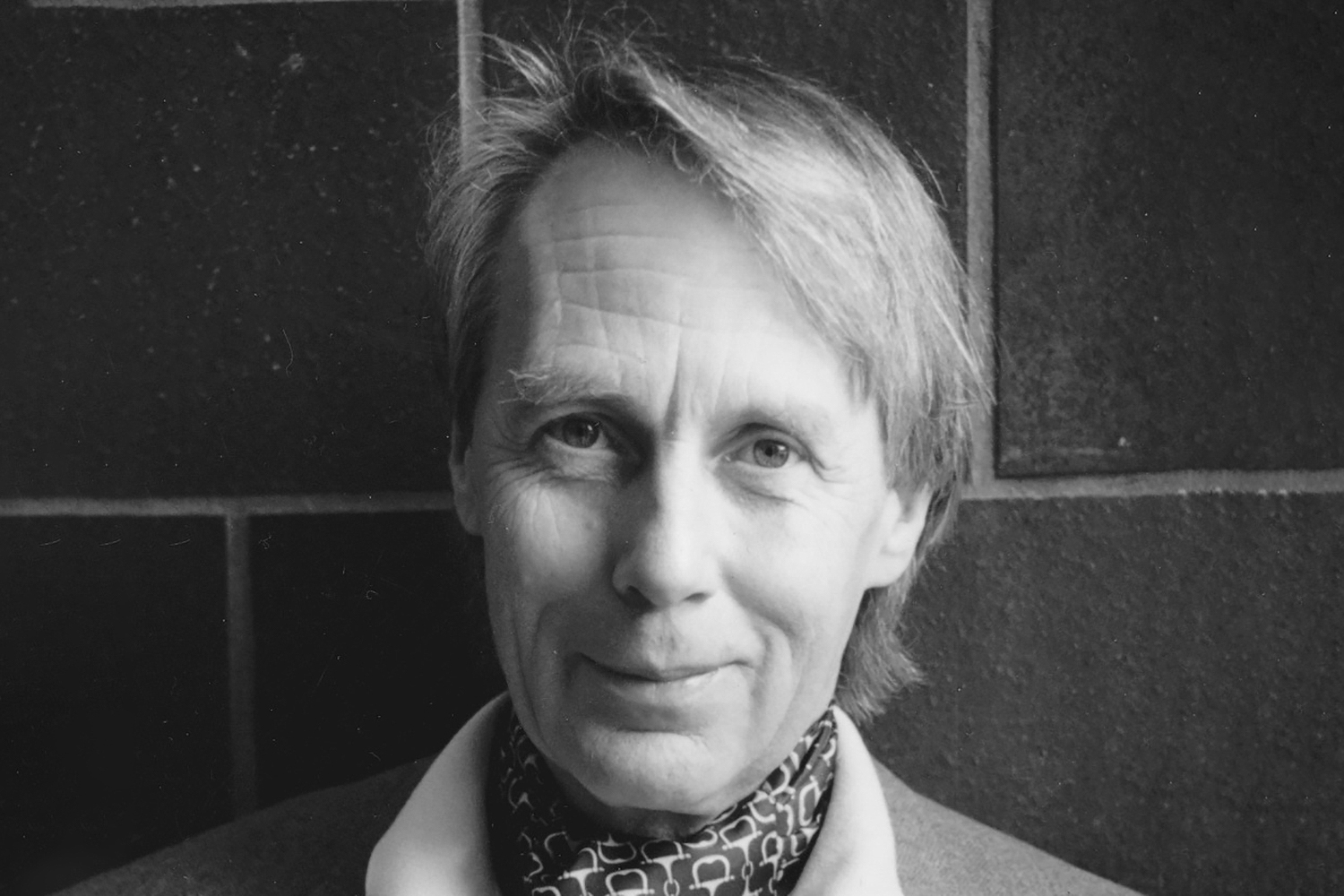
Antony “Tony” Jameson, professor emeritus of aeronautics and astronautics at Stanford University, died on June 11, 2026. He was 91.
Across a groundbreaking career spanning more than six decades, Jameson developed mathematical methods and computer programs that helped transform aircraft design. His work made it possible not only to calculate how air would move around a proposed airplane shape but also to use those calculations to improve the airplane’s performance.
“Many of the techniques, the methods, the theories that he came up with have been used by every single airplane company in the world,” said Juan Alonso, the Vance D. and Arlene C. Coffman Professor and the James and Anna Marie Spilker Chair of the Department of Aeronautics and Astronautics, who was Jameson’s doctoral student and later his colleague. “They most certainly have influenced the design of all the airplanes that you and I fly in.”
Jameson’s fascination with what Alonso called the “magic” of flight animated his work. Alonso described Jameson as soft-spoken and without pretension, with a “childlike enthusiasm about technical matters.” He wrote code beside students and filled lecture notes with sketches of airplanes, birds, and improbable hybrids of the two.
Before bringing that curiosity to Stanford as a researcher and mentor, Jameson followed a circuitous path through engineering, economics, and applied mathematics, eventually turning to aircraft design.
From mathematics to aircraft
Born on Nov. 20, 1934, in Gillingham, Kent, England, Jameson spent part of his childhood in India, where his father served as a British Army officer. He earned a bachelor’s degree with first-class honors from the University of Cambridge in 1958 and a PhD in magnetohydrodynamics – the study of how electrically conducting fluids behave in magnetic fields – in 1963.
After a postdoctoral fellowship at the Massachusetts Institute of Technology, he worked briefly as an economist for the British Trades Union Congress, then returned to engineering as chief mathematician for Hawker Siddeley Dynamics’ missile division.
Jameson moved to the United States in 1966 to join Grumman Aerospace’s aerodynamics section. His first work there applied automatic control theory to aircraft stability systems. In 1970, he turned to predicting airflow near the speed of sound after existing numerical methods proved inadequate.
Working at Grumman on an IBM 1130 punched-card computer, he wrote FLO1, which calculated airflow past a two-dimensional airfoil, and SYN1, which worked backward from a desired pressure distribution to determine an airfoil shape. Those were the first in his FLO and SYN series of computer programs, which grew to model wings and complete aircraft, establishing computational fluid dynamics as a practical engineering discipline.
Jameson joined the Courant Institute of Mathematical Sciences at New York University in 1972, then moved to Princeton University in 1980. He and his collaborators steadily expanded what computers could model. By 1976, their FLO22 program could calculate transonic airflow around a swept wing. In 1985, their AIRPLANE program, running on a Cray-1 supercomputer, calculated the inviscid flow around a complete aircraft – a milestone in modern computational aerodynamics.
He joined Stanford’s Department of Aeronautics and Astronautics as the Thomas V. Jones Professor of Engineering in 1997. Over the next 21 years, he extended his foundational work into increasingly realistic methods for computational aircraft design.
Turning analysis into design
During his Stanford years, Jameson concentrated his research on aerodynamic optimization. Conventional computational fluid dynamics predicted how air would flow around a proposed wing; his methods allowed engineers to use those calculations to reshape the wing to reduce drag, maintain lift, or meet other performance goals.
A wing’s shape can involve thousands of variables, and testing each possible adjustment separately would require thousands of costly simulations. Jameson’s adjoint method analyzed them together, showing how the changes would affect drag, lift, or another goal at roughly the cost of one extra simulation. That made it practical to optimize a shape with thousands of variables instead of testing each alteration at a time.
The adjoint approach predated Jameson’s arrival at Stanford. But his early Stanford-era studies used the power of parallel computing to extend it to optimize full aircraft configurations – including wings, fuselages, engine nacelles, and pylons – under multiple operating conditions and constraints.
Jameson and his Stanford collaborators then extended the approach to simulations that accounted for air’s viscosity. In a 2004 paper, his group applied it to the wings, flaps, and slats used during takeoff and landing, where air moves through narrow gaps between surfaces. Other studies coupled aerodynamic and structural calculations, allowing researchers to alter a wing’s overall planform while accounting for its weight, flexibility, and performance in several flight conditions.
Later at Stanford, Jameson pursued high-order methods, which represented airflow more precisely within each section of a computational grid. Because the calculations demanded enormous computing power, he was early to use graphics processing units (GPUs) to perform many calculations at once, accelerating the work.
A 2018 study with Jacob Crabill (PhD ’18) and Freddie Witherden combined these methods with overlapping grids and GPU-oriented algorithms to simulate airflow over a spinning golf ball, tracking its rotation and the flow around individual dimples. The example demonstrated that the methods could handle moving, complex surfaces under realistic conditions.
Throughout his career, Jameson remained a hands-on programmer, testing new methods on his own computer. Sanjiva Lele, the Edward C. Wells Professor in the School of Engineering and a professor of mechanical engineering and of aeronautics and astronautics at Stanford, said Jameson often recognized computing trends early. “Tony could see where the field was going to go, and that’s what he would work on,” Lele said.
At Stanford, Jameson created an advanced computational fluid dynamics course sequence that taught the methods he used in his research. Students trained in it went on to university posts and careers in aerospace and software companies, Alonso said. Most spring quarters, he also organized Stanford’s Case Studies in Aerospace Design seminar series, where leading designers explained how landmark aircraft were developed.
Jameson also contributed to Stanford’s Center for Integrated Turbulence Simulations, established in 1997 as part of the Department of Energy’s Accelerated Strategic Computing Initiative. Over the program’s decade-long run, the center helped expand simulations from relatively modest systems to hundreds of thousands of processors and entire jet engines, Alonso said. Jameson’s 2022 book, Computational Aerodynamics, distilled the mathematical and practical knowledge he had developed and taught over his decades at Stanford.
Jameson became emeritus in 2018 and joined Texas A&M University as a professor of aerospace engineering and ocean engineering, where he continued researching and teaching into his 90s. At a Stanford symposium honoring his 90th birthday, “Tony was attending and asking questions, as usual,” Lele said. “He was sharp.”
About a month before Jameson’s death, Alonso visited with him at Texas A&M. “I had lunch with him and chatted about research,” Alonso said. “I think he enjoyed what he did so much that he still wanted to spend time doing it at age 91.”
Over his career, Jameson authored or co-authored more than 500 scientific papers. His honors included the Daniel Guggenheim Medal, the Elmer A. Sperry Award, the Royal Aeronautical Society Gold Medal, and election as a fellow of the Royal Society and a foreign member of the National Academy of Engineering. The U.S. Association for Computational Mechanics awarded him the John von Neumann Medal, and he was an honorary fellow of the American Institute of Aeronautics and Astronautics.
Outside the lab, Jameson was athletic. He would play squash with Alonso and students on Sunday mornings and watch soccer and football games. He read voraciously about economics and world affairs. He was also a gifted storyteller whose wide-ranging conversations could move easily from aircraft to exchange rates, inflation, and international trade.
Jameson is survived by his wife, Charlotte Ansted-Jameson; five children; and multiple grandchildren.
For more information
This story was originally published by Stanford Engineering.
Writer
Jennifer Welsh