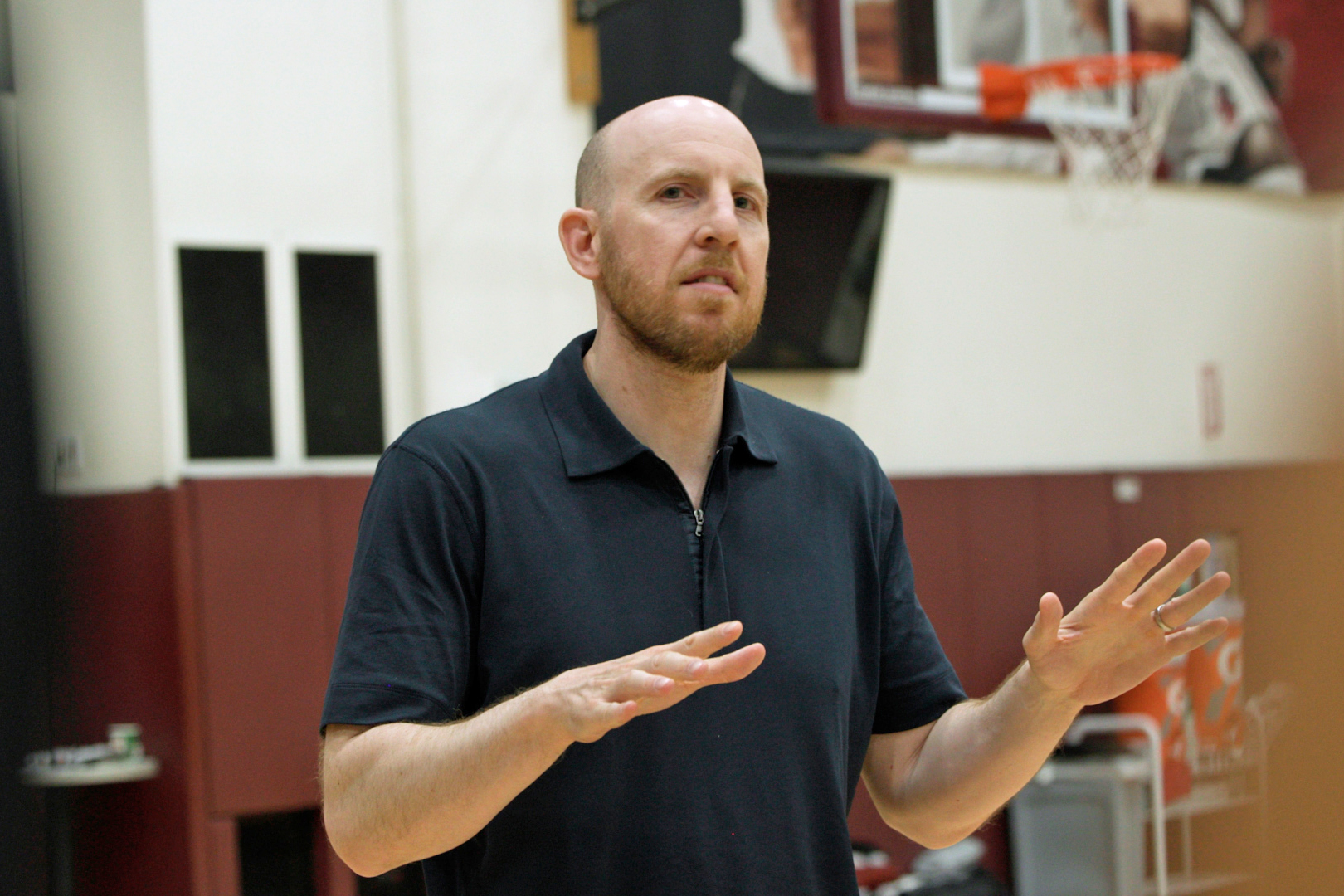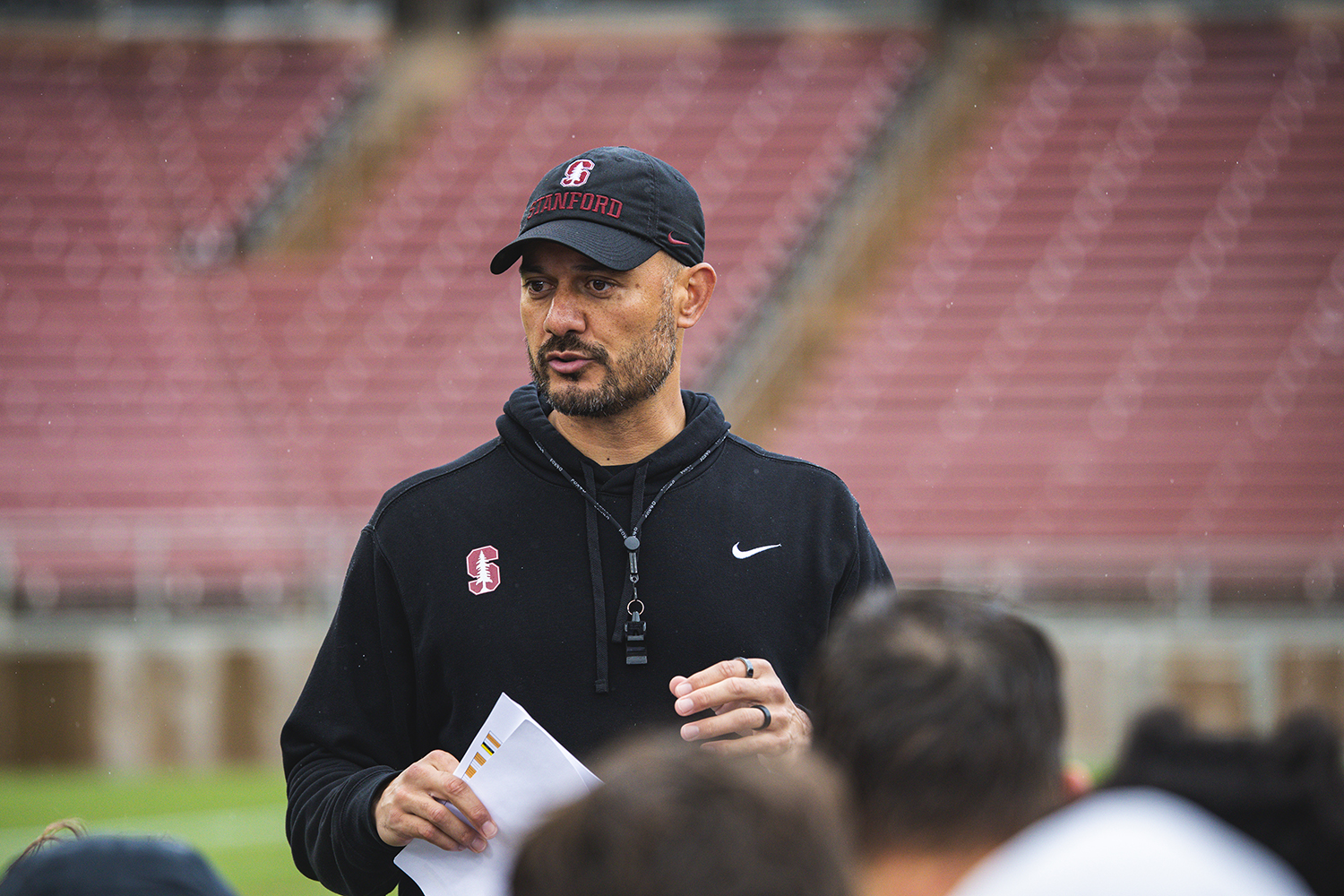
Tavita Pritchard is excited to be home.
His first game as the Bradford M. Freeman Director of Football on Aug. 29 marks the latest in a series of landmark Cardinal moments for the Stanford alum: Pritchard played quarterback 2006-09 (overlapping for a year with football general manager Andrew Luck), met his future wife in the sociology class Sex and Love in Modern Society, and earned a bachelor’s degree in communication in 2009.
Fun fact: He also played on the Stanford men’s basketball team for a year as an undergrad. “I’m kind of a geek for team dynamics,” he said. “Just getting to see a college sport through a different lens, a smaller team, a different lifestyle, was really a special experience.”
After graduation, Pritchard spent nearly 13 years in Cardinal football coaching roles before becoming the quarterbacks coach of the Washington Commanders in 2023.
Game day
Come cheer for the Cardinal, which hosts the Hawai‘i Rainbow Warriors at Stanford Stadium on Aug. 29. The evening will include a celebration of Pacific Islander heritage with live performances, special recognitions, and more. It’s also Cardinal Kids Day, and families can get up to four free youth tickets with a paid adult ticket. Learn more and get tickets.
Ahead of Saturday’s game against Hawai‘i, he talked about how teams build trust, what sets Stanford students apart, and where you’ll find him hanging out on campus.
Answers have been edited for length and clarity.
What kind of energy do you hope to build around Stanford football this season?
One of the things I love about Stanford is that the students support our players because they love people who are passionate about what they do, who take it very seriously. Our players are pursuing excellence. Every year we have people going to the NFL. It’s noble to come watch these guys pursue that.
In the spring, we really encourage our players – we actually had a team competition around this – to attend other sports because rising tides lift all ships. That’s true across campus. I still remember going to watch friends of ours in Gaieties and talking about games during dorm meetings at Rinconada. Honoring people’s passions is a space that Stanford does really well, so it’s not just a fun experience but it’s about community.
There’s gonna be high energy. We play really hard, and our hallmark is going to be the energy that we play with, how we finish our plays and games.
Your father, David Pritchard, and your uncle, Jack Thompson, both played for the Washington State Cougars, and your uncle went on to the NFL. What role has your family heritage played in your approach to football?
Many things in football, like selflessness toward the team, are core to our beliefs as Samoans. There’s a strong correlation between what it takes to be successful in football – physically, mentally, emotionally, spiritually – and Samoan values and culture, like teamwork, community, respect, family, service, leadership, discipline. I grew up in a biracial Samoan household, and my dad instilled a lot of those things in our family. I have 10 siblings, and the culture and football almost seemed intertwined in the way we were raised. My dad was a high school football coach, so I was a ball boy on the sideline Friday nights, and I learned my love of football from him. My uncle taught me how to play quarterback.
We have a phrase in Samoan, “O le ala i le pule o le tautua,” which means “the road to leadership is through service.” I saw that with my dad, as players he coached in high school approached him years later to thank him. The way I saw leadership played out through service in that way was integral to my understanding of football and our culture.
Have you used that concept in coaching?
I have, but one I tell the players more often is “teu le vā,” which means you “nurture the space.” The best teams I’ve ever been a part of were ones in which we had great camaraderie. “Teu le vā” is about the sacred space between people. In our culture, it’s about your relationship with your siblings, parents, elders, to the community and the intentional ways we nurture our connections. We talk a lot about that on our team. One of our values in our program is connection, because that’s the foundation on which we have to approach this game. That’s incredibly hard. There’s a lot of adversity. You have to work really hard in the season, in the offseason. You have to hold each other to a standard, and the foundation for that has to be this understanding that we’re in this together. So much of what we do has to be rooted in trust and genuine care for each other.
Honoring people’s passions is a space that Stanford does really well.
Your first game as head coach is also Pacific Islander Heritage Night. What does that timing mean for you?
It’ll be very special to run out in that stadium again, having played there with so many great memories and moments. It is also special because of who we’re honoring and representing. My sister had this Samoan-style Stanford sign made for me that’s in my office, and it’s a reminder for me that I don’t have this role separate from my community. I think about my grandparents who immigrated here from American Samoa and the people who came before me to this country with opportunities, all of which has propped me up and propelled me. This game will be a great representation for many Pacific Islanders, not just in the Bay Area, but also the players coming from Hawai‘i. It’s a great way to honor those who came before and those in our community now. We have four Pacific Islander players on our team. We have multiple Pacific Islanders on our staff. We approach it with a lot of pride, and I approach it with a lot of humility, because the game is a representation of all the love and support that I’ve gotten along the way.
In your experience, what sets Stanford student-athletes apart?
It comes back to focus. There’s so much here – academics, student life, athletics, the surrounding Bay Area. One of the challenges for Stanford students and student-athletes is how to shift focus when necessary in order to learn, progress, and pursue the things you want to pursue. That focus is core to what we do in football. Stanford student-athletes have a capacity for toughness, which at the end of the day is the ability to shift focus to the things that are enriching your life and not get burnt out on any one thing. It makes them better football players if they approach it the right way, if they’re able to zoom in and out when it’s appropriate.
How does it feel to be back?
Stanford has been so special and transformative in my life for the obvious reasons of playing football here, coaching here, meeting my wife here, three of my four children were born at Lucile Packard [Children’s Hospital]. During last year’s Big Game win, I was watching and thinking about my journey here. It was a moment of gratitude and humility, because I can now help create an environment for our players that can be transformative for them too. I want to support their pursuits and passions.
Part of the magic of Stanford is that when you’re an athlete here, you’re also just one of the students. I would love to meet more students, for them to introduce themselves to me. My wife and I live on campus; this is our home. We love taking our four little kids to Meyer Green or the Quad, and we go to Treehouse quite often. We love being around the energy of Stanford.
Writer
Chelcey Adami