In brief
- Stanford Medicine researchers engineered a two-headed molecule called TCIP3 that redirects BCL6, a lymphoma-driving protein, to trigger cancer-cell death.
- The study found that TCIP3 eliminated lymphoma tumors in mice within 11 days of twice-daily treatment with no obvious signs of toxicity.
- Researchers believe this protein-redirecting approach could potentially extend to other cancers and autoimmune diseases, including rheumatoid arthritis.
A two-headed molecule designed by Stanford Medicine researchers hijacks one of the most common protein drivers of B-cell lymphoma, flipping it from its role as a promoter of cell growth into an arbiter of cell death. In mice, a short course of twice-a-day treatment eliminated aggressive lymphoma tumors within 11 days.
The approach builds on a strategy the researchers have been refining for several years: Rather than trying to block a cancer-causing protein, they engineer a small molecule that physically links the culprit with another molecule that switches on the cell’s own self-destruct program. A similar approach may work for other types of cancers and autoimmune diseases, the researchers believe.
“We’re trying to essentially fight cancer with its cause – taking the driving force of the cancer and then rewiring it to activate cell death mechanisms,” said Gerald Crabtree, MD, the David Korn, MD, Professor in Pathology and a professor of developmental biology.
Crabtree shares senior authorship of the study, which was published online July 20 in Cell, with Nathanael Gray, PhD, the Krishnan-Shah Family Professor and a professor of chemical and systems biology; Stephen Hinshaw, PhD, assistant professor of molecular and cellular physiology; and Michael Green, PhD, director of translational and laboratory research, lymphoma/myeloma at the MD Anderson Cancer Center. Graduate student Meredith Nix and postdoctoral scholar Sai Gourisankar, PhD, are the lead authors of the research.
A cancer-enabling protein
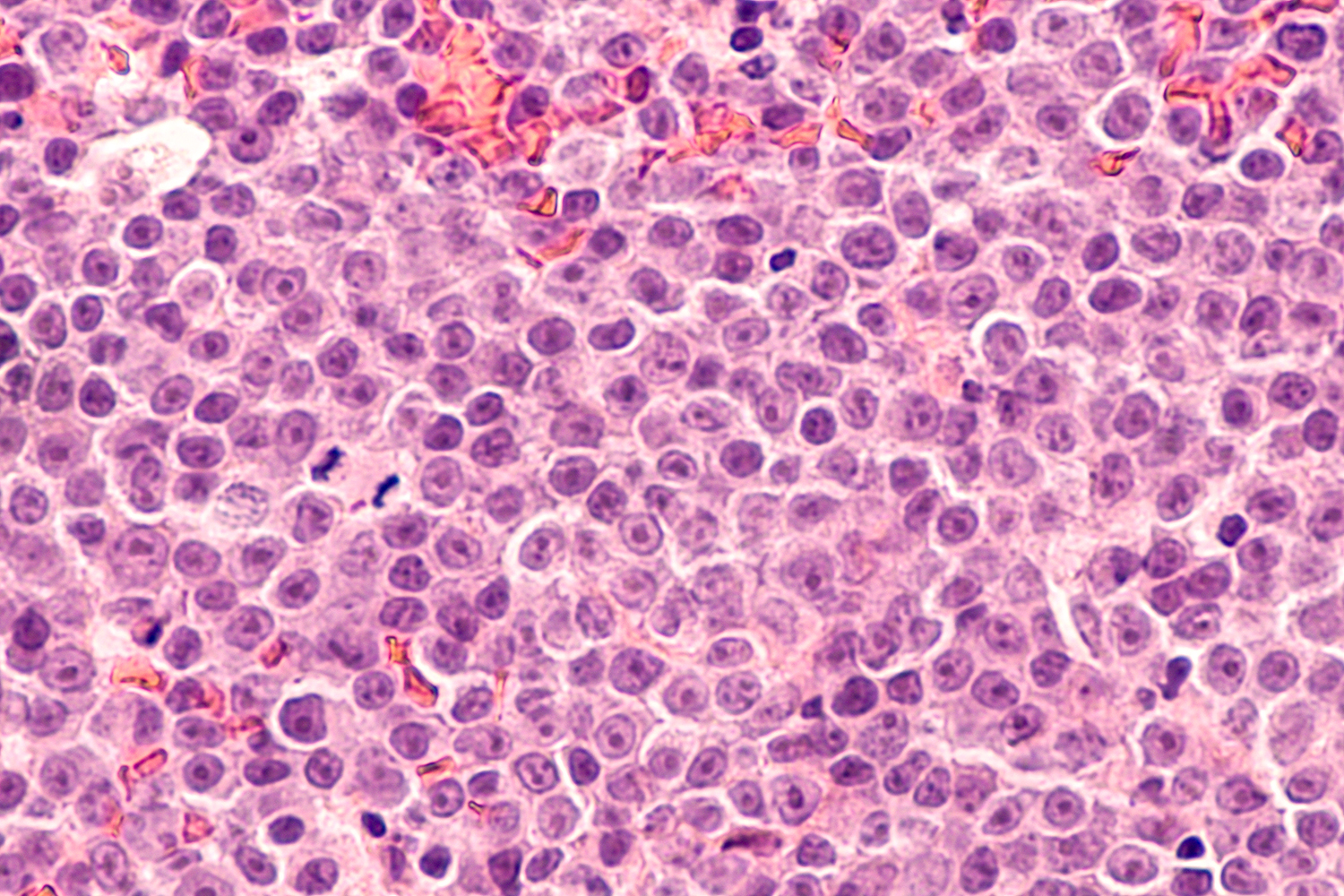
Diffuse large B-cell lymphoma, the most common form of a blood cancer called non-Hodgkin lymphoma, is often driven by a protein called BCL6. In healthy immune cells, BCL6 sits on DNA and temporarily silences genes that would otherwise trigger cell death or halt growth, allowing those cells to multiply as needed during an immune response.
After the threat is nullified, other proteins modify BCL6 in a way that blocks its gene-silencing ability, triggering the now unneeded immune cells to die off. This process of programmed cell death, called apoptosis, is a vital way the body removes excess, damaged, or cancerous cells without triggering inflammation or tissue damage.
Lymphomas arise when BCL6 gets stuck in the “on” position, permanently muzzling the death genes and letting cancer cells proliferate unchecked. Crabtree, Gray and their colleagues sought a way to not only release this repression, but also to shift the expression of the death genes into overdrive. To do so, they used a technique called chemically induced proximity, in which molecules that interact rarely or not at all under normal conditions are brought together through chemical bonds.
The molecule they created, TCIP3, is built like a two-sided key. “One side binds to BCL6,” Nix explained. “The other side binds either of two proteins called P300 and CBP that add chemical tags called acetyl marks onto nearby proteins.” Adding an acetyl tag to BCL6 blocks its ability to silence the expression of downstream cell death genes. Critically, P300 and CBP also add acetyl tags to neighboring DNA packaging centers called histones. These tags trigger histones to release their DNA and allow access to proteins called transcription factors required for gene expression.
The effect differs from that of existing BCL6-targeted drugs, which simply block or degrade the protein. “We’re not just relieving the repression conferred by BCL6; we’re also actively driving the expression of these cell death genes, which is why we’re able to get really potent compounds,” Nix said, comparing the difference to easing off a car’s brake versus flooring the accelerator.
‘Molecular glue’
To understand why the molecule worked so well, the team visualized its atomic-level structure by bombarding its crystallized form with X-rays – showing exactly how the drug links the two proteins together. That structure revealed something the researchers hadn’t fully anticipated: The proteins, once forced into proximity by TCIP3, formed a handful of their own unplanned chemical contacts that locked the whole assembly in place, making the effect of the hybrid molecule far stronger than expected.
“We used structural studies and biophysical measurements to determine that TCIP3 acts as a kind of molecular glue, anchoring these proteins together,” Gourisankar said. That structural insight let the chemists stiffen the connection between the molecule’s two halves, locking favorable contacts in place rather than letting the molecule flex and waste energy. The result was TCIP3, which killed lab-grown lymphoma cells at very low concentrations.
We’re trying to essentially fight cancer with its cause – taking the driving force of the cancer and then rewiring it to activate cell death mechanisms.Gerald CrabtreeThe David Korn, MD, Professor in Pathology
Finally, the researchers implanted human lymphoma cells in mice, allowed them to form tumors and treated the animals with TCIP3 twice daily. “By 11 days, the tumors that had been treated with TCIP3 were completely gone, whereas the tumors in the control animals remained,” Nix said. The treated mice showed no obvious signs of toxicity, and blood tests found no spike in inflammatory signals, even though the drug was also eliminating germinal centers – clusters of rapidly dividing immune cells that rely heavily on BCL6 and are the same cell type that goes awry in lymphoma.
That side effect turned out to be a clue to a second possible use for the technology. Because germinal center cells also drive certain autoimmune diseases, including rheumatoid arthritis and myasthenia gravis, the researchers believe that molecules like TCIP3 might eventually be turned against those conditions as well.
More research needs to be conducted to determine if TCIP3 or its derivatives can be used in the clinic, however. The molecule needs further chemical refinement and testing in additional animal species before it can be considered for human trials. But the underlying strategy – using bivalent, or two-headed, molecules to redirect, rather than simply block, a cancer-driving protein – appears to be broadly extendable. The researchers are now searching for other cancer-driving proteins that might be susceptible to the same molecular matchmaking.
“This could be a powerful approach to tackling other cell death repressors or transcription factors that control genes we want to activate in cancer,” Nix said.
For more information
Researchers from MD Anderson Cancer Center and the AI-powered drug discovery platform Deep Origin contributed to the study.
The study was funded by the National Institutes of Health (grants CA276167, CA163915, R01CA3044298, MH126720-01, S10OD028697-01, R01CA201380 and 1K99CA296700-01), the Howard Hughes Medical Institute, the Mary Kay Foundation, the Williams Foundation, the Victor Family Fund, Ed and Beatriz Schweitzer, the David L. Sze and Kathleen Donahue Interdisciplinary Fellowship, and a PhRMA Foundation Predoctoral Fellowship in Drug Discovery.
Crabtree is a founder and scientific advisor for Shenandoah Therapeutics, which has a license from Stanford University for the TCIP technology described in the study. Gray is a founder, scientific advisor, and board member for Shenandoah Therapeutics.
This story was originally published by Stanford Medicine.
Writer
Krista Conger