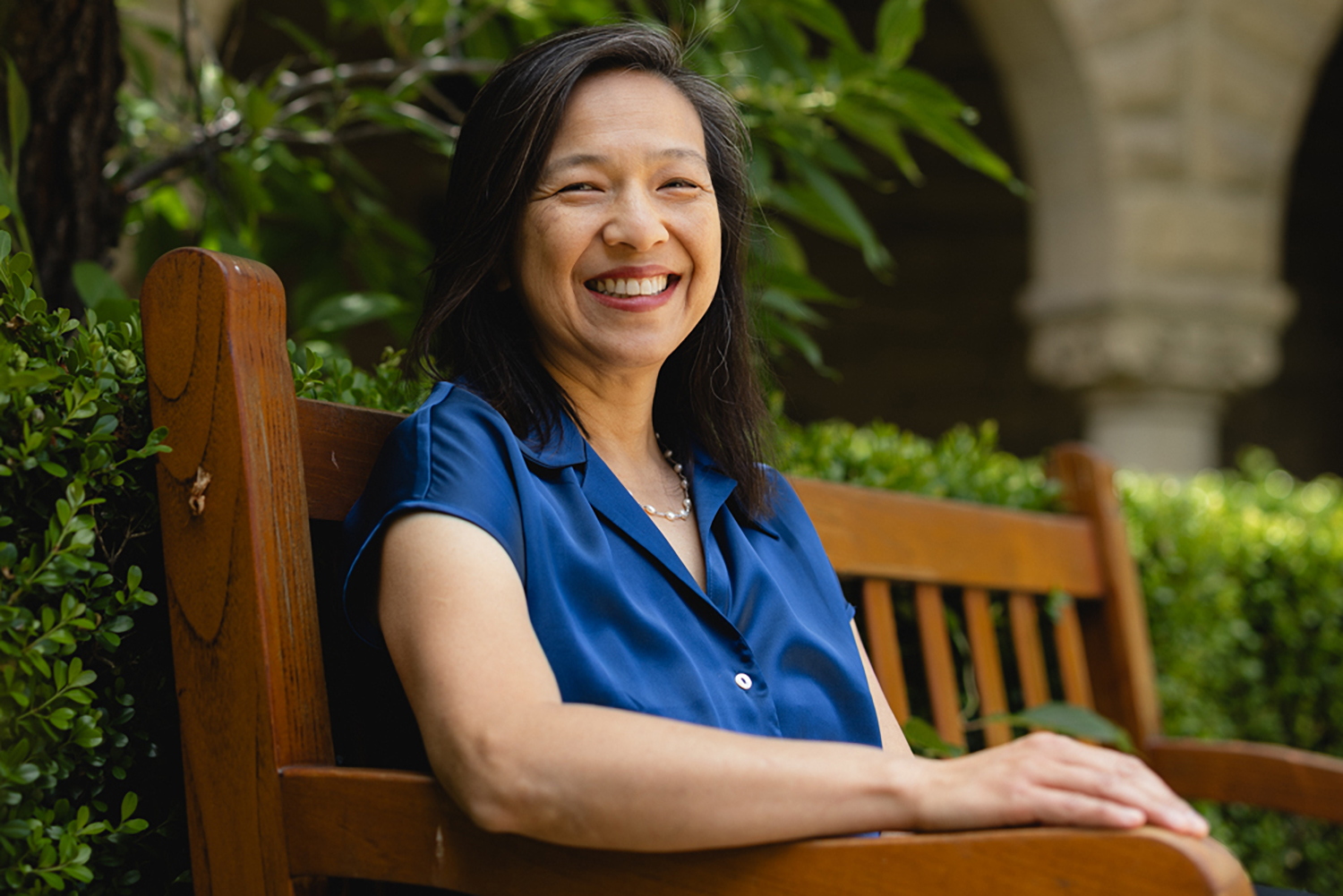
Mary M. Chen has spent more than 25 years building a legacy of thoughtful leadership, strategic support, and dedicated mentorship that has made a lasting difference in research at the School of Medicine (SoM).
In honor of her outstanding contributions, Chen has been awarded this year’s Marsh O’Neill Award for Exceptional and Enduring Support of Stanford University’s Research Enterprise.
Chen is executive director of the Stanford Maternal and Child Health Research Institute (MCHRI), assistant dean of maternal and child health research at the SoM, and staff leader for the maternal and child health component of the Stanford Clinical and Translational Science Award, which accelerates the translation of new biomedical treatments into interventions that improve patient care and population health.
“I feel incredibly humbled to receive this award,” Chen said. “There are so many people who deserve this, so I feel really grateful and honored to be the one representing MCHRI and SoM staff who contribute to the university and its research.”
Under Chen’s leadership, MCHRI has become a model for clinical research infrastructure and has grown to include nearly 1,500 members representing all clinical and basic science departments at the SoM and all seven Stanford schools.
Mary Leonard, the Arline and Pete Harman Professor and Chair of the Department of Pediatrics, director of MCHRI, and the Adalyn Jay Physician in Chief at Lucile Packard Children’s Hospital, describes Chen as “the single most talented, creative, generous, thoughtful, steadfast, impactful, effective, and wise executive administrator” encountered in her 30 years of leadership.
“The breadth and depth of her contributions will endure for years to come,” Leonard said. “She leads and motivates others through coaching, generosity, professionalism, mentorship, and innovative approaches.”
Chen received nominations from faculty and leaders across the School of Medicine.
“MCHRI is the beating heart of pediatric and maternal health care research activities of the university, and Mary literally keeps it running,” said Karthik Balakrishnan, the Susan B. Ford Surgeon-in-Chief of Stanford Medicine Children’s Health and Lucile Packard Children’s Hospital. “She is deeply committed to the mission and success of MCHRI and the university, and even more so to the health of mothers and children who will benefit from the work supported by the institute.”
‘Science of the science’
In 2000, Chen earned her master’s in molecular microbiology and immunology from Johns Hopkins University and began working as a research assistant in the SoM’s Division of Cardiovascular Medicine.
After a few years, Chen transitioned to a lab manager role and then became associate director of the Reynolds Cardiovascular Research Center. This sparked her interest in the business side of research support – which she calls the “science of the science” – and she began pursuing her MBA at Santa Clara University part time in the evenings.
“I’ve always been very interested in business, and this was applied to science, which is my training,” Chen said. “It was a perfect marriage to have as a background to what I do.”
In 2006, Chen transitioned to a pediatrics program that was the foundation of what is now MCHRI. “It was really taking on the Child Health Research Program as a manager and then building it up over many years,” Chen said. “I evolved with the growth of this institute – from managing the program to administrative staff leader, and now as the executive director.”
Early on, Chen developed an “acuity tool” for estimating research personnel effort that has since been refined by her team, led by May Zepeda, associate director of clinical research coordinator services, over the past 15 years. The tool enables Stanford to accurately budget for clinical trials and is currently being made widely available, Leonard said.
Chen also played a key role in building the formalized structures and review processes that now form MCHRI’s grant infrastructure, strengthening the institute’s ability to support faculty and trainees and advance maternal and child health projects with the highest potential for success. Her team developed online applications for intramural grant programs, created rigorous scientific review processes, and established metrics to track program outcomes.
Chen enjoys making things run smoothly. “When people almost haven’t noticed the detailed preparations, we know we’ve done a good job,” Chen said. “I feel like the impact is never too big or too small.”
In 2015, she was named the assistant dean of maternal and child health research at the SoM, and in 2017, Chen became executive director of MCHRI, which oversees 14 grant programs, 17 review panels, and more than 120 faculty reviewers each year under the leadership of Kim Stern, associate director of grants programs.
Chen also co-directs the Clinical Research Support Office (CRSO) with Alyson Falwell and Karl Sylvester in partnership with Lucile Packard Children’s Hospital (LPCH). Her contributions to the development of the CRSO have “helped to transform the [LPCH] into a nationally preeminent institution capable not only of delivering the highest quality of care for children but also carrying out clinical investigations that can advance maternal and pediatric care,” said David K. Stevenson, the Harold K. Faber Professor of Pediatrics and director of the Prematurity Research Center.
Additionally, Chen has served on several school-wide committees, such as co-chairing the Clinical Human Subjects Research Committee during the pandemic under the leadership of Ruth O’Hara, senior associate dean of research at the SoM.
“We spend so much time at work, I strive for our collective efforts to be meaningful and impactful,” Chen said. “Sustaining excellence is really hard, and I’m relentless when it comes to standards in everything we do at MCHRI. I must make sure it’s as good as I can make it – that I’m a role model for my kids and my team, and that our work makes a lasting impact.”
Supporting others
Chen is a “tireless advocate for research education and mentoring of research staff, trainees, and faculty,” Leonard said. In 2007, Chen wrote a business plan, secured funding, and launched what is now the Pediatric Faculty Mentoring Program (PCAMP), which fosters professional development for early-career faculty and has been used as a model for other departments and institutions. To sustain the program, Chen ensured that protected time was built in for faculty mentors and administrative staff – something she said is essential but often overlooked.
Chen also led the implementation of the Diversity, Respect and Inclusion are Vital for Excellence (DRIVE) in Research Pathway, a summer internship research program for first-generation and low-income undergraduate students, now in its sixth year. In 2022, her team launched the Community Engaged Research to Promote Health Equity Pilot Grants and helped establish the Office of Community-Engaged Research under the leadership of Anisha Patel, director of the office, and Dongmei Tan, program manager.
Chen also serves as a mentor in programs like the Stanford Asian American Interactive Mentoring Program for undergraduates and the SoM’s Staff Mentoring Program for staff.
“To feel fulfilled in your work, consider what you are doing daily that will build over time and last beyond what you do today. Keep that legacy as your North Star,” Chen said. “This award highlights that staff are really important partners to our faculty, trainees, and learners. We are here to support them, and we are really critical to the research mission, the patient care, and the education of the university.”
For more information
The Marsh O’Neill Award is administered by the Office of the Vice Provost and Dean of Research (VPDoR) and recognizes outstanding contributions to Stanford’s research mission.
The prestigious award was inspired by the career of Marsh O’Neill, associate director of the W.W. Hansen Laboratories from 1952 until 1990, and the first recipient of the award. Faculty nominate outstanding staff members who support their research activity for the award, which is presented annually to university staff and includes a $5,000 cash prize.
The award will be presented on June 25 at a reception hosted by VPDoR.
O’Hara is the Lowell W. and Josephine Q. Berry Professor in the Department of Psychiatry and Behavioral Sciences and director of the Stanford Center for Clinical and Translational Research and Education (SPECTRUM).
Writer
Chelcey Adami