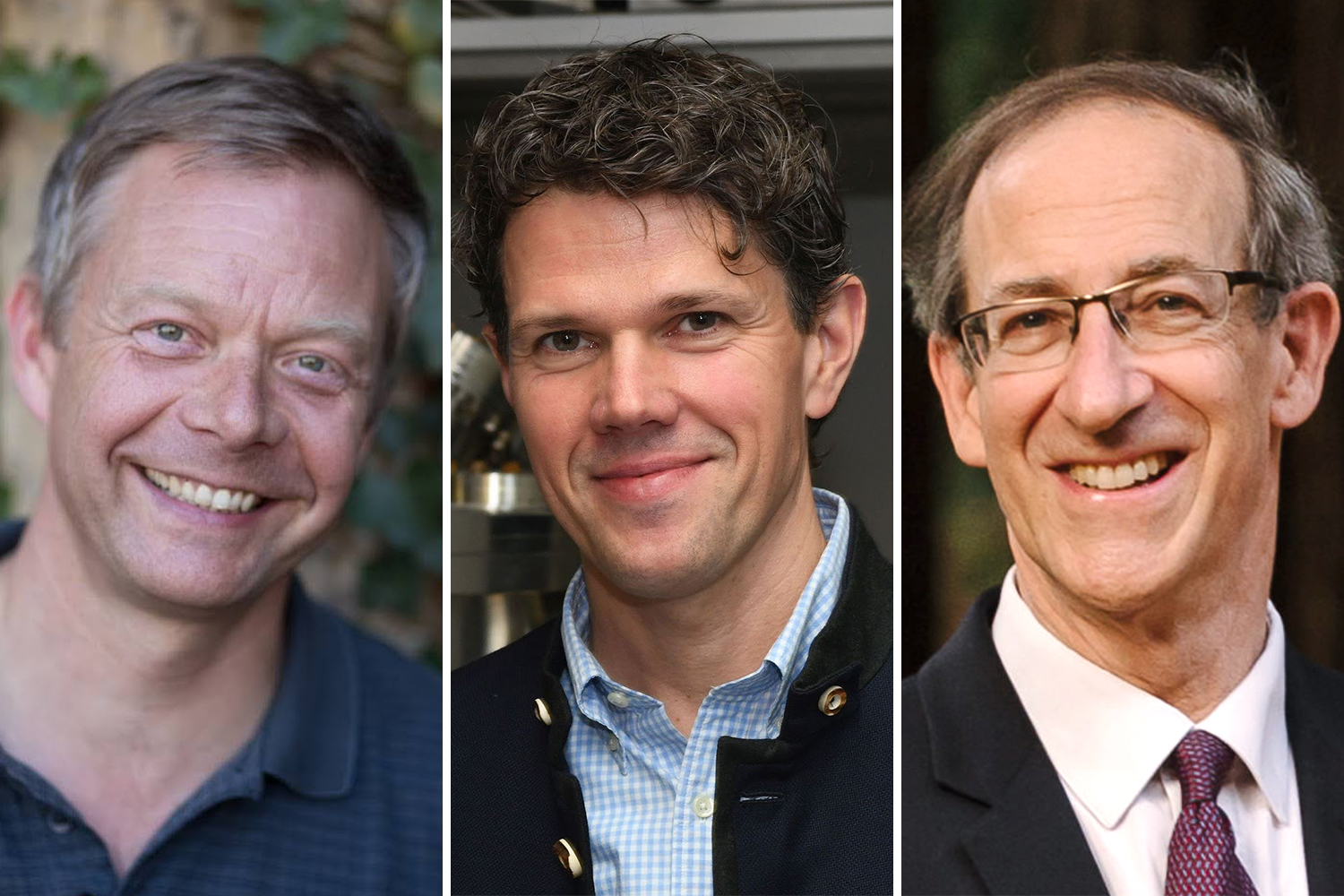
Stanford has appointed new directors to three of its independent research laboratories, organized under the Office of the Vice Provost and Dean of Research (VPDoR). Mark Brongersma, Matthias Kling, and Tony Heinzwill lead the Geballe Laboratory for Advanced Materials (GLAM), the Stanford PULSE Institute, and the Edward L. Ginzton Laboratory, respectively.
The units span different scientific domains but serve the same purpose: they are home bases for clusters of faculty labs, which also house specialized equipment and expertise that serve scientists across campus. The faculty directors oversee research priorities, access, collaborations, and long-term equipment investments. All three have recently started their new faculty director roles.
“GLAM, PULSE, and Ginzton are vibrant research communities where physical scientists from four schools, more than a dozen departments, and SLAC can work alongside one another on problems that demand multidisciplinary approaches,” said David Studdert, vice provost and dean of research. “These organizations have remarkable track records, going back decades, of impactful research and top-notch training programs. Mark, Tony, and Matthias are highly respected faculty leaders, and each has a vision to build on their labs’ success.”
Meet the new faculty directors and learn more about the labs and institutes they are leading.
Mark Brongersma
Geballe Laboratory for Advanced Materials (GLAM)
Mark Brongersma is GLAM’s former deputy director and was appointed faculty director in June 2025. His extensive knowledge of the lab ensured a smooth transition from Sarah Heilshorn, who left her post after a distinguished term to become chair of the Department of Materials Science and Engineering.
While a postdoctoral research fellow at the California Institute of Technology from 1998 to 2001, Brongersma coined the term “Plasmonics” for a new device technology that exploits the optical properties of nanoscale metallic structures to route and manipulate light at the nanoscale. He received his PhD in materials science from the FOM Institute for Atomic and Molecular Physics in Amsterdam, and at Stanford, he serves as the Stephen Harris Professor of Materials Science & Engineering and professor, by courtesy, of applied physics.
“Since I joined GLAM almost 25 years ago, I have been profoundly invested in its mission and have enjoyed its collaborative culture and dynamic research programs,” he said. “In my new role, I have the privilege of actively contributing to the continued excellence of one of the world’s leading materials research institutes.”
In hosting and supporting more than 30 faculty members from three schools and six departments, GLAM amplifies Stanford’s interdisciplinary research efforts. “GLAM aspires to craft the future’s electronic, optical, magnetic, environmental, and biological materials through a culture of collaboration, efficiency, and inclusive excellence,” Brongersma said. “We actively build bridges with other independent labs, departments, industry partners, and foundations to uncover entirely new materials’ behaviors and harness them to solve some of humanity’s most elusive grand challenges.”
Matthias Kling
Stanford PULSE Institute
New faculty director Matthias Kling is no stranger to PULSE. He joined Stanford and the SLAC National Accelerator Laboratory in 2021 after holding positions at Ludwig Maximilian University of Munich and the Max Planck Institute of Quantum Optics in Munich, Germany. Most recently, he was the director of the Science Research and Development Division at the Linac Coherent Light Source (LCLS), operated by Stanford for the U.S. Department of Energy.
Founded in 2006 with Professor Philip Bucksbaum as its inaugural faculty director, PULSE is a joint research institute of Stanford and SLAC. Its mission is to advance the frontiers of ultrafast and short-wavelength science and technology. The institute leverages many of SLAC’s facilities, including the LCLS, which lets scientists capture snapshots of atomic and electronic motion in matter.
“Looking ahead, I believe PULSE will play a vital role in enabling the next wave of scientific discovery,” said Kling, whose research interests include ultrafast X-ray science, petahertz electronics, nanophotonics, and laser physics. “While continuing our leadership in ultrafast science, we can explore the broader field of dynamics – the science of how systems change and evolve – creating stronger synergies with research efforts across campus.”
Kling succeeds David Reis, whose leadership of the institute over the past seven years navigated an exciting period for ultrafast science – both at Stanford, with significant facility advances at LCLS, and internationally, with the award of a Nobel Prize for attosecond science.
Tony Heinz
The Edward L. Ginzton Laboratory
Tony Heinz, professor of applied physics, of photon science, and, by courtesy, of electrical engineering, began his term as the new faculty director of the Edward L. Ginzton Laboratory on Jan. 1, 2026. He replaces Olav Solgaard, the Audrey S. Hancock Professor in the School of Engineering, who served as director for a total of 10 years over two separate terms.
Since joining the Stanford faculty in 2015, Heinz has served with distinction in several leadership roles at SLAC – as director of the Chemical Sciences Division (2015-2019), and associate laboratory director for Energy Sciences (2017-2022). Heinz also served on the Stanford Faculty Senate and the Committee on Research.
Before becoming a professor of electrical engineering and physics at Columbia University in 1995, Heinz was at the IBM Research Division in Yorktown Heights, New York. At Columbia, he was the electrical engineering department chair and is a former president of Optica (the Optical Society of America). He is a Stanford grad who earned a BS degree in physics in 1978 and a PhD, also in physics, from the University of California, Berkeley, in 1982.
Ginzton Lab explores the rich area of research discoveries that occur where engineering and the quantum sciences overlap, with a core expertise in controlling light in ingenious new ways. Its interdisciplinary environment provides graduates with an opportunity for intellectual entrepreneurship in combining the best ideas and technologies from different fields for new inventions and scientific advances.
“The Ginzton Lab has a remarkable history of innovation in understanding and developing new methods of controlling light – from early work in microwaves through lasers and tunable coherent sources to the manipulation of light at the single photon and atom level,” Heinz said. “It is a pleasure and honor to contribute to the leadership of this highly collaborative group of students, postdocs, and colleagues,” added Heinz, whose own research seeks to understand how light interacts with sheets of material only one or a few atoms thick.
Beyond gaining fundamental insight into the properties and control of light and its interaction with matter, research in the Ginzton Lab is addressing a wide range of current and future technological needs. These range from enhancing the capabilities of optical communication systems and precision sensing of our environment to developing and testing new platforms for quantum communication and computing.
Writer
Deborah Petersen