


Excerpted from McNamara at War: A New History. Copyright (c) 2025 by Philip Taubman and William Taubman. Used with permission of the publisher, W. W. Norton & Company, Inc. All rights reserved.
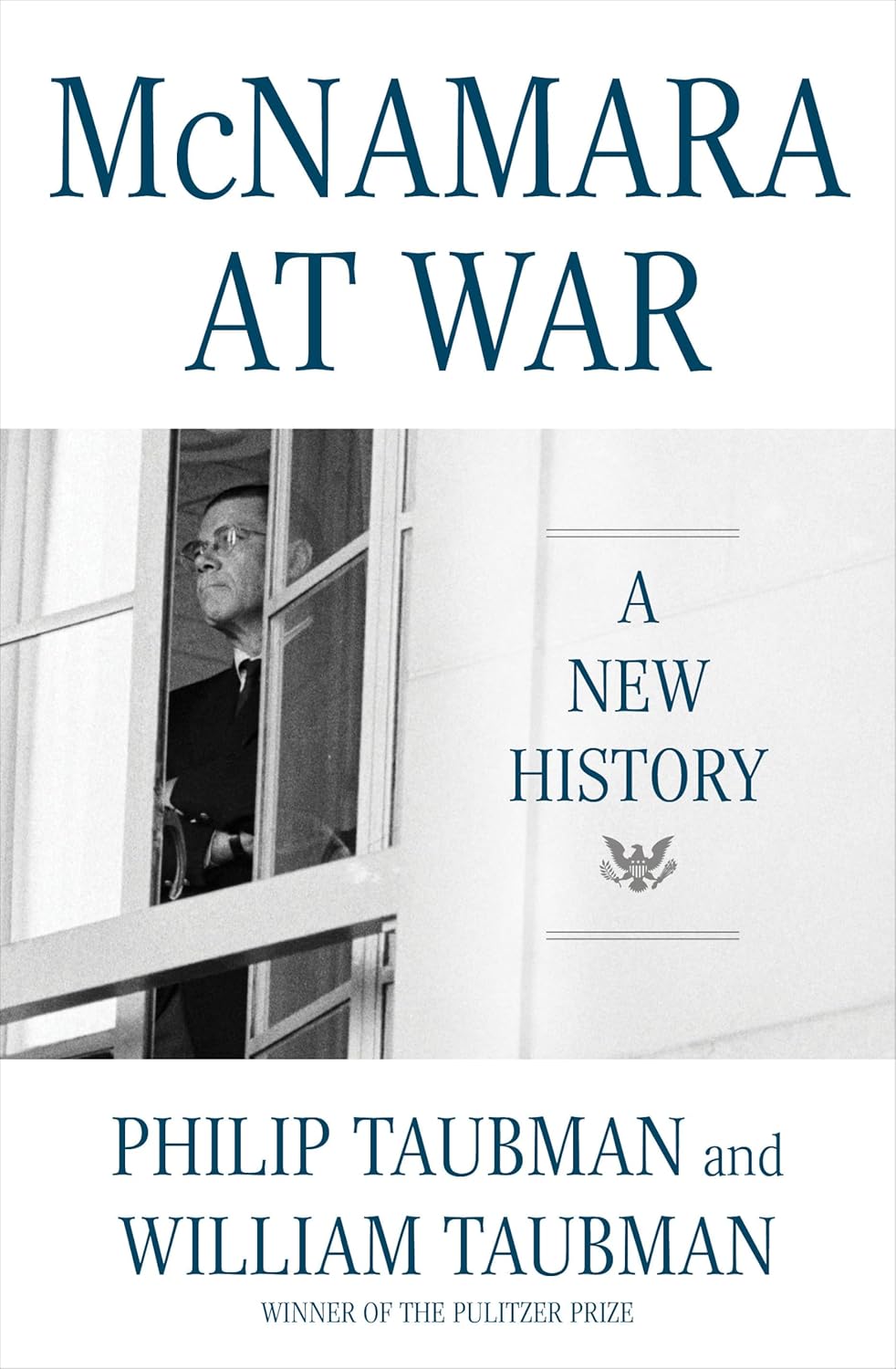
In his last years, Robert S. McNamara was not the man the world knew at the height of his fame when he was US secretary of defense and the dominant figure in the cabinets of Presidents John F. Kennedy and Lyndon B. Johnson. Nor the man who was president of the Ford Motor Company before being summoned to Washington in 1960 by Kennedy. Nor he who led the World Bank from 1968 to 1981 after leaving the Pentagon. During those years, especially during his time at the Defense Department, he seemed brilliant but distant, cold, and arrogant, a “computer with legs,” as Senator Barry Goldwater once dubbed him,1 a man who presided over much of the Vietnam War in which some 58,000 Americans and millions of Vietnamese died. As early as 1965, McNamara had ceased to believe that that war could be won militarily, but he continued to manage the conflict as Johnson’s principal wartime adviser rather than urging the president to exit it. He chose not to resign, with or without a howl of protest, and then mostly refused to talk about the war for nearly two decades afterward.
Russell Baker, longtime columnist for The New York Times, saw McNamara at the zenith of his powers as an archetypical American figure, a leader in over his head who mesmerizes those around him, draws them into his orbit, then leads them to ruin. “People like this are not uncommon,” Baker observed. “Their schoolhouse intellectual powers dazzle sensible people, disarming our normal healthy instinct to be skeptical when faced with any product that’s being sold too vigorously. . . . We all marvel at the speed of their rise.” Baker compared McNamara to the seemingly omniscient owl in a James Thurber fable who enchanted other animals only to lead them to slaughter when he fails to see a truck bearing down on them on a country road. “Thurber understood McNamara before there was a McNamara,” Baker said.2
Baker may have overstated the case a bit, yet McNamara’s mastery and commanding presence at the peak of his career were undeniable. But there was another side to McNamara, mostly unknown. He could be warm and emotional, especially with close friends. He was overwhelmingly powerful in defending his own views, but later condemned himself with equal fury for not welcoming more debate about them. His confidence and self-confidence before the war awed and intimidated his associates. But, especially when first called to Washington, he was politically naive and felt insecure. He came across as incredibly intense, without revealing that much of that tension reflected the acute stress he himself was feeling. As Arthur M. Schlesinger Jr., his Kennedy administration colleague, put it more than three decades later, “I have known for a long time that underneath that disciplined exterior, McNamara is a man filled with tense and pent-up emotion,” so “wound up” that in his later years, “he is almost out of control.”3
McNamara tried to hold himself to the highest ethical standards, but he repeatedly violated them and chastised himself for doing so. After he left the Pentagon, driven in part by a deep sense of repentance, he applied his extraordinary energy to trying to eradicate global poverty as president of the World Bank. After that, he struggled for nearly three decades to understand the folly of the Vietnam War and its lessons for the future. “We were wrong, terribly wrong” about Vietnam, he confessed in his memoir, In Retrospect: The Tragedy and Lessons of Vietnam, published in 1995.4 But his admission of grave error, virtually unprecedented in the annals of retired leaders, never came with a heartfelt apology for the war. His admission of error provoked critics to charge he was even more evil because, despite concluding that the war was unwinnable, he continued to send brave soldiers to their deaths. The lessons he derived from Vietnam produced insights that, had they been taken into account by his successors, could have helped the United States avoid disasters in Iraq and Afghanistan. The danger that unwavering loyalty to presidents on national security matters can lead to calamity should prove instructive to current and future commanders in chief. But not only have such lessons been disregarded, they failed to comfort McNamara himself, who was overwhelmed with personal anguish and a sense of guilt at the end of his life. The striking success he had long aspired to achieve ended up fracturing his family. The war he presided over sundered for several years his relations with his son, stressed his ties with his daughters, and, he believed, sickened and in effect killed his beloved wife. In that sense, it was his very rise that brought about his fall.
For more information
Footnotes:
1. Barry Goldwater said he was an IBM computer with legs. Stephen Braun, “Robert S. McNamara Dies at 93; Architect of the Vietnam War,” Los Angeles Times, July 7, 2009.
2. Russell Baker to David Halberstam, February 8, 1997, David Halberstam Papers, Boston University.
3. Arthur M. Schlesinger Jr., Journals: 1952–2000 (New York: Penguin Publishing Group, 2007), 681–82.
4. Robert S. McNamara with Brian VanDeMark, In Retrospect: The Tragedy and Lessons of Vietnam (New York: Random House, 1995), xvi.