


External Relations commitment: External Relations leadership supports and is committed to offering all staff flexibility in line with our operational needs, ensuring that we continue to create and nurture broad and purposeful relationships with university stakeholders.
“As an education and research institution we encourage creativity, learning and experimentation. Applying this mindset to re-imagine work is important and it takes courage to intentionally change where, when, and how we work. There will be trial and error as we iterate and evolve our work practices to support the mission, achieve business goals, foster overall well-being, increase diversity and maintain collaboration.”
—Elizabeth Zacharias
Vice President for Human Resources
Our process
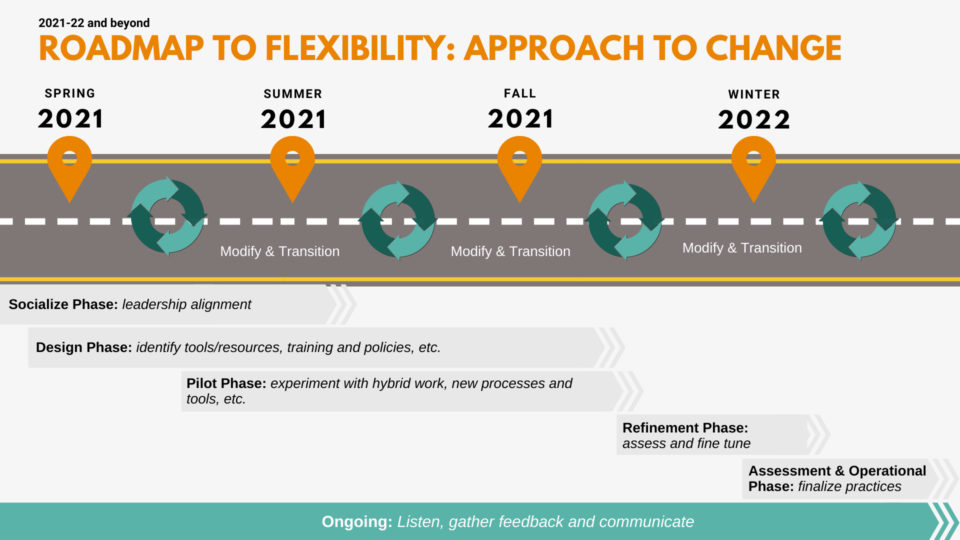
We are in the midst of planning for our return to onsite work, which will begin after Labor Day, September 2021. This planning work requires managers and staff to step back from our experiences and learnings over the last 15 months, identify connection and engagement opportunities that are important to be in person to support our goals and our work, and determine the level of flexibility positions can have around those guidelines. The managers that I have worked with so far appreciate stepping back and re-assessing each of their positions.
Step 1: Gather manager input
May through June, I and the respective HRMs are meeting with senior managers to evaluate roles and job functions for determination of flexibility – the extent to which a role needs to be on-site, can be hybrid, or fully remote. We are also discussing the identification of in-person engagement and connection priorities within a team and with other colleagues and external stakeholders. Managers will continue these discussions with their teams.
Step 2: Establish standard criteria
We are recording and summarizing the input from meeting with managers noting any differences in the level of flexibility. We are reconciling or providing support for any differences that are noted. The result of this will be “Standard Position Criteria.”
- Create personas for positions based on work in Steps 1 & 2
- Review with senior leadership to obtain decisions and approval (Mid-July)
- Communicate results – Manager & Employee lunch & learns, etc.
Step 3: Managers share criteria and gather employee input
Managers will speak to employees 1:1 during performance reviews or in other 1:1 meetings to understand preferences, concerns and needs, working within the “Standard Position Criteria” noted above.
Step 4: Aggregation and decisions
In August, data will be aggregated and reviewed with management.
- Refine personas as needed
- Plan Fall return process, including IT needs, chairs, etc., leveraging UHR policies
- Communicate results – Manager & Employee lunch & learns, etc.
Step 5: Refinement phase post-Fall
Assess and fine-tune as we operationalize practices through Spring FY22.
Pilots: Mid-July through August
- We are looking for suggestions from managers and staff members to create a few return-to-work pilots. We are generating some ideas in our discussions with managers and staff. We also plan to take advantage of any that are proposed university-wide if they make sense for External Relations.
- We also will create a way for people to visit their workspaces prior to September and reset them, purge papers now that we know we can survive online, etc. Please be on the lookout for communication about these options in mid-July.
- We are looking to gather ideas from staff and managers about facilities use and where and how they need to do their collaborative work. We are also looking at ways to reconfigure spaces to help make them more collaborative. We are reconfiguring some of the Finance and Learning & Performance space in Fran as an example of what can be done. We are also looking at the Office of Government Affairs and University Communications space in Building 170, creating more collaborative and conference space. All of this work will be informed by the amount of on-site work that we will be defining through our process, and as we continue to iterate on our work practices and patterns after we begin our return to onsite work.
Author
Noel Hirst