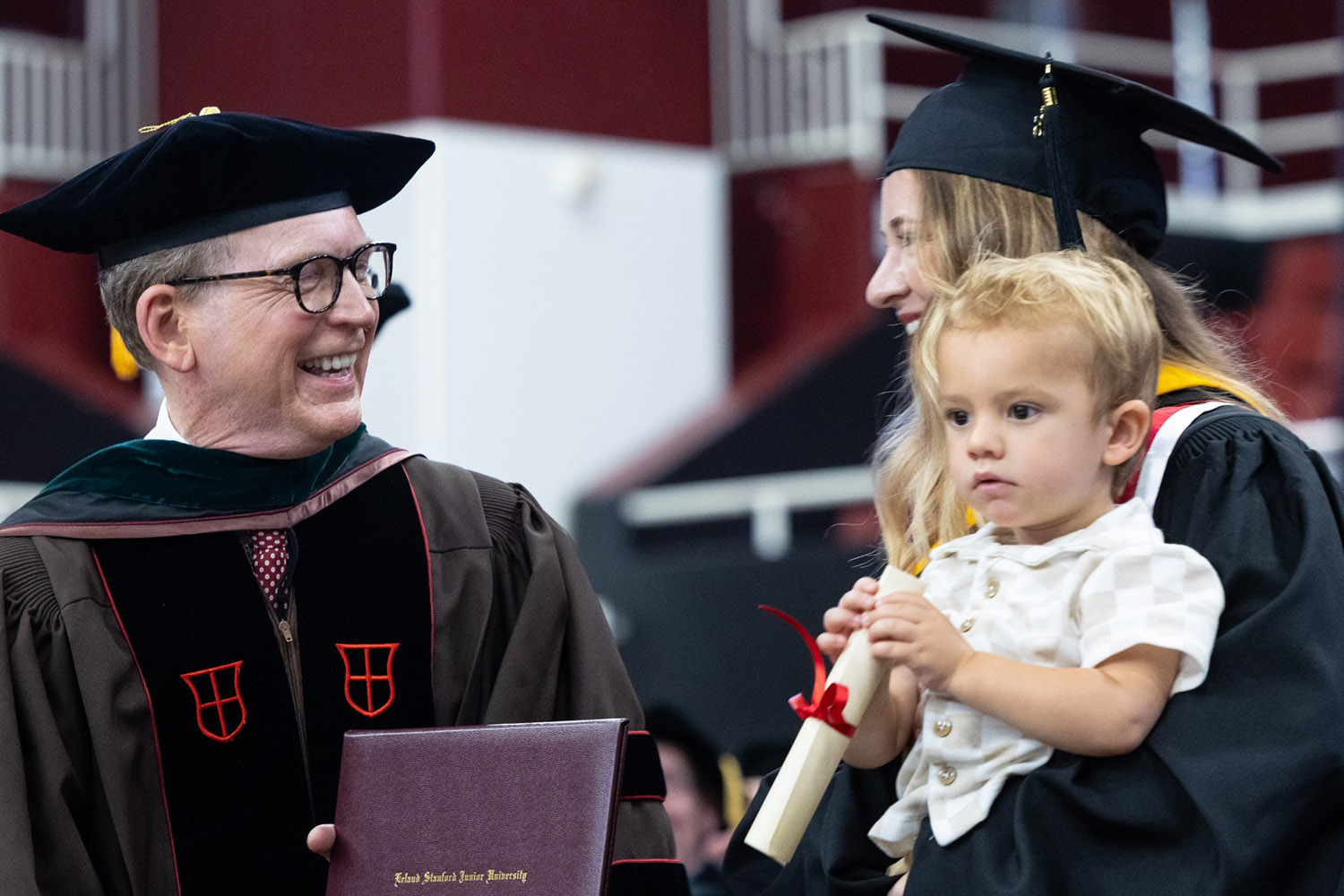
As Marin Phillips, PA-C, draped in a black robe and yellow hood, waited to march across the stage at the Stanford School of Medicine graduation ceremony, her husband darted from the audience to deliver their son, 2-year-old Rhett. Mother and son then walked up to the dean, Lloyd Minor, MD, who presented them with a diploma.
Rhett, born as his mother was pursuing a master’s in physician assistant studies, “has been with me every step of this journey,” said Phillips, who took a year off to give birth and care for him. “Motherhood has taught me so much about resilience and compassion, but also a deep appreciation for the privilege it is to take care of someone else’s loved one.”
Rhett was the first of dozens of children, from newborn to middle school-aged, who joined their parents on stage at the June 13 ceremony in Maples Pavilion on the Stanford University campus. The graduates received master’s (marked by a yellow hood), doctoral (blue hood), and medical (green hood) degrees.
“Through experiences in the classroom, in laboratories, and in clinical settings, you’ve built the single most important belief in life: the belief in yourself,” said Minor, the Carl and Elizabeth Naumann Dean of the School of Medicine and vice president for medical affairs at Stanford University, addressing the graduates. “You have learned that, even when faced with uncertainty that can be chilling, you can move forward, make plans, and find a way to thrive, not just survive.
“My ask of you today is simple: I want each of you to take that mindset, that approach to the future, out into the world – and then inspire it in others. In so doing, you inspire hope.”
Images by Steve Fisch
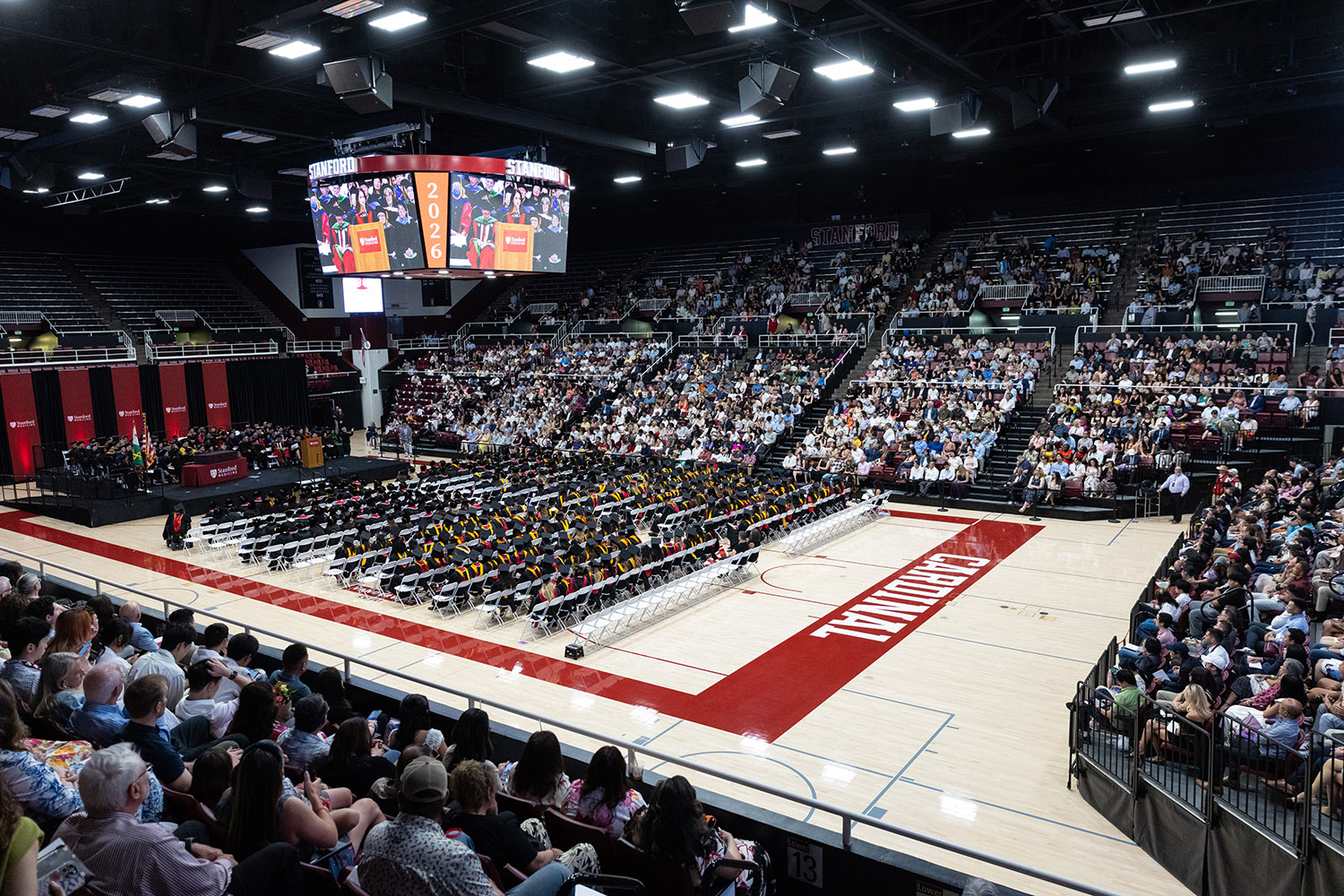
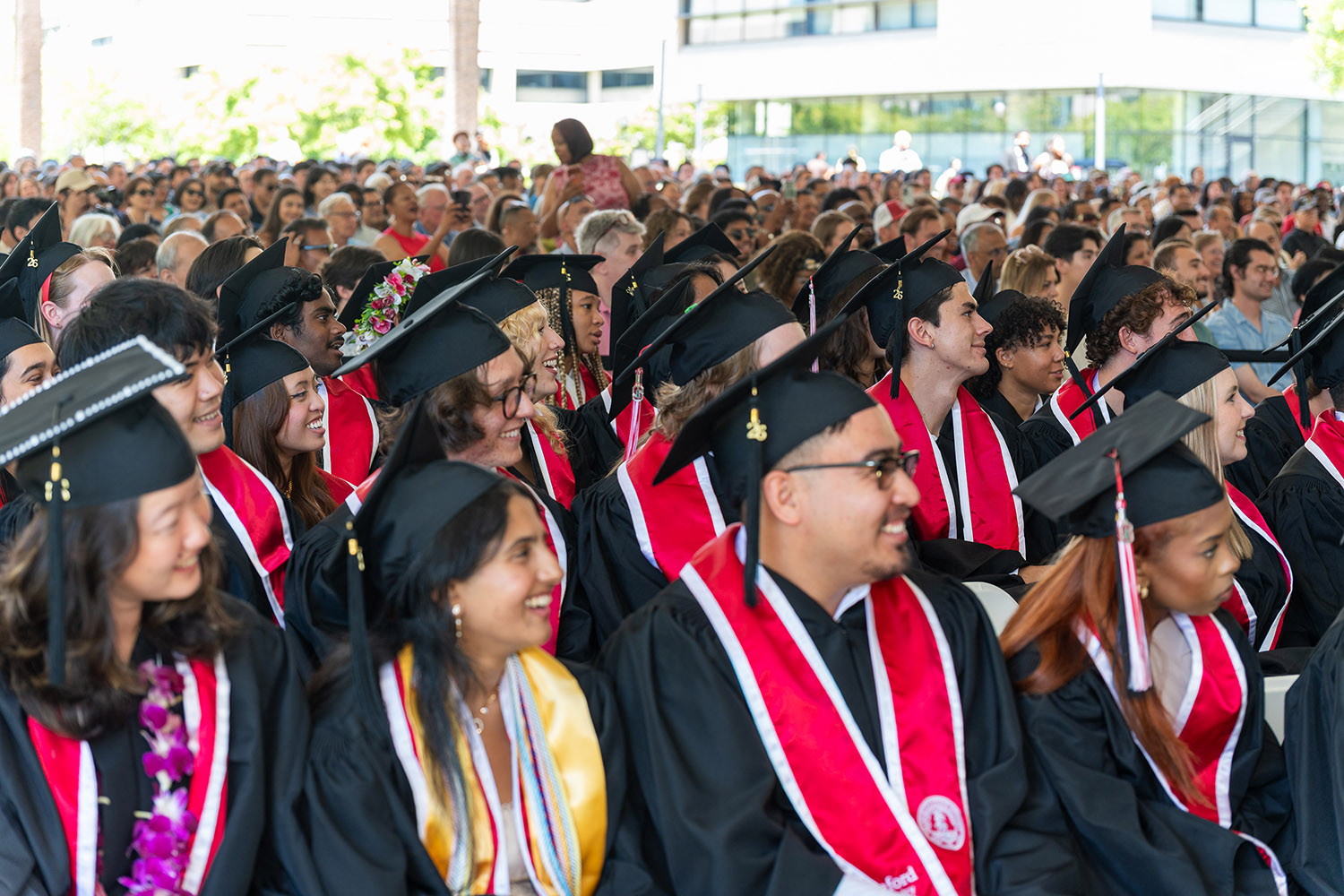
Hundreds of students were awarded master’s, medical, and doctoral degrees at the ceremony in Maples Pavilion.
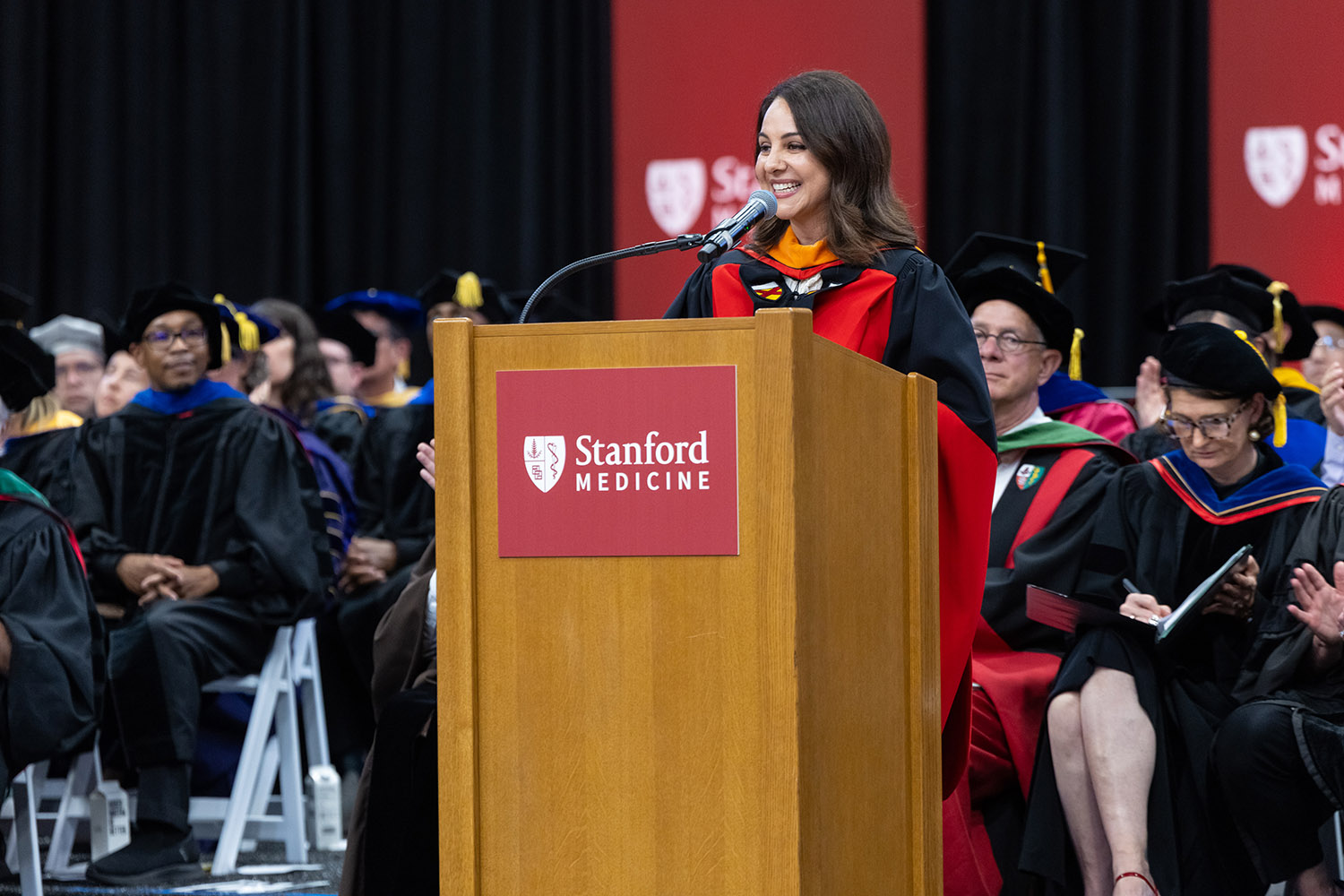
Lily Sarafan, chair of the Stanford University Board of Trustees, told grads in her keynote speech that good physicians take the time to translate information into meaning for the patient. “This is part of the genius of science, of medicine practiced well. The world needs these sensibilities now more than ever.”
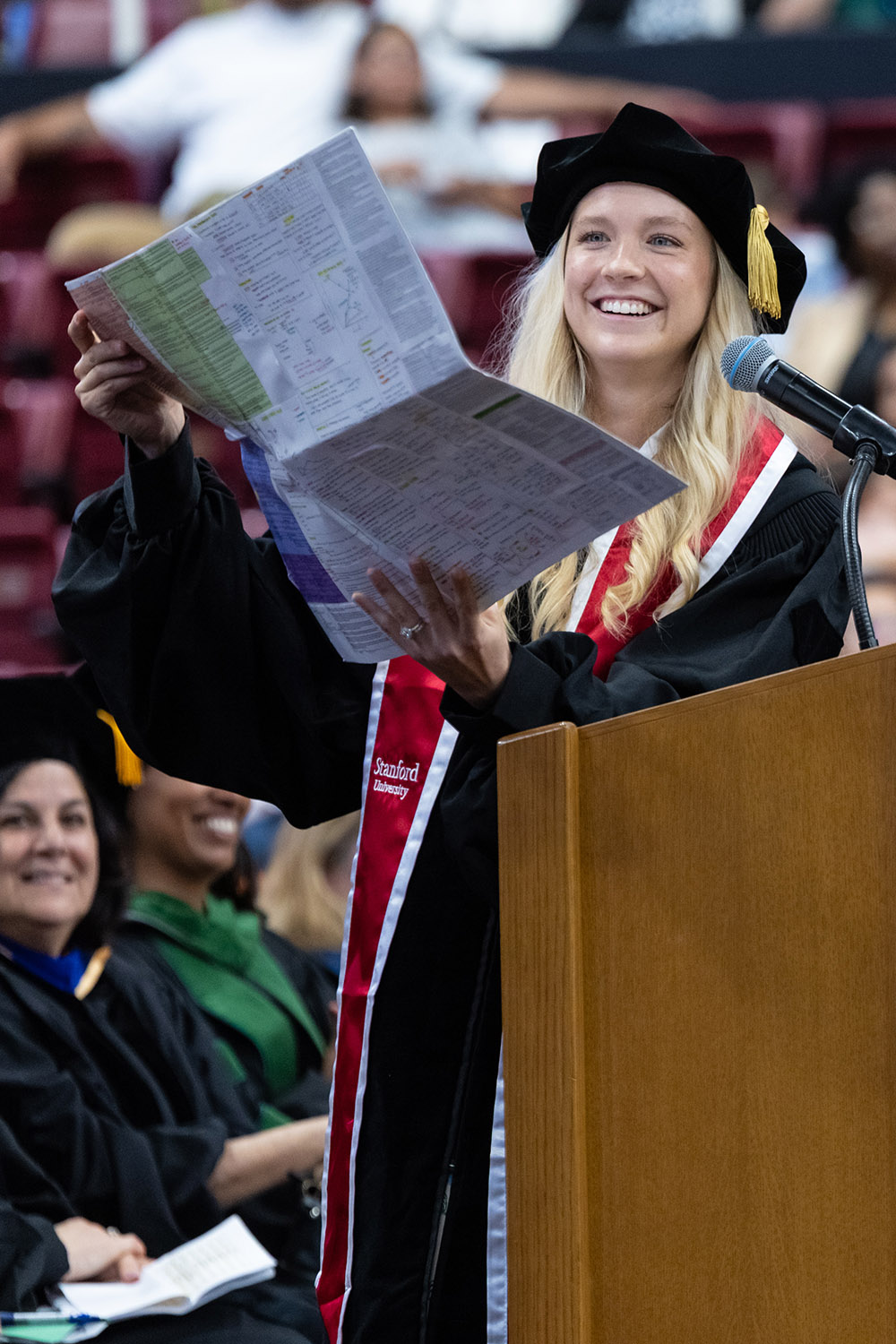
Georgiana Burnside, MD, representing the newly minted physicians, used a prop in her speech focused on what it means to connect with patients.
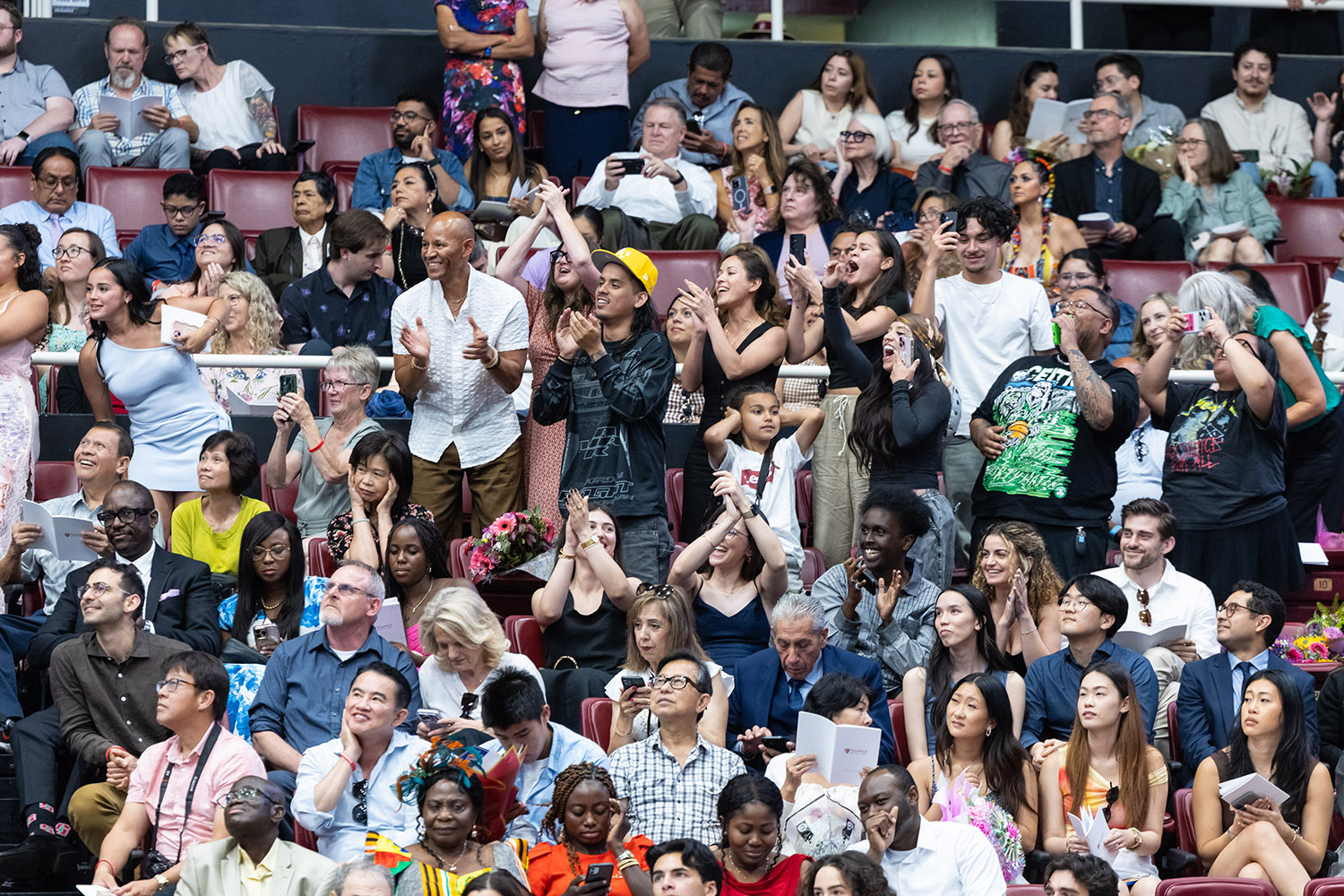
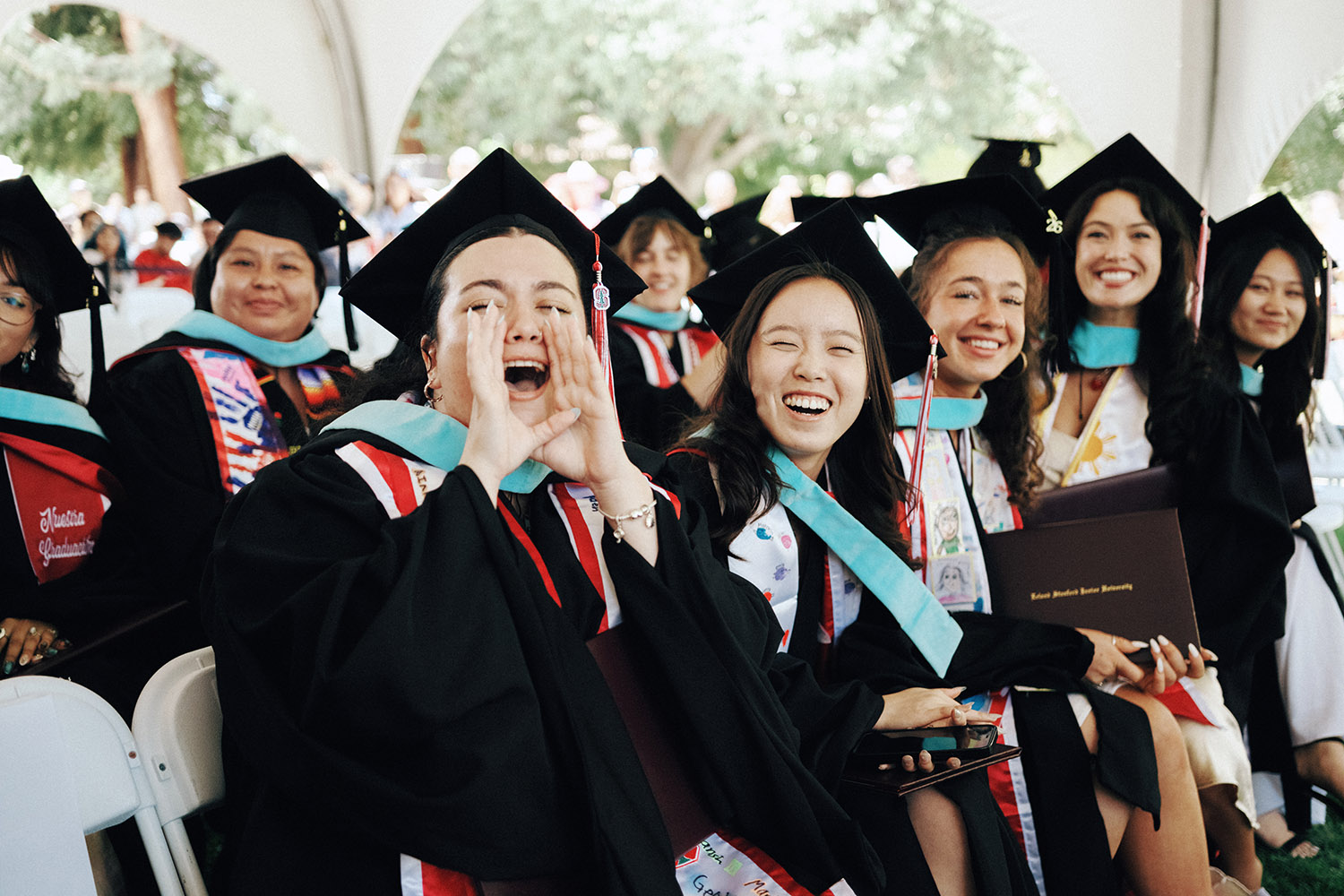
Graduates received a noisy ovation from the audience.
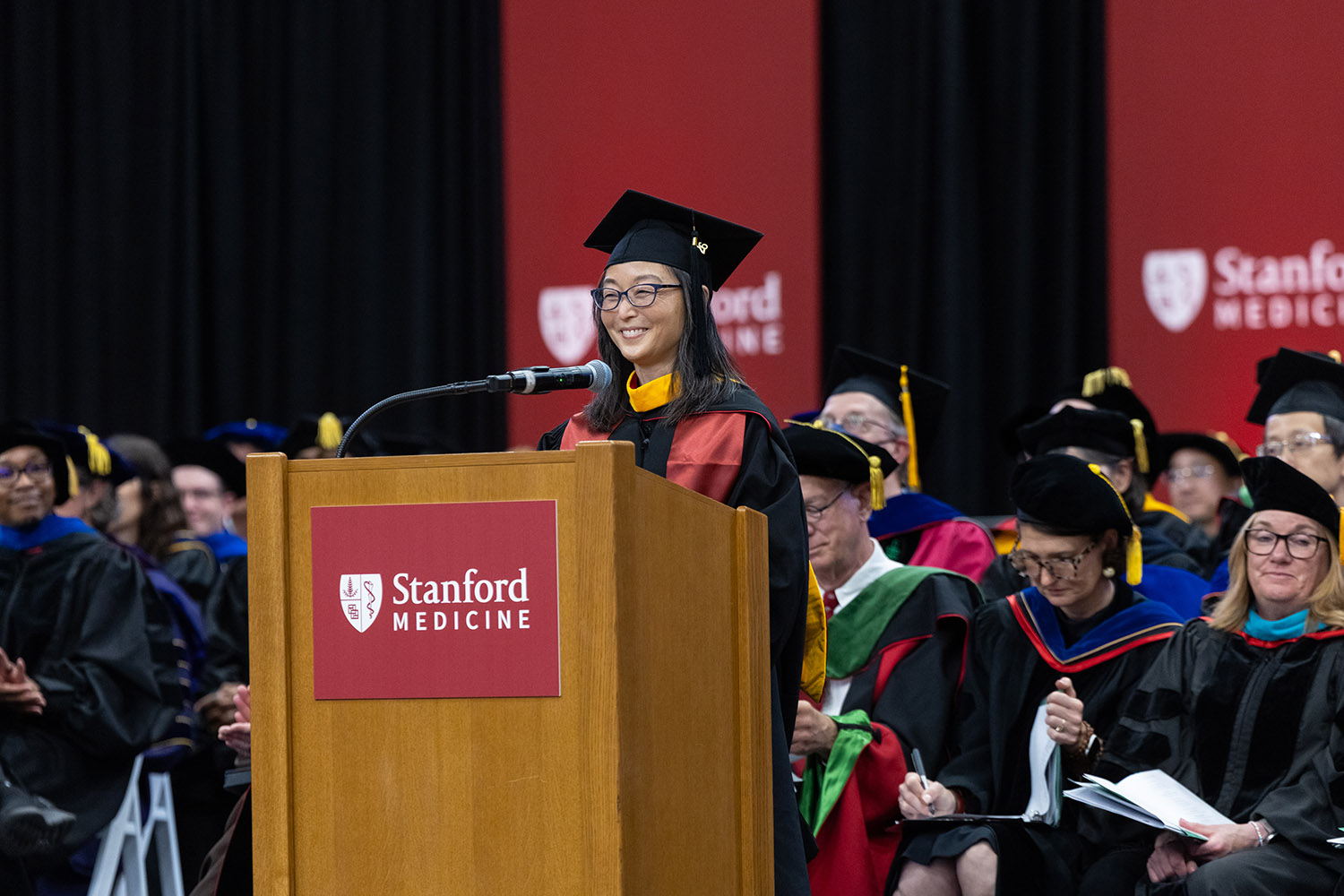
Evelyn Kim, MD, who returned to school after decades as an emergency medical physician to earn a master’s in clinical informatics management, spoke on behalf of those earning a variety of master’s degrees.
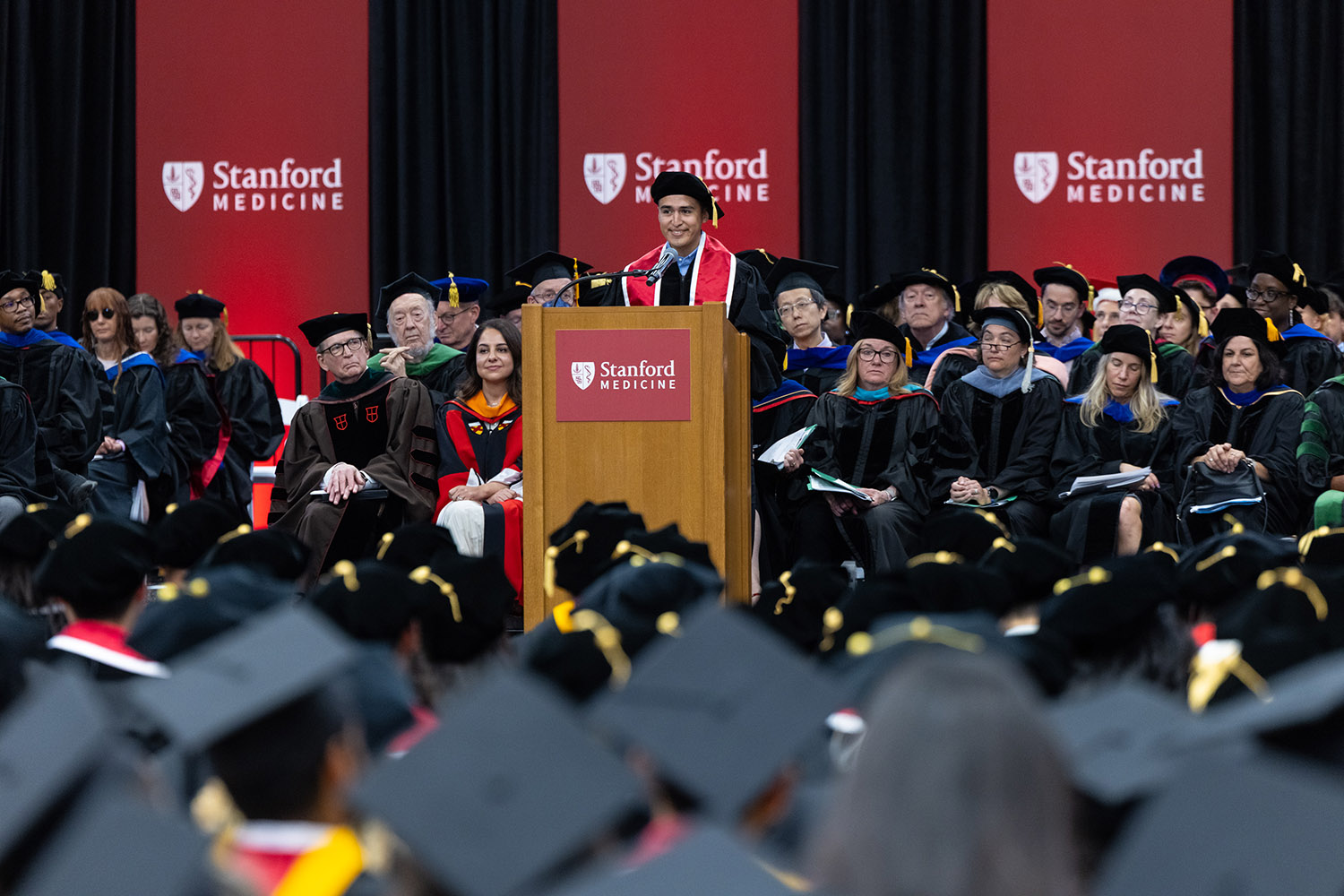
Doctoral student speaker Gabriel Barrón, PhD, who earned his degree in immunology, quoted Ada Limón's poem “In Praise of Mystery.”
Taylor Blow, PA-C, representing the students earning their master’s in physician assistant studies, described how members of the class held one another up during three difficult years of training: “When someone didn’t understand a concept, we all pitched in with different study methods, videos, or ridiculous mnemonics until something finally worked. When somebody felt overwhelmed, someone else stepped in beside them. And when confidence ran low, we borrowed it from each other.”
The compassion her classmates showed to fellow students will guide them in treating patients, she said. “There will be moments when our patients are scared, exhausted or convinced they can’t keep going. And in those moments, we will remember what our class taught us – to slow down, to notice who’s struggling, and to run beside them for a while.”
Evelyn Kim, MD, who returned to school after decades as an emergency medical physician to earn a master’s in clinical informatics management, spoke on behalf of those earning a variety of master’s degrees. “Students who are today receiving their master’s degrees in biomedical data science, community health, epidemiology, health policy, genetics and counseling … they – we – all of us can work together to find scientific breakthroughs, new technologies, better paradigms of delivery, a different kind of health,” she told the graduating students. “Physicians, [advanced practice providers] and nurses may be the tip of the spear in care delivery, but we are all here today because we share a common north star – improving the lives of patients.”
The doctoral student speaker, Gabriel Barrón, PhD, who earned his degree in immunology, described taking a trip to Napa Valley to hear his favorite poet, Ada Limón, read “In Praise of Mystery.”
“My favorite line from the poem is ‘We are made of wonders, of great and ordinary loves, of small invisible worlds, of a need to call out through the dark,’” he said. “I have thought about that line a lot. Because I think it might be the most accurate description of what a PhD entails.”
Georgiana Burnside, MD, representing the newly minted physicians, spoke from experience when she told the audience, “Patients rarely remember the lab value you quoted, the differential diagnosis you generated, or the paper you cited. They remember how you made them feel. They remember whether you sat down, whether you learned their name … whether you listened, gave them hope, helped them find joy or laughter in the midst of illness or dignity at the end of life.”
Burnside suffered a spinal injury from a skiing accident when she was 16 and spent years in rehabilitation; she walked onto the stage with the help of a cane. “They remember when you celebrated the first time the 16-year-old girl put on her socks independently, or the day she successfully completed her first wheelie in the wheelchair that would carry her for years to come,” she said, her voice thick with emotion.
The keynote speaker, Lily Sarafan, chair of the Stanford University Board of Trustees and founder of the senior in-home care provider TheKey, related a story about her childhood as an Iranian immigrant in Los Angeles trying to fit in:
In preschool, her mother made a bee costume for a school play about a swarm of bees; when they arrived for the play, they saw all the other children in identical bee suits, apparently purchased from the same costume shop.
“It was immediately obvious that everyone else knew something that we did not,” Sarafan said. “In a stroke of genius, my mom, not yet confident in her own English, decided to have me approach my teacher and explain that given my distinctive ensemble … I should be the queen bee.”
She noted that patients often feel like an immigrant who didn’t know about costume shops. “Each of us eventually finds ourselves inside a system we don’t fully understand. Science, and especially medicine, is full of those moments.”
“Every day, people enter hospitals,” she continued, “as teachers, carpenters, chefs, and lawyers. And then suddenly it’s their first day of school again. Surrounded by unfamiliar terminology, unfamiliar risks, unfamiliar fears – everyone around them apparently fluent in a language they do not speak. And this is often happening on one of the worst days of their lives.”
Good physicians take the time to translate information into meaning for the patient, she said. “This is part of the genius of science, of medicine practiced well. The world needs these sensibilities now more than ever.”
As the hundreds of graduates took their turn walking the stage and receiving their diplomas, sections of the audience cheered at each name (despite requests to hold applause until all the diplomas had been handed out), with children receiving the loudest ovation and a few proud family members shouting out, “That’s my sister!” and “That’s my little girl!”
Once all the graduates had crossed the stage, Sheri Krams, PhD, senior associate dean for graduate education and postdoctoral affairs, led the doctoral students in reading aloud the Stanford biosciences affirmation; afterward, Reena Thomas, MD, PhD, senior associate dean of medical education, led the new physicians and physician assistants in reading the Stanford medicine affirmation.
Finally, the Rev. Dr. Tiffany Steinwert, dean for religious and spiritual life at Stanford University, offered a benediction: “May we never cease to show up for one another. May we passionately pursue our own sacred purpose. May we remember we are made for this. … Above all – above all – may we go forth this day to inspire hope. Not just for some day but for this day.”
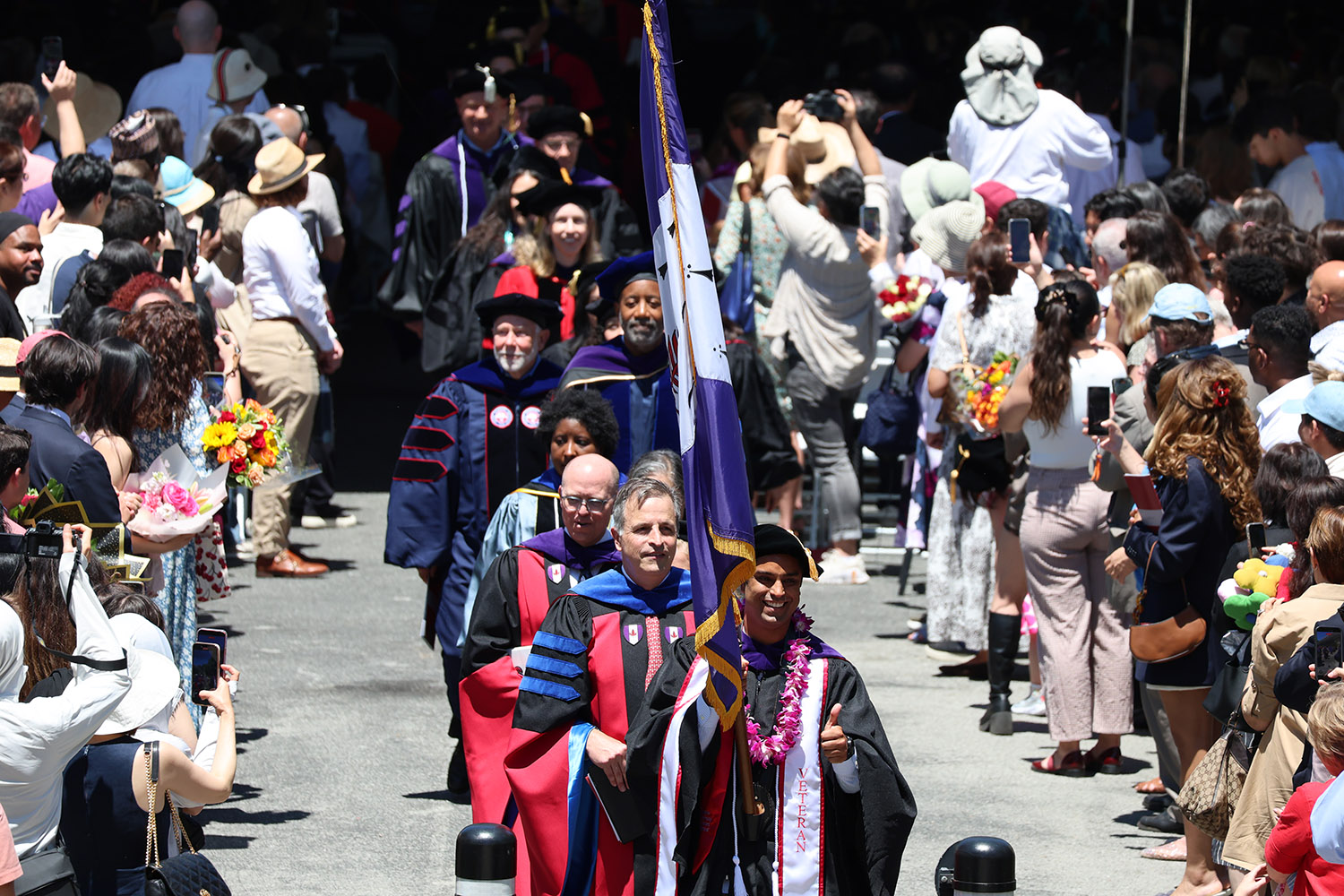
Then the new physician assistants, physicians, doctoral degree holders, and holders of master’s degrees filed out of the pavilion and headed off to new jobs, fellowships, internships, and residencies.
For more information
This story was originally published by Stanford Medicine.
Writer
Mandy Erickson