Jackson Pollock’s Number 1A, 1948 – a major work from the artist’s drip‑painting period – is a dense lattice of looping lines and splatters in black, white, brown, and silver, punctuated by specks and daubs of primary color. The identity of the vivid blue pigment in the painting has long been a mystery. In a new study published in the journal of the Proceedings of the National Academy of Sciences, researchers at Stanford University, the City College of New York, and the Museum of Modern Art (MoMA) in New York City identified it as manganese blue, a synthetic pigment that was phased out in the 1990s due to concerns about the toxicity of its manufacturing process.
Chasing an elusive hue
Conservation scientists routinely use a variety of noninvasive technologies to determine the chemical compositions of paintings, the better to preserve them and root out fakes. But some pigments resist identification.

Jackson Pollock’s 1947 painting “Lucifer,” one of the earliest large-scale works in his drip style, hangs in the Anderson Collection at Stanford University. | L.A. Cicero
After an X-ray fluorescence scanning of “Number 1A” showed clear signatures for the yellow and red Pollock used but failed to definitively identify the blue, conservators at MoMA sent microscopic scrapings of the paint from the underside of the canvas to the Stanford lab of inorganic chemist Edward Solomon.
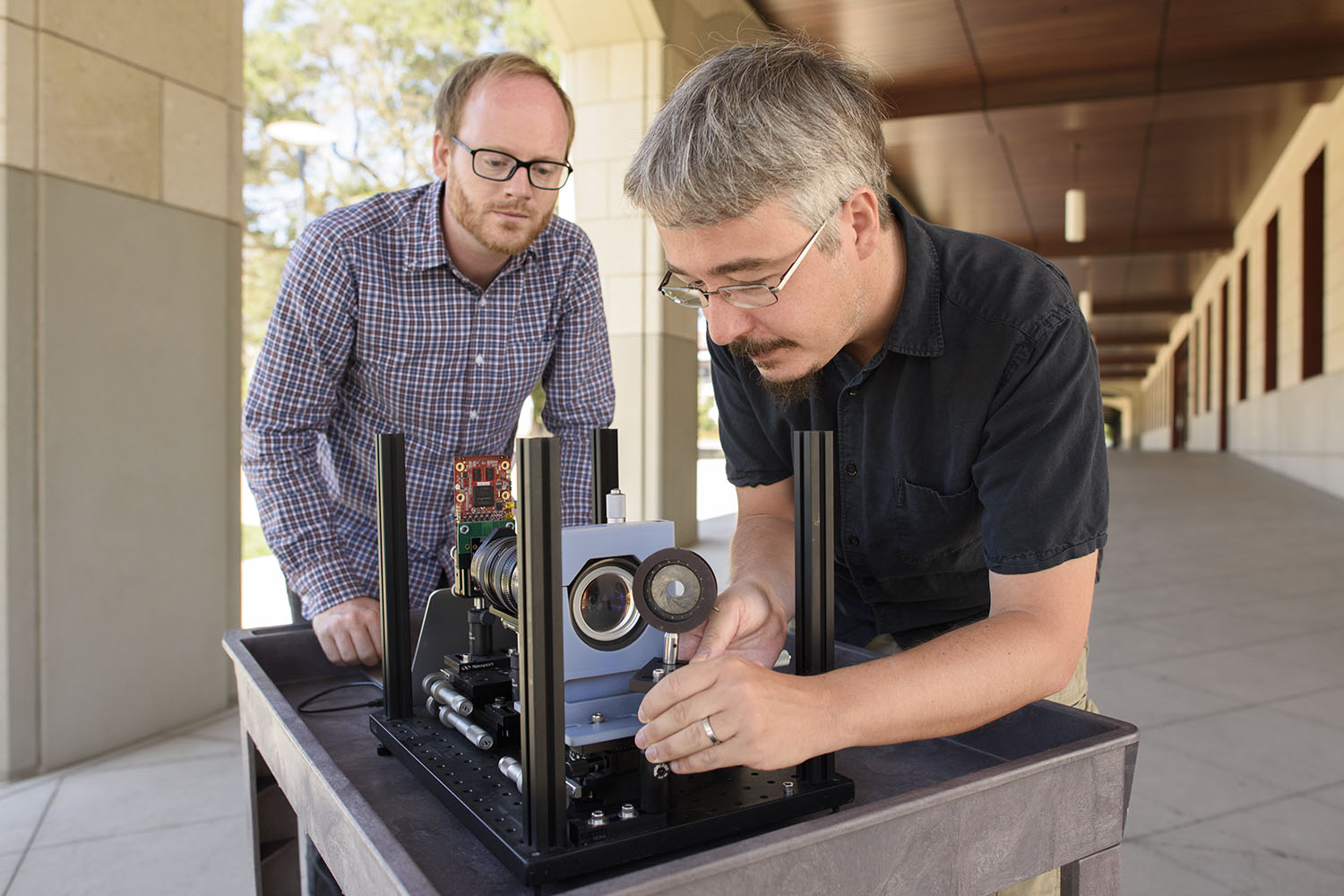
Solomon, the Monroe E. Spaght Professor of Chemistry, emeritus, and professor of photon science at SLAC, uses spectroscopy to understand how transition metals such as iron and copper help drive chemical reactions in the body. Alex Heyer, then a PhD student in Solomon’s research group, was using the same technology to study chemical transformations that could convert methane to a less-potent greenhouse gas. The two applied resonance Raman spectroscopy, a technique that analyzes how light interacts with a substance’s molecules, to identify Pollock’s choice of blue.
“I don’t work in this field,” Solomon said of art conservation. “But it turns out that these methods that we've been developing for biology and catalysis were a really useful approach.”
Science confirms, it’s a very special blue
In addition to identifying the pigment, Solomon’s lab took the opportunity to investigate the specific interactions that give manganese blue its unique color, which is sometimes described as “pure,” “clean,” and “luminous.”

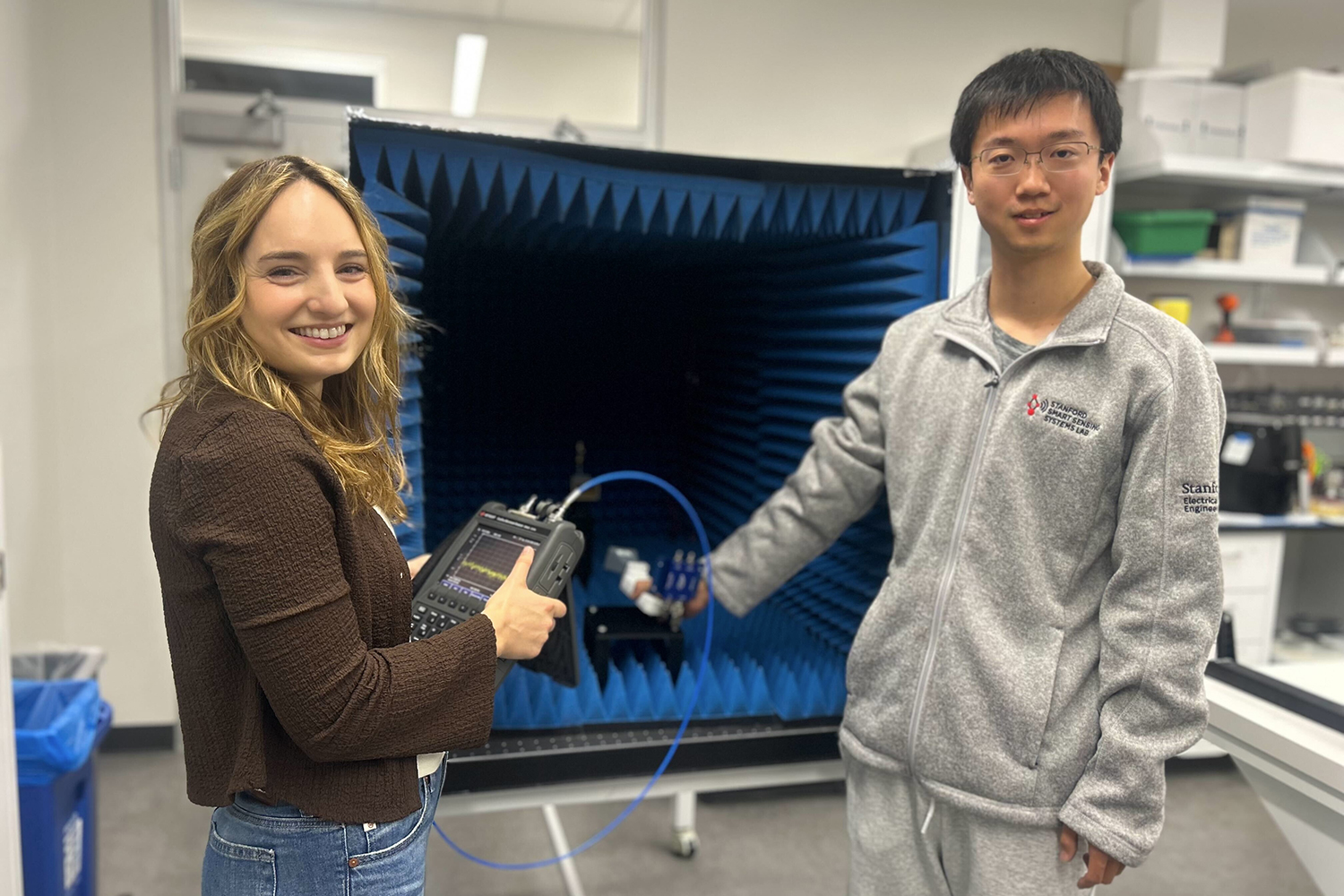
Resonance Raman spectroscopy uses a series of laser lines to enhance specific molecular vibrations related to how a material absorbs light, producing a “fingerprint” of its chemical structure. | Alex Heyer
Existing as it does toward the middle of the color spectrum, blue has historically been a difficult color for pigment makers to get right – to look purely blue, a material has to strongly absorb light in both the green and violet regions of the visible light spectrum, without absorbing blue wavelengths.
Using a magnetically sensitive light absorption test called magnetic circular dichroism (MCD) and computer modeling, the team found that the pigment’s electronic structure is the key to its color. The manganese ion is surrounded by four oxygens in a lattice structure, creating two distinct absorption features that filter out light in the green and violet regions.
“You really just get this nice window between the absorption features that send out the blue light that you observe with your eyes,” Heyer said. “Given that Pollock was so specific in the colors he chose, we wanted to understand, what was he intuiting? It turns out there’s actually a really interesting chemical mechanism that’s creating this blue.”
For more information
Edward I. Solomon is the Monroe E. Spaght Professor of Chemistry, emeritus, in the School of Humanities and Sciences and a professor of photon science at SLAC.
Alexander Heyer, PhD ’24, is a postdoctoral researcher at UC Berkeley.
Writer
Charity Ferreira