


Each year about 1,000 Stanford undergraduates work closely with faculty mentors on research in disciplines as diverse as biology, engineering, art, social sciences and mathematics. The projects help students build research and analytic skills and may help them find their own path to a later career.
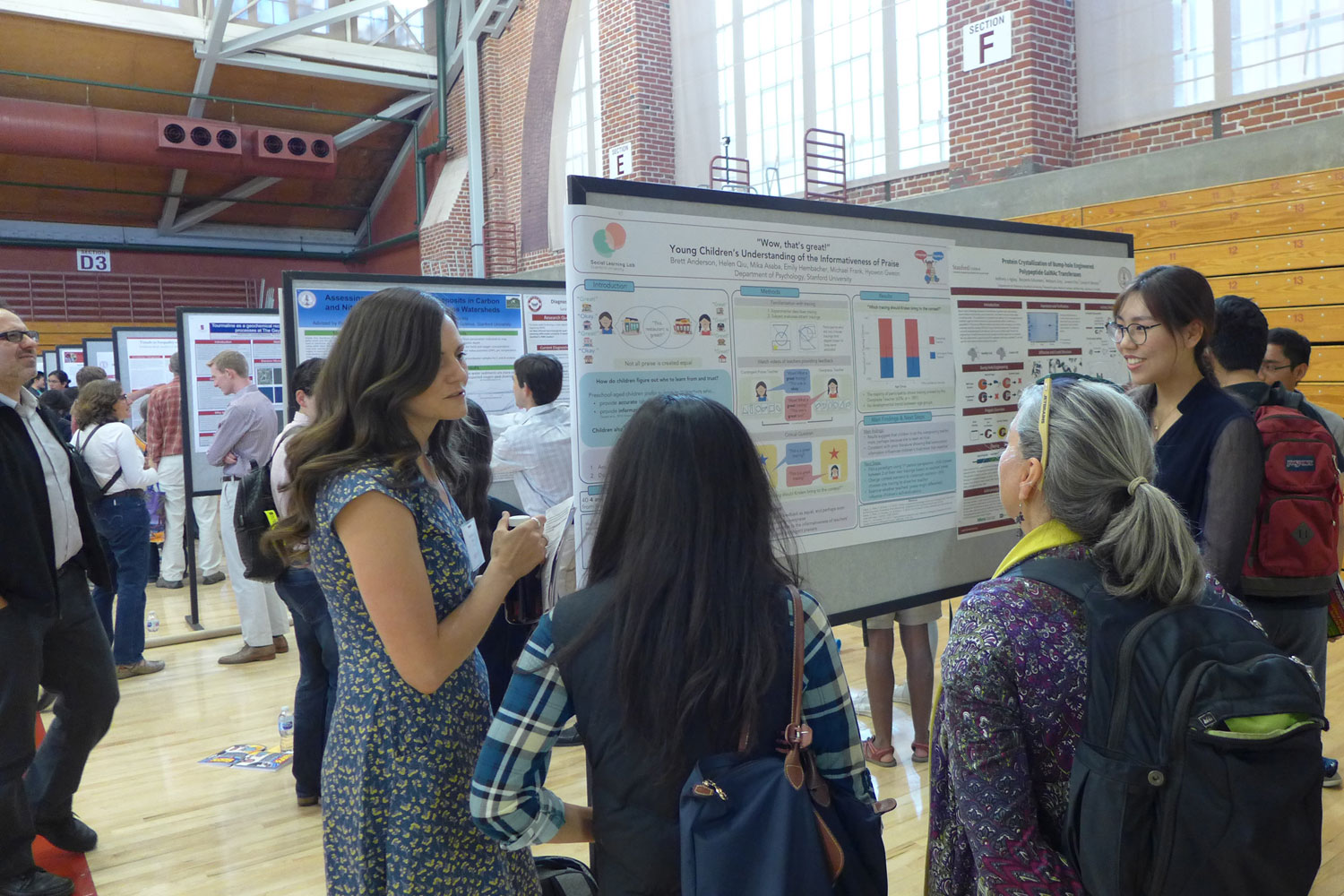
The Symposium of Undergraduate Research and Public Service offers students an opportunity to talk about their findings and share their experiences working collaboratively with faculty. (Image credit: Courtesy Undergraduate Advising and Research)
Many of this year’s undergraduate projects will be on display at the April Symposium of Undergraduate Research and Public Service (SURPS) hosted by Stanford’s Undergraduate Advising and Research (UAR) office on Saturday, April 28, from 9 to 11 a.m. in Tresidder Oak Lounge.
This bustling event, held in conjunction with Admit Weekend, connects admitted students and their families with a discipline-diverse group of undergraduate researchers who are eager to talk about their findings and share their experiences working collaboratively with faculty to pursue research, arts and public service projects outside the classroom.
Philosophy major Eliza Wells, a junior from Sandy, Utah, will present her research project, “A Woman’s Place: Rhetoric and Authority in Modern LDS General Conference.” Wells says the opportunity to do undergraduate research has been one of the best parts of her Stanford experience.
“I’ve been able to do original work on a project that I care about deeply, applying the skills that I’ve learned in the classroom in new and exciting ways. This research has given me the self-confidence and self-discipline to become a better student, thinker and scholar,” she says.
Stanford allocates more annual funding for undergraduate research – nearly $5 million – than any other U.S. university. Students can join faculty in their work in laboratories, libraries and studios as well as connect classroom learning and intellectual interests through an independent project under faculty mentorship.
The student projects are funded through UAR research programs. Many grant awardees get to present at either the fall or spring SURPS events – nearly 200 each year – and around 40 students travel nationally or internationally to present at conferences annually.
Saturday’s SURPS event will feature more than 74 undergraduates presenting their project posters. Seven of the presenters, supported by UAR Conference Grant funding, have already had research projects accepted for presentation at prestigious national and international conferences, including the Joint Mathematics Meetings of the Mathematical Association of America and the American Mathematical Society; The Annual Conference on Information Systems and Sciences; and Experimental Biology.
This weekend’s SURPS presenters include a diverse array of fields and interests, including:
- Annabel Chen, biology: “Regulating Nociceptive Channel Trafficking by Site-Directed Mutagenesis of a Calcineurin Interaction Motif”
- Davis Chhoa, human biology: “Intergenerational Perceptions of Well-Being Among Cambodian Americans”
- Theo Diamandis, electrical engineering: “Ranking Causal Influence of Financial Markets via Directed Information Graphs”
- Julia Goolsby, art: “Seeds of Thought: An Artistic Exploration of California Ecology”
- Brian Zhang, computer science: “Mitigating Unwanted Biases with Adversarial Learning”
Chen, Diamandis and Zhang will present their research at national and international conferences.
To learn more about available research funding for Stanford undergraduates, including details about eligibility, visit https://undergrad.stanford.edu/opportunities/research/get-funded/eligibility
For more information on SURPS, visit http://surps.stanford.edu.
Author
Eric Van Danen