
Environment getting short shrift, Annan tells graduates
Kofi Annan, secretary-general of the United Nations, urged graduates to take time to reflect upon the precarious state of the globe’s natural environment and build a “new ethic of global stewardship.”
Tears flowed freely under mortarboards as the final strains of the Stanford Hymn, sung by the chamber chorale, signaled the closing chapter for Stanford’s 109th graduating class on Sunday morning, June 11, and the final time President Gerhard Casper would confer the degrees.
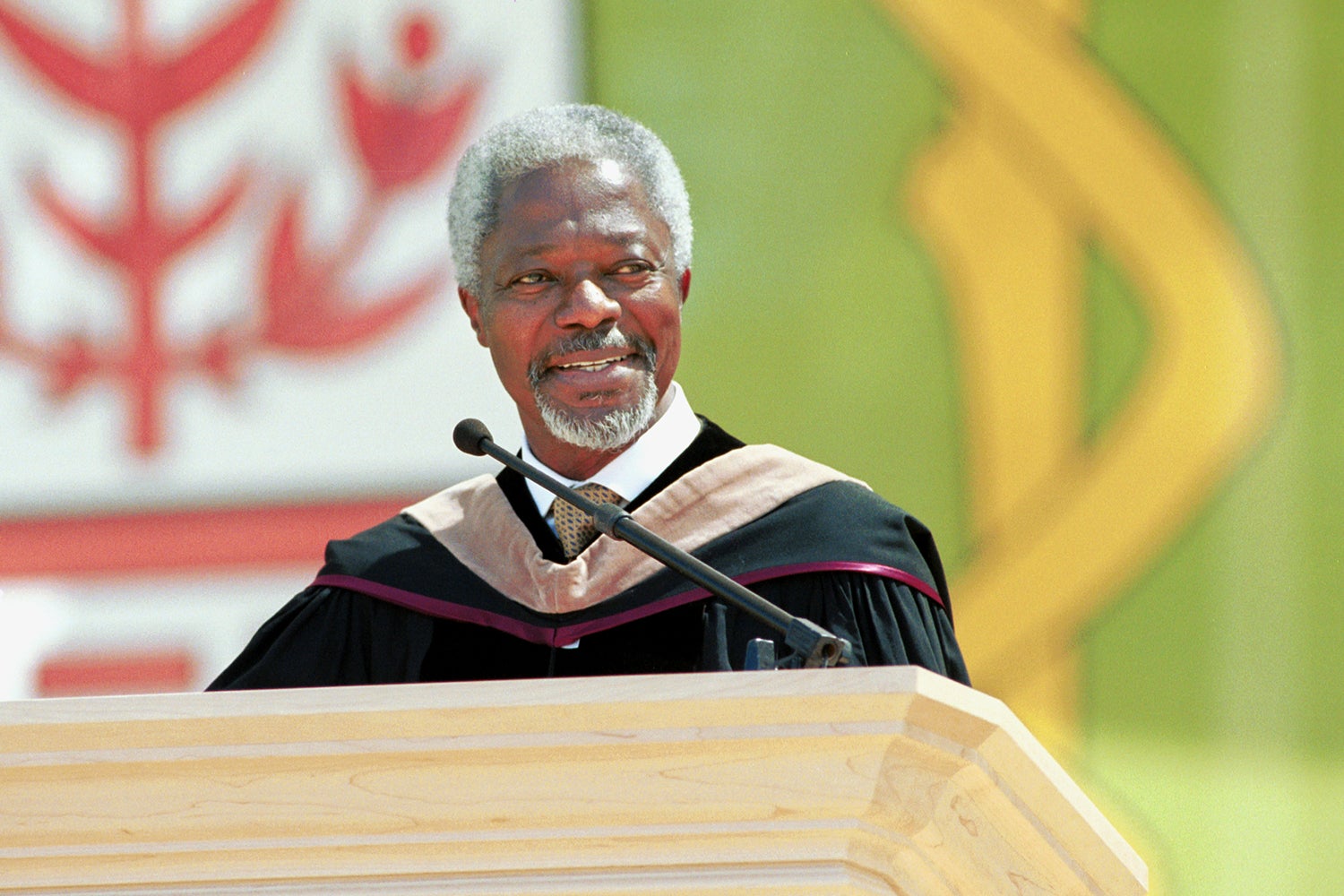
U.N. Secretary-General Kofi Annan delivers the Commencement address. (Image credit: Rod Searcey for Stanford News Service)
Under the mildest Commencement-day sun in years and on a new, collapsible stage built solely for Commencement mornings, Casper conferred 4,815 degrees, bringing the total to 36,506 during his eight-year presidency, which ends Aug. 31.
The Commencement ceremony drew approximately 25,000 people to Stanford Stadium where Kofi Annan, secretary-general of the United Nations, and Casper provided dignified, serious remarks to counterbalance the silly processional antics of a healthy portion of graduating seniors, a Stanford tradition.
In what is known as the “wacky walk,” students paraded into the stadium dressed in modified black robes — portraying everything from M&M candies and Pokémon to Chinese dragons and yellow schoolbuses. The lush field that is normally reserved for NCAA sports was quickly spattered with pick-up games of horseshoe, twister, tetherball, croquet, bowling and baseball, with a cardboard tube for a bat and paper wads for balls. There were watergun fights, twist and ballroom dancing demonstrations, rope jumping displays, plenty of seniors talking to their relatives in the bleachers via cell phones, and a few carrying political banners urging the end of U.N. economic sanctions against Iraq or endorsing a “living wage” for all.
Annan, aware of the Silicon Valley’s reputation for leading the communications revolution, prompted laughter when he said he suspected some in the audience were “sending each other e-mails with your Palm Pilots even as I speak!” In this world of “collapsing borders and connections among people,” the secretary-general urged his audience to take time to reflect upon the precarious state of the globe’s natural environment and build a “new ethic of global stewardship.”
Casper, during his turn at the podium, also reminded the graduates of the nature of the global village. If the village were made up of just 100 people with the existing human ratios remaining the same, he said, 60 villagers would be Asian, 14 would be from North and South America combined, 13 would be from Africa and 13 from Europe.
“Three would own a computer and only one would have a college education,” he said. “As that one in 100 with a college education, much will be asked of you in addressing the problems of the world you now enter.”
Annan, expanding upon a report he made to the U.N. General Assembly in April, said he has been shocked not so much by the poor state of the environment as by the “state of the debate on the environment. In a nutshell, the need for sustainable development is failing to register on the political radar screen. That is something that should concern us all, not least because half the world’s jobs depend directly on the sustainability of ecosystems.”
In contrast to last year’s commencement speaker (U.S. poet laureate Robert Pinsky), who urged graduates to “honor the past and to convey its treasures beyond,” Annan suggested that the Class of 2000 break with the tradition of his generation by showing more concern for those to be born 50 or 100 years from now.
“The inescapable global reality is that we are plundering our children’s future,” he said. If current consumption patterns continue, scientists estimate that two out of every three people on earth will live in “water stressed” countries by 2025, the globe’s “food-security” supply will be threatened by mid-century and global warming will accelerate, he said.
Yet during 18 months of planning discussions by the General Assembly for the Millennium Summit to be held in New York this September, he said, “environmental concerns were hardly mentioned at all. Policy-makers seem to be giving the environment frighteningly low priority. Perhaps they are overwhelmed by other concerns. Perhaps they are deliberately avoiding tough choices.”
Annan criticized “those in a position to make a difference” for framing environmental management issues as “an intractable conflict between economy and ecology, when in fact sustainable development offers a road-map for reconciling the two.” He urged the students to implement “green accounting,” the practice of taking into account the costs inflicted by pollutants in measuring the value of products and services. He also noted that the United States is the largest producer of greenhouse gases and has yet to ratify the Kyoto Protocol on climate change, which, if implemented, would begin to control world carbon emissions.
Annan’s speech, and later Casper’s remarks, were briefly interrupted by shouts from individuals who sat at the east end of the stadium crowd, about 60 people in all. Some protesters carried signs opposing Ethiopia’s ongoing invasion of disputed territory along its border with Eritrea, while others protested the U.N. Security Council’s program of economic sanctions against Iraq. One banner, paraded repeatedly through the bleachers, said, “Lift sanctions on Iraq; One million civilians dead.” An airplane flew over the stadium before the formal ceremonies started, trailing the banner “U.N./U.S. end sanctions on Iraq now,” part of an “educational protest” organized by some Stanford and local community groups who say the 9-year-old sanctions program has been both inhumane and counterproductive to its stated goal of removing weapons of mass destruction from Iraq.
As Casper conferred degrees on the candidates — 1,799 bachelor’s degrees, 2,094 master’s degrees and 922 doctorates — he repeated the same formula eight times, once for undergraduates and once for each of the seven schools. Halfway through, the high-spirited crowd began to join him in the refrain as he admitted candidates to the “rights . . . responsibilities . . . and privileges” of their degrees.
“That was very good, ” the president joked. “It shows you can still learn.”
Casper then used the occasion to “express the gratitude of countless children in remembrance of a Stanford alumnus, who on behalf of a merciful nation helped alleviate the scars of war and hunger twice in the course of the 20th century.”
The reference was to Herbert Hoover, who graduated in Stanford’s first class and, before becoming president of the United States, organized a private relief agency to deliver food to Belgians when they were facing famine at the beginning of World War I. President Truman later called upon Hoover to take charge of famine relief in Europe after World War II.
“At the end of World War II, I was a 7-year-old living in the devastated port city of Hamburg,” Casper said. “There and then, I heard the name Hoover for the first time as the label attached to American food supplies that reached our schools. They were known as ‘Hoover foods.'” No one could have predicted then, he said, that he would wind up as president of Stanford, living in the Hoover family home, which Hoover and his wife, Lou Henry Hoover, gave to the university in 1945.
Stanford, he told the new graduates, stands for “common purpose, for fortitude, faith and good cheer. It stands for diversity. It stands for generosity, for doing, as Jane and Leland Stanford did, something for ‘other people’s’ sons and daughters. It stands for understanding the importance of higher education and its support.
“Above all,” he concluded, it stands for “continuous commitment to the power of reason and the unceasing process of inquiry.”
Of the new graduates, 314 were graduated with departmental honors, 260 with university distinction, 162 with multiple majors, 79 with dual bachelor’s degrees and 318 with co-terminal master’s and bachelor’s degrees.
Zuri Ray-Alladice contributed to this report.